

















After treating low rocks as impassable edges, The Shore: Enhanced Edition asks you to jump over similar-looking obstacles. The required action is simple. Recognizing that it has become an option is the problem. Earlier movement has taught you to read these shapes as limits, and the later passage offers insufficient visual distinction to revise that understanding. You can discover the exception through experimentation, but the discovery weakens the usefulness of what you have already learned. The scenery becomes something to test for permission to move through it.
Another encounter compresses that uncertainty into a chase. Andrew drops into a pit and immediately faces a Shoggoth, leaving little opportunity to establish a route through the dark corridors. Getting caught on the surroundings interrupts escape while you are still trying to understand the space.
Repeated attempts supply information that the initial view fails to communicate. With each attempt, attention shifts toward corners, obstructions, and the route that might actually work. The creature remains dangerous, yet the task increasingly becomes diagnosing the corridor around it.
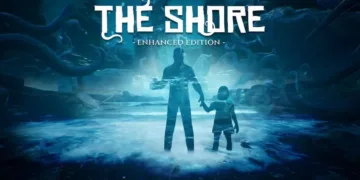
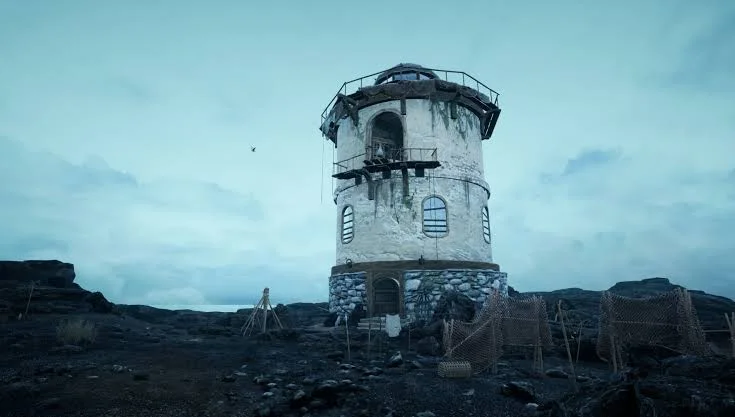
That shift is particularly wasteful because the island initially gives looking a satisfying purpose. Andrew, a shipwrecked fisherman searching for his missing daughter, explores the area around a lighthouse, gathers objects, investigates anomalies, and reads accounts left behind.
These activities establish a manageable rhythm: inspect the surroundings, find something worth examining, and use that discovery to understand the place a little better. The relatively open coastal area allows time for that process. Progress and curiosity briefly pull in the same direction, without requiring complicated mechanics to make the exploration worthwhile.
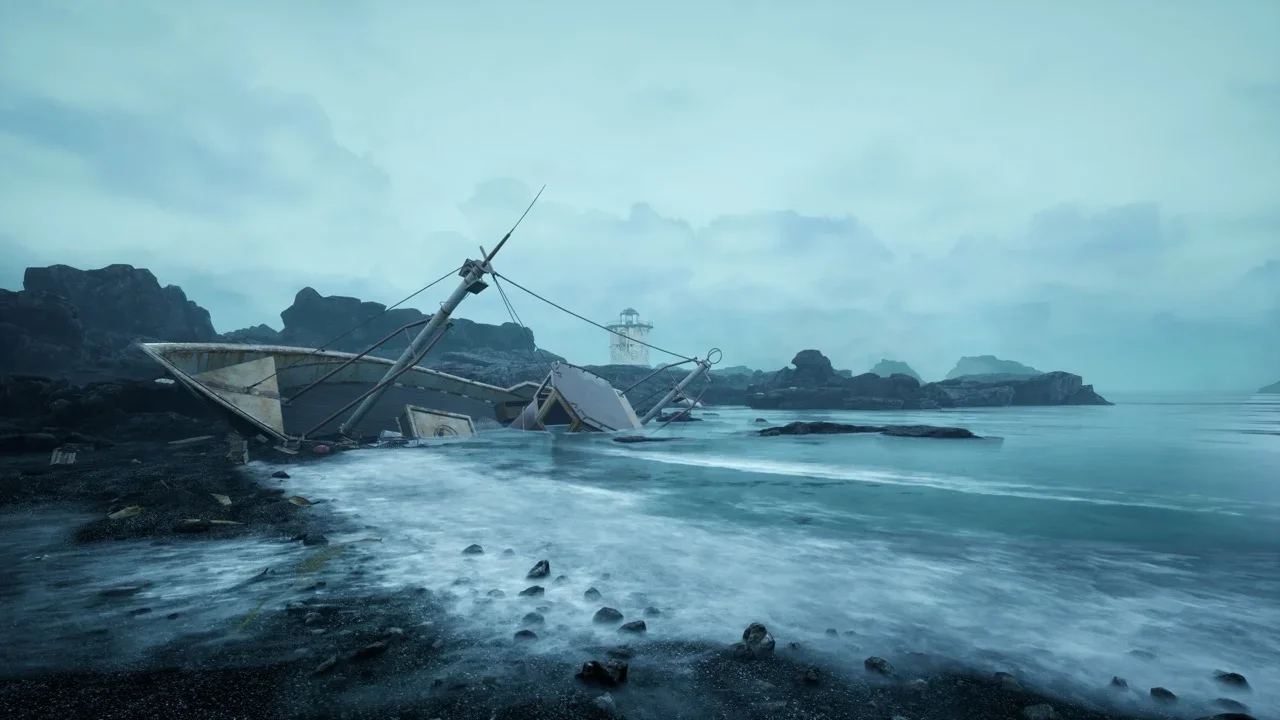
Shipwrecks and dead marine animals give those searches a physical setting that deserves the attention. Examining the beach keeps returning your eye to evidence of life stranded or destroyed, while fog restricts the view beyond it. Muted colors and gull calls make the shore feel exposed and deserted; the melancholy score supplies an undertow of loss.
The arrangement works because the pace permits you to register these details between interactions. Looking for a useful object also means spending time among the carcasses and wreckage. Exploration makes the setting oppressive through the ordinary business of moving around it.
The written material is less restrained. Notes, journals, and bottled messages explain both the island and Andrew’s connection to it, sometimes crowding the discoveries with elaborate exposition. They provide information, but their density reduces the space for the surroundings to suggest an answer.
Andrew’s dependence on a dark entity is a stronger narrative fit for the activity itself. Offered the prospect of reunion with his daughter, he has a reason to accept guidance from something he cannot trust. Following instructions acquires an emotional purpose before the game needs to explain the larger supernatural conflict.
The environmental puzzles do limited work with that dependence. Pressing buttons and activating devices provide steps toward the next encounter, but operating a mechanism seldom offers much satisfaction by itself. Finding the required interaction can occupy time without making the eventual action intellectually rewarding. This matters once exploration gives way to a succession of tighter supernatural passages.
The player loses some freedom to investigate, while the replacement activities offer thin deductions and awkward escapes. Across a game lasting roughly two hours, repeated pursuit attempts take up space that could have developed the relationship between Andrew’s objective and the forces directing him.
The console conversion adds a separate problem at the point where players seek practical help. Its controls screen displays keyboard keys rather than controller buttons, so consulting the menu fails to answer the question a console player brought to it.
Default audio levels also need adjustment, an unnecessary preliminary to appreciating the score. On PS5, uneven motion, texture pop-in, and visible changes in distant detail interrupt the presentation. Those faults do not explain every failed escape, but they compromise the consistency of a world whose main attraction is the opportunity to examine it. The interface should at least make learning its interactions straightforward.
There are creatures here worth stopping for. Dagon’s immense scale establishes a relationship between Andrew and the supernatural that the pursuit sequences struggle to sustain: he occupies a tiny part of a space dominated by something vastly larger.
Distant tentacled forms extend that imbalance beyond the immediate playable area. They do not need to present a solvable obstacle to affect how the island feels. Their placement leaves room to imagine activity continuing beyond Andrew’s search, making his access to this world seem partial. The walking and looking can carry the horror without another escape task attached.
Cthulhu’s direct appearance changes that relationship. A monologue about the world’s fate gives the encounter an explicit subject and turns an immense presence into a figure delivering information. Speaking is a valid dramatic choice, but here it narrows the uncertainty that distance and scale had created.
The encounter asks the player to receive an account of cosmic stakes, much as the written material explains the island. Recognition of the creature provides an immediate attraction; the staging does less to preserve the disturbing sense that Andrew has seen something he cannot place within his own concerns.
Andrew’s search has difficulty retaining its weight through these encounters. His daughter supplies a clear reason to accept the entity’s demands, yet the fragmented succession of otherworldly scenes gives that motive little opportunity to develop. Disorientation can serve a story about a person drawn into conflicts he barely understands.
It needs some stable pressure for the player to carry between those fragments. The promise of reunion could supply it, but escape routes and supernatural explanations repeatedly occupy the available attention. Andrew keeps obeying because he wants his daughter back, while the player’s immediate concern becomes finding the next usable path.
The Review
The Shore: Enhanced Edition
The Shore: Enhanced Edition rewards patient observation with a desolate coastline and creatures whose scale makes Andrew feel insignificant. Its later encounters demand fast movement through spaces that communicate their rules poorly, turning pursuit into repeated route testing. Thin puzzles and fragmented storytelling leave his search for his daughter underdeveloped. The console controls guide and uneven PS5 presentation add friction to an experience already struggling to connect its striking imagery with satisfying interaction.
PROS
- Coastal imagery, gull calls, and melancholy music create convincing isolation.
- Early exploration gives curiosity a useful role.
- Dagon and distant creatures convey immense cosmic scale.
CONS
- Unclear routes and inconsistent obstacle cues undermine pursuit sequences.
- Puzzle interactions offer limited satisfaction.
- Dense exposition and fragmented scenes weaken Andrew’s personal search.
- Keyboard diagrams fail to explain console controls.
- Uneven PS5 motion and texture pop-in disrupt the presentation.