


























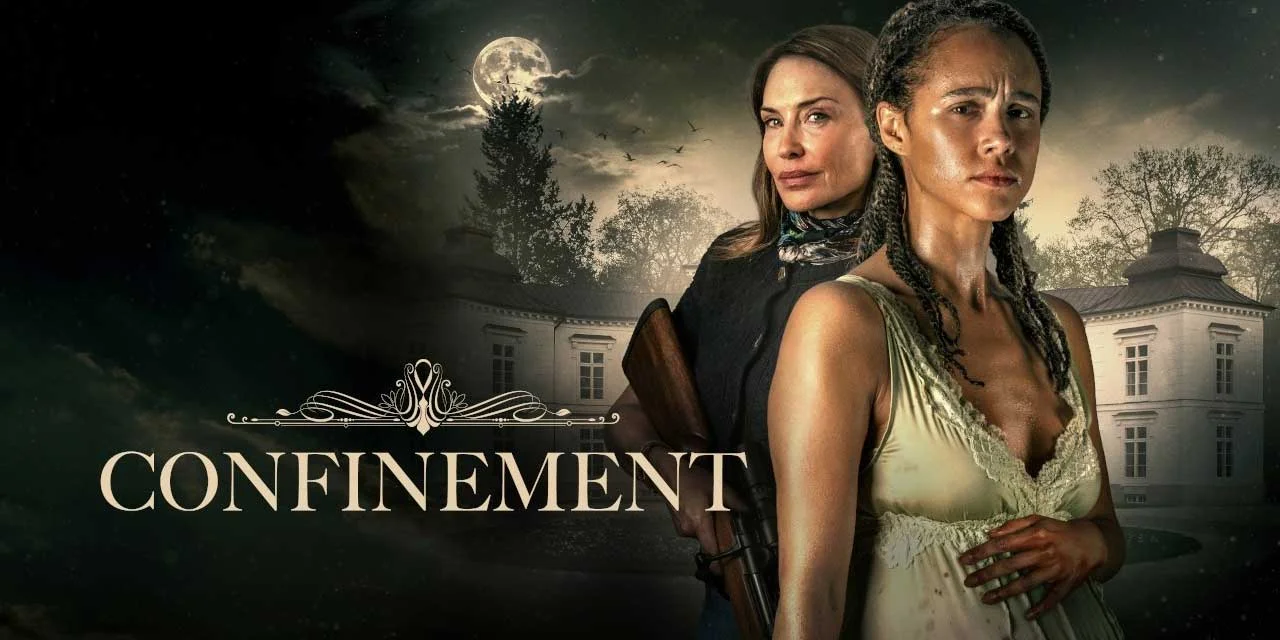

Ian has kept his family out of his marriage long before his death makes that secrecy Stella’s problem. The opening of Peter Howitt’s Confinement places his anxiety about impending fatherhood beside a fatal car crash, with enough suggestion of intent to leave an uncomfortable question behind. His pregnant wife loses both her partner and the person who could explain what he feared. Nathalie Emmanuel’s Stella is approaching childbirth with financial worries and little family support. An invitation from Ian’s relatives reaches her at a point when help has considerable practical value.
Caroline, Ian’s mother, offers that help in the reassuring form of a country visit. Claire Forlani gives the welcome a useful credibility: this woman has lost a son, and her interest in his unborn child has an immediately understandable basis. Stella has reasons to accept without being foolish. Ian’s estrangement also gives her reasons for caution, but he has left her so little information that she cannot measure the risk. The screenplay, by Will Honley and April Maguire, initially makes those competing needs do real work. Stella must decide about a family whose history her husband denied her.
The estate quickly supplies information of its own. The advertised cottage proves to be a mansion, and its inhabitants have firm ideas about managing a pregnancy. Granno, played by Tina Gray, insists on fish and makeshift tokens beside the bed. These details make care feel increasingly prescriptive. Food is offered with instructions; rest comes with ritual.
The connection to Rosemary’s Baby is clear, particularly in the way supposedly protective people acquire authority over an expectant mother. There is still room for uncertainty here. An intrusive relative and a supernatural threat require different responses, and Stella has yet to establish what she faces.
A baby-shower ritual involving a dead insect placed on her stomach pushes that distinction considerably harder. So do the warnings from Rose, another pregnant woman within the household. Rose gives Stella something the family’s odd behavior cannot: a warning from someone exposed to similar pressures.
Angela Sant’Albano makes the character a valuable presence because her concern interrupts the relatives’ claim to know best. The script now has a means of changing Stella’s understanding from inside the house. Instead, it spends too long adding reasons for alarm before allowing that alarm to develop into sustained resistance.
This is where the middle act loses its grip. The family’s beliefs can remain unproven while its treatment of Stella becomes plainly unacceptable. The script postpones her decisive rejection of the household as though she first needs to settle its supernatural claims.
Suspicion accumulates through rituals, warnings, and excessive interest in the baby, but Stella’s response develops at a much slower rate. Eventually she tries to leave and discovers that her departure is no longer hers to arrange. The screenplay has been protecting the duration of her visit with an attention it might have usefully extended to her reasons for continuing it.

The household’s competing registers provide some diversion during that delay. Bunny, Ian’s brother, drinks early; Lake’s contentious marriage to Felix supplies another source of domestic hostility. Charlie Hiscock and Eloise Lovell Anderson help establish a family capable of making an ordinary visit unpleasant before any ancestral explanation becomes necessary.
Gray’s Granno brings a more theatrical insistence to the pregnancy customs. Her certainty can produce uneasy amusement, especially when those customs are presented as routine assistance. Yet the eccentricity also works against the trap. The relatives announce their dysfunction so freely that Caroline’s reassuring welcome has increasing difficulty accounting for Stella’s continued cooperation.
Emmanuel holds the film together most effectively once cooperation gives way to survival. Her distress has a clear purpose during the escape attempts, and the restriction of Stella’s movements, eventually to extended stretches in one room, gives that distress an immediate cause.
The writing offers less room for the bereavement that brought her here. Ian’s death remains useful as an explanation for her vulnerability, but alarm and problem-solving take over much of her characterization. We understand the need to get out. Her relationship with the child she is carrying receives less development before the final stretch asks it to bear considerable emotional weight.
The late disclosure is better constructed than much of the waiting that precedes it. The presence of two pregnant women gives the family’s attention a focus that can shift, and the script makes knowledge unevenly available. A character’s reaction becomes decisive evidence, allowing a performance to settle a question that dialogue has kept open. It is an economical piece of storytelling, with the additional benefit that what convinces the audience does not give Stella an identical experience of the truth. The revelation changes how earlier behavior can be interpreted without making that behavior harmless.
That gap in understanding places a difficult demand on Stella’s maternal attachment. Having concentrated on her attempts to escape other people’s control, the film reaches a situation in which she must assess what those same people claim to understand about her child.
The predicament gives maternal attachment a difficult test, but the earlier scenes have mostly prepared her to endure danger and seek an exit. They have spent less time developing the private hopes that might govern her response to the birth. She is left trying to trust her experience of motherhood while the family insists that its judgment must govern her child’s future.
Confinement was released digitally on September 1, 2026, through Paramount Pictures and is available to stream on platforms such as Prime Video and Fandango at Home. Directed by Peter Howitt, the psychological thriller follows a pregnant, recently widowed woman who accepts an invitation to stay at the remote countryside estate of her late husband’s estranged family, only to find herself fighting to protect herself and her unborn baby as their unsettling obsession turns deadly.
Where to Watch Confinement (2026) Online








Full Credits
Title: Confinement
Distributor: Paramount Pictures
Release date: September 1, 2026
Rating: R
Running time: 1 hour 33 minutes (93 minutes)
Director: Peter Howitt
Writers: Will Honley, April Maguire
Producers and Executive Producers: Steven Paul, Scott Karol, Conor O’Farrell
Cast: Nathalie Emmanuel, Claire Forlani, Eloise Lovell Anderson, Charlie Hiscock, Ben Cura, Tina Gray, Adam Woodward, Angela Sant’Albano
Director of Photography (Cinematographer): Leo Hinstin
Composer: Laurent Eyquem
The Review
Confinement
Confinement gives Stella credible reasons to accept help, then stretches those reasons past their dramatic usefulness. Nathalie Emmanuel steadies the survival scenes, Claire Forlani makes the initial welcome persuasive, and a late revelation uses a reaction with welcome economy. The middle keeps accumulating warnings without developing Stella’s response at the same pace. Grief and maternal attachment receive too little attention to support the ending’s emotional demands.
PROS
- Emmanuel grounds Stella’s distress during the escape attempts.
- Forlani makes Caroline’s initial hospitality credible.
- The late revelation handles unequal knowledge effectively.
CONS
- Accumulating warnings outpace Stella’s move into resistance.
- Bereavement serves chiefly to establish vulnerability.
- Maternal attachment receives insufficient preparation for the ending.