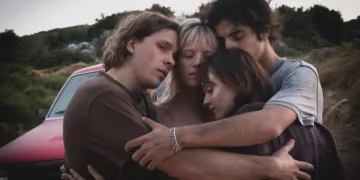



























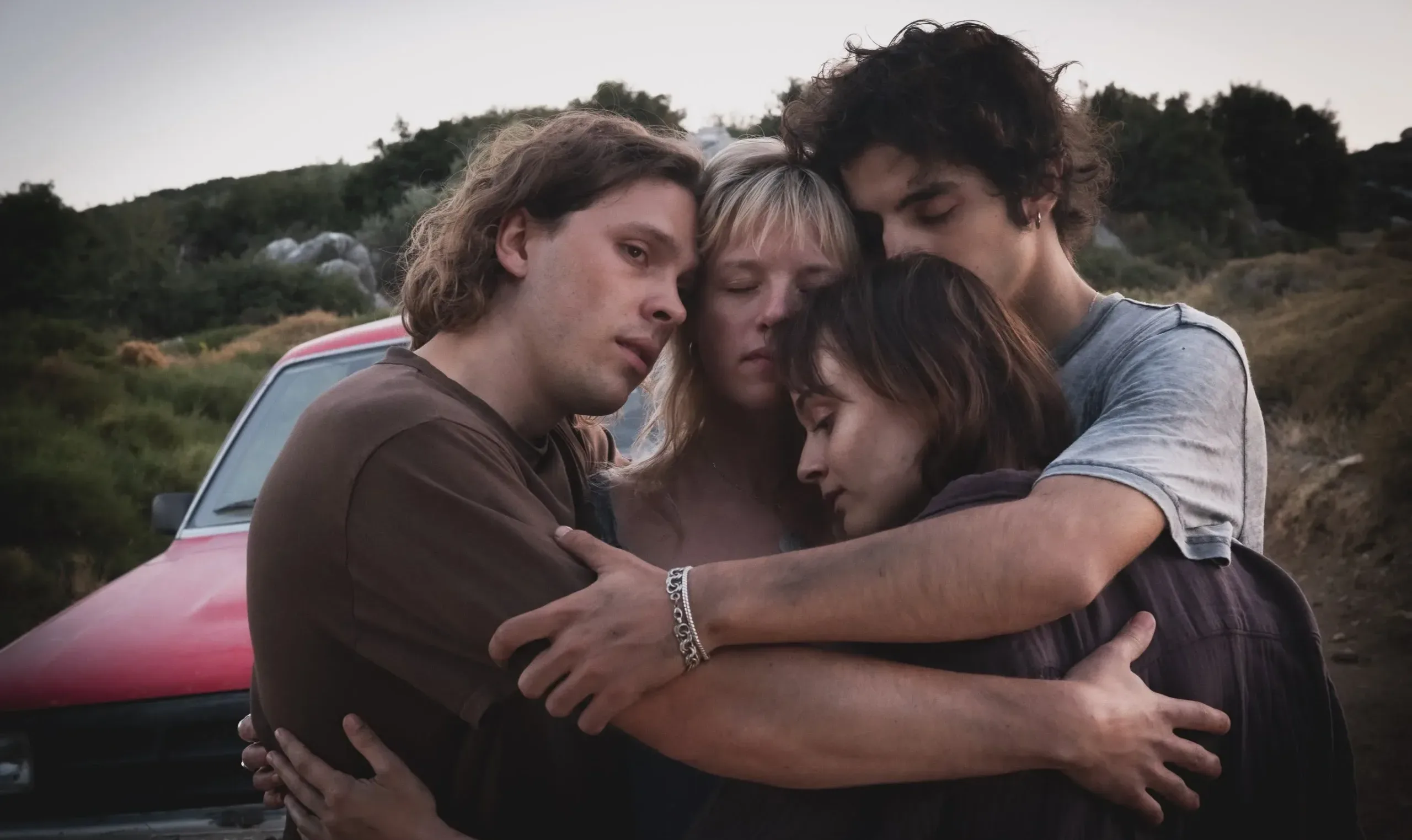

Can an experiment in personal freedom teach its participants how to live responsibly together? I initially took the pleasure in Children of the Sun as evidence that it could. The touching, shared clothes, and gradual rearrangement of four bodies suggest people learning to loosen their claims on one another. There is something persuasive about being allowed to enjoy that possibility before being asked to defend it. Leonie Krippendorff gives the experiment time, and the small physical inconveniences of sex keep its participants human: a hair gets caught in a mouth; a necklace interferes with a kiss.
Those interruptions are lovely. They allow desire to require a little practical adjustment, and they make the tenderness credible. Nobody needs to become an emblem of sexual liberation just to get a necklace out of the way.
The harder adjustments are less thoroughly explored. Of the two couples camping in mountainous Greece, Zora and Alexandros have been together for four months; Klara and Junis have five years behind them. A change in partners cannot carry the same weight for everyone. Krippendorff understands this unevenness, especially through Klara’s initial hurt, but gives the group’s pleasure greater clarity than its negotiations. I would recommend the film for the generosity and bodily intelligence of this experiment. Its later turn toward corporate exploitation and political action is considerably less persuasive, with explanations taking over from the intimate observations that first earned my attention.
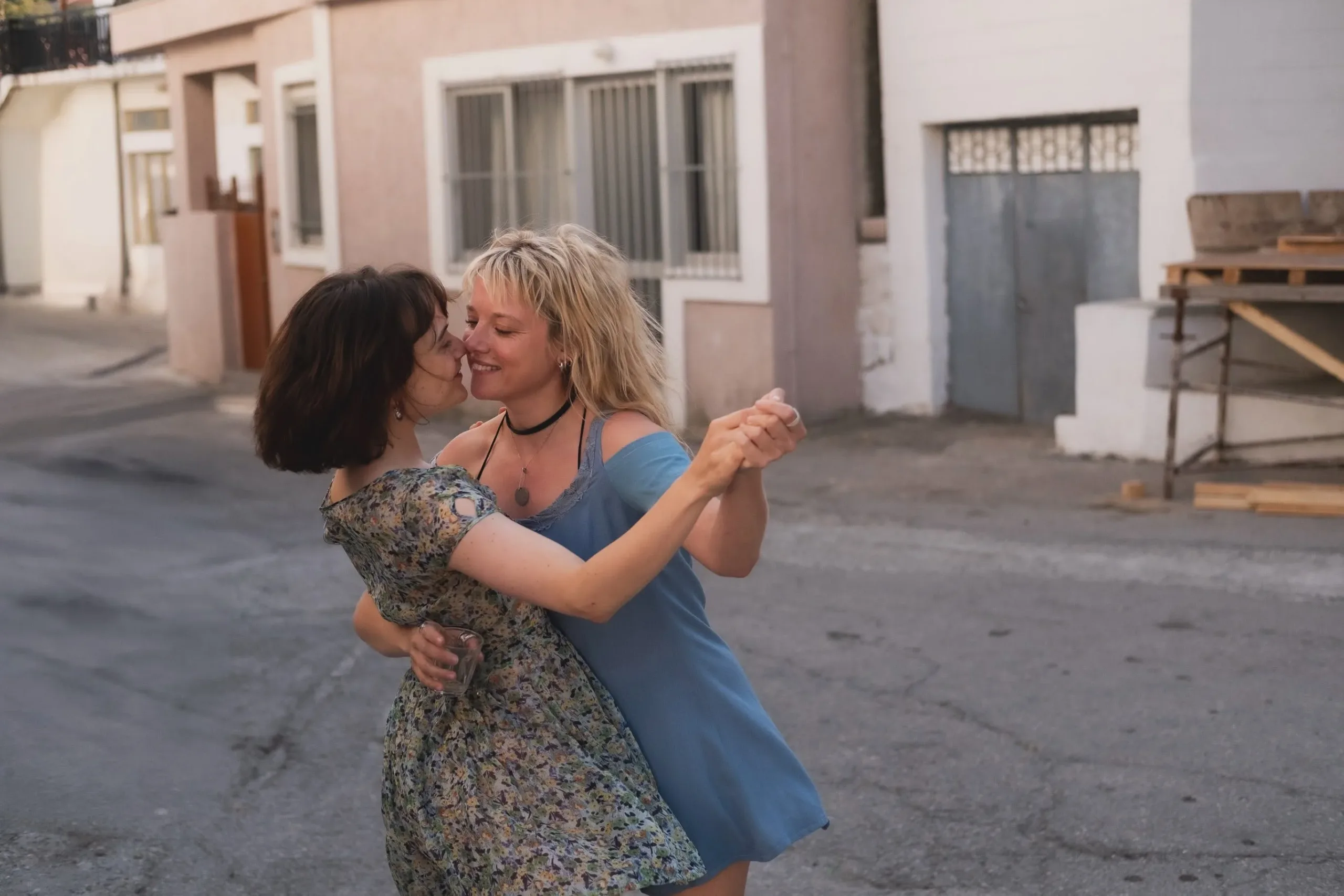
Jella Haase’s Zora provides the initiative. In the tent, after the others have gone to make coffee, she touches herself and places her fingers in Junis’s mouth. The gesture sets the pace of an encounter to which the others must respond. Her appetite has consequences outside the immediate contact, particularly for Klara, played by Lena Urzendowsky. Junis and Alexandros adjust more tentatively. Their acceptance helps the new arrangement take shape, but Zora has already made the first consequential choice.
I need to revise that initial equation of shared pleasure with equality.
The revision does not make Zora a villain or Klara a passive victim. Klara’s later participation prevents such an easy account. It does, however, make the missing negotiation matter. A person can welcome an outcome and still have been hurt by the way it arrived. The film’s looks and touches register changing allegiances with a sensitivity that its sparse account of these discussions cannot quite match. I wanted to understand how Klara’s hurt became a willingness to participate, and how the others understood what had changed for her.
The imagery sometimes helps explain the collective and sometimes makes the people harder to read. Clothes circulate between bodies, turning possessions into shared materials. Then the chapter interludes invoke figures such as Gaia and Poseidon alongside still-life images of fruit and oysters. The four-element framework grants the group a mythological scale (a substantial promotion for four people sharing a tent). Yet assigning elemental significance to their differences can make those differences feel settled before the characters have worked through them. A temperament becomes a symbolic function. The shared clothes tell me something about how they live; the mythological interruptions encourage me to interpret them from a greater distance.
A pregnancy puts a different kind of pressure on their collective identity. Decisions now extend beyond the immediate distribution of affection and pleasure. The arrangement has to accommodate a future, with responsibilities that cannot simply pass between people like clothing. That development earns its place because it grows from the intimacy the film has spent time establishing.
The threatened landscape offers another strong test. Dry rock, exposed skin, cold water, and punishing sunlight make this retreat attractive through sensations that also reveal its vulnerability. The electronic and vocal score gives the encounters a suspended quality, but the dryness remains visible around them. Fire belongs to this landscape before it becomes an emergency in the story. It threatens the physical conditions of the life the group has chosen, including the pleasures that made staying seem possible.
The film then grows impatient with this kind of implication. Wind turbines, cobalt extraction, a British energy company, and a Danish businessman played by Thure Lindhardt enter an increasingly explicit account of exploitation. There are serious questions here about the interests shaping the land and the limits of private refusal. The trouble is how much explanatory work these connections are asked to perform. The businessman offers an identifiable target, but the earlier intimacy had made power legible through initiative, hesitation, and hurt. The corporate material gives the argument additional subjects to cover, and the relationships lose some of their particularity under that burden.
Give me the awkward kissing.
Zora and Klara’s differing responses to resistance deserve attention, especially when withdrawal and possible political violence become competing answers. Their disagreement also gives Zora’s forcefulness a new consequence: the energy that unsettles the group can press it toward action. Yet anger does not settle the justification for that action. The film has a difficult argument to make about responsibility, and its widening network of commercial interests leaves less room to examine what each person is prepared to demand of the others.
There is a smaller, sharper version of the problem at the family table. The group’s concern about eating animals encounters the reassuring account of a pig raised humanely. Ethical consistency suddenly has to survive dinner (the pig’s contribution to the discussion is limited). Here the film allows ideals to meet an ordinary practice, with affection and convenience involved. It gives the visitors’ convictions something specific to work against.
Their retreat is a kind of borrowed paradise: a place whose existing relationships support an imagined independence from society. Alexandros’s family connection complicates that description. These are not four strangers treating Greece as vacant scenery. Still, a family connection cannot make everyone’s obligations identical, and throwing away phones does little to explain how the group will care for the place supporting it.
The easy acceptance of unconventional relationships, including at the family table, and a boy wearing a dress at the village café can express a welcome possibility. I do not need the villagers to punish sexual freedom to believe in them. I do want their social world to acquire some of the specificity granted to the visitors’ desires and the corporate threats. When the campers announce that they no longer feel like tourists, the locals’ skeptical looks briefly supply it. The declaration changes how the visitors understand their stay; it establishes nothing about what they owe the people already living there. With fire threatening that inhabited land, those obligations require attention beyond the group’s decision to remain or leave.
Children of the Sun had its world premiere at Filmfest Hamburg in September 2026 ahead of its scheduled German theatrical release on December 24, 2026. Written and directed by Leonie Krippendorff, the drama follows four young people spending a summer in the Greek mountains to build a communal life free from possessions, digital connections, and monogamy, only for wildfires to shatter their fragile utopia.
Full Credits
Title: Children of the Sun (Kinder der Sonne)
Distributor: Vuelta Germany (Germany), DCM
Release date: September 2026 (Filmfest Hamburg world premiere), December 24, 2026 (German theatrical release)
Running time: 1 hour 59 minutes (119 minutes)
Director: Leonie Krippendorff
Writers: Leonie Krippendorff
Producers and Executive Producers: Peter Hartwig, Anna Werner, Konstantinos Vassilaros
Cast: Jella Haase, Lena Urzendowsky, Joshua Hupfauer, Andronikos Korakas, Thure Lindhardt, Yannis Kokiasmenos, Syrmo Keke, Eric Kabongo, Gogó Kartsana, Argyris Gaganis
Director of Photography (Cinematographer): Lotta Kilian
Editors: Emma Alice Gräf
Composer: The Boy, Trichromi (Miss Trichromi)
The Review
Children of the Sun
Children of the Sun earns my recommendation through its bodily intelligence: awkward kisses, shared clothes, desire that requires actual adjustment. I’m less convinced by the community those details promise. Klara’s hurt needs fuller attention, and the corporate plot starts explaining what the threatened landscape already makes palpable (the mountains have made their point). This borrowed paradise remains an attractive, uneven experiment, strongest when freedom has to accommodate another person in the tent.
PROS
- Tender, physically specific intimacy
- Landscape imagery connecting pleasure and ecological vulnerability
- Thoughtful tests of freedom and shared responsibility
CONS
- Underexplored emotional negotiation
- Corporate exposition weakens the intimate drama
- Elemental symbolism obscures individual complexity
- Local social life receives limited development