






















Bob Saget started recording Martin Mull in 2018, and the time needed to finish the documentary became part of its subject. Saget died in 2022. Mull died in 2024. Neil Berkeley completed a film in which conversations between friends now reach us across a distance neither participant could measure when they began. Watching Who Is Martin Mull?, I kept feeling the peculiar embarrassment of grief arriving where nobody had invited it: these men are enjoying each other’s company, and we know something terrible about their future.
The pleasure survives that knowledge. This is a tender, rewarding film, worth seeing for the company alone, especially when Mull and Fred Willard recall their work on Fernwood 2 Night. Mull likens following Willard’s improvisation to following a driver who never signals. There is affection in his acknowledgment that his partner might turn anywhere; recalling their work becomes another occasion to enjoy Willard’s unpredictability.
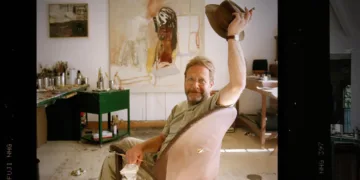
Mull’s own comedy could make an audience wait in an entirely different way. Announcing that he wants to become serious, he proceeds to spend a minute making serious faces. The invitation sounds like the familiar preamble to a confession. Nothing is confessed. Instead, the faces continue, and the audience has to inhabit the absurd length of the minute with him. His upholstered chair and stage furnishings suggest the comfort of a living room; from that position of settled ease, he can make everyone else’s expectations uncomfortable. The film gives us enough of this comic patience to make its relative lack of sustained inquiry into his technique frustrating.
His friends understand his gifts, but their admiration sometimes leaves the mechanics of those gifts unexplored. I wanted to stay longer with that minute, with the confidence required to let a joke become almost indistinguishable from its own absence. The documentary has other business: Mull keeps directing our attention toward painting.
He studied at the Rhode Island School of Design, and acting and comedy paid for the practice he regarded as his principal work. This is familiar biographical material, the celebrated person with an unexpected private vocation, until the paintings begin to disturb the division between the public entertainer and the man at home. Photorealistic figures occupy arrangements assembled from family photographs, old magazines, children’s books; backgrounds can resemble paint-by-numbers landscapes. The reassuring materials of childhood return with their reassurance removed. Everything belongs to a recognizable American domestic world, yet the joins remain troubling, as though recognition itself has become unreliable.
The precision makes it worse. A loosely remembered suburb might soften into nostalgia; Mull’s exactness makes familiarity difficult to escape. Images drawn from ordinary household culture sit inside these painted arrangements carrying the promise that life ought to be intelligible, even its landscapes supplied with the orderliness of a numbered painting kit.
There is a possible kinship with the complacent comic in the comfortable chair, making a familiar social ritual go wrong. I would hesitate to turn that kinship into a complete theory of Mull. The paintings warrant attention on their own, and the film’s attention to them is its richest corrective to his public image. Steve Martin’s collecting supplies an affectionate endorsement.

Mull depreciates his achievements by describing himself as someone who earned passing grades in several disciplines. That account becomes harder to accept beside the studio routine, the early starts, the days spent painting. His modesty is funny. It also obscures the persistence involved. The documentary lets employment and vocation coexist in the same life, with the income from familiar screen appearances buying the hours he could spend at an easel.
Then the family testimony makes those painted domestic worlds harder to look at innocently. Mull is reluctant to discuss his father. His siblings describe abuse toward the other children and indifference toward Martin; his brother David suggests that performing offered the recognition their father withheld. An explanation presents itself with almost indecent readiness: the neglected child learning to command a room.
I don’t know how much of Mull that explanation reaches. His reluctance leaves a space the film’s intimacy cannot close, and I felt less certain of the psychological account than of the paintings’ unease. Reading every unsettling domestic image as an encoded childhood wound would make the art smaller. Still, his siblings’ testimony changes the emotional temperature of those borrowed family photographs and the idea of home they carry into his work.
His account of functioning alcoholism gives the private life another pressure, but the footage with Wendy Haas resists becoming merely the reassuring next step in a recovery narrative. A longtime friend and musical collaborator who became his wife, she belongs to the activities through which he made a life. When they sing together, the shared music allows tenderness to occupy time rather than arrive as somebody else’s description of a happy marriage. Mull’s emotion has somewhere to go, into the song and toward the person singing with him.
Their daughter Maggie remembers completing doodles her father began. It is a small recollection, and the documentary is right to make room for it. After all the testimony about his abilities, here is drawing as something unfinished that another person is invited to touch, a father giving his daughter a place on the page.
Late in the film, Mull describes an opera that has ended: the performers leave, the scenery is replaced, and he remains in his chair as a production he does not understand takes over. It is his spoken image, and its fear extends beyond death into the experience of surviving one’s familiar world. He worries about having enough friends left to serve as pallbearers. The humor has become an act of counting. The singing with Haas remains part of the same life as this fear, and I found myself wondering how much of that loneliness he could share with her.
Who Is Martin Mull? premiered on Netflix on October 7, 2026, and is available to stream on the platform. Begun by the late Bob Saget and completed with co-director Neil Berkeley, the documentary chronicles the multifaceted career of comedian, actor, musician, and painter Martin Mull, highlighting his journey from folk clubs and television sitcoms to his enduring dedication to visual art.
Where to Watch Who Is Martin Mull? (2026) Online


Full Credits
Title: Who Is Martin Mull?
Distributor: Netflix
Release date: October 7, 2026
Running time: 1 hour 34 minutes (94 minutes)
Director: Neil Berkeley, Bob Saget
Producers and Executive Producers: Neil Berkeley, Tara Billik, Sean Bradley, Ron Haas, Kevin Bright
Cast: Martin Mull, Bob Saget, Steve Martin, Tom Waits, David Alan Grier, Patton Oswalt, Fred Willard, Eric Idle, Kerri Kenney, Penn Jillette, Norman Lear, Mitchell Hurwitz, Paul Feig
Director of Photography (Cinematographer): Jonathan Na, Steven Paul
Editors: Ron Haas, Zachary Kashkett, Jason Zeldes
Composer: Timo Elliston
The Review
Who Is Martin Mull?
Who Is Martin Mull? earns its tenderness through the company of old friends and the disturbing domestic worlds Mull paints. Saget and Berkeley leave some of his comic technique unexplored, and the childhood explanations remain uncertain. But the paintings, the shared singing with Wendy Haas, and his fear of outliving his friends give this affectionate portrait its weight. It is well worth seeing for the intimacy of a man making music with his wife as he wonders who will remain to carry him.
PROS
- Conversations preserve the pleasure of longstanding friendships.
- Paintings deepen the portrait beyond familiar screen roles.
- Shared music with Wendy Haas gives affection concrete expression.
- Late reflections on aging make loss painfully personal.
CONS
- Limited sustained examination of Mull’s comic technique.
- Psychological explanations offer an incomplete account of his artistic motivations.