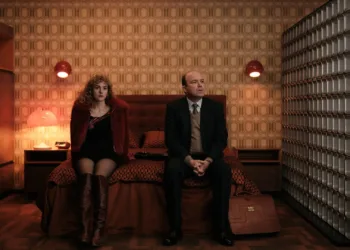















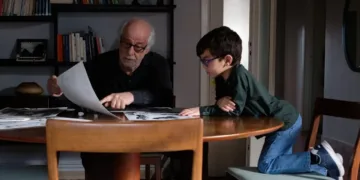









Watch the shape of the chocolate in the opening of Hershey. A familiar Kiss gives way to a lump of coal, joined by what filmmakers call a match cut: a transition that connects images through their visual resemblance. It is a neat invitation to look backward. We recognize the product, and Mark Waters’s film asks us to consider the difficult beginnings behind it. For a moment, the telling seems capable of making a familiar success story feel freshly connected to its subject’s experience.
The childhood material gives that connection something to work with. Milton’s mother insists on disciplined labor, while his father, played by Alan Ruck, pursues ventures that put the family’s finances at risk. Young Milton buries his savings to keep them safe.
That small action tells us something useful about the future businessman: he has learned to protect what he earns before he has much worth protecting. It also introduces a promising tension between his attraction to possibility and his firsthand knowledge of what a dreamer can cost the people around him.
Once Finn Wittrock takes over as the adult Milton, that tension becomes difficult to find. The film moves through confectionery ventures and financial trouble with a reassuring habit of putting the solution close to the crisis. A large overseas order arrives to relieve one business emergency.
Later, another setback is followed almost immediately by the discovery of the Hershey’s Kiss. Each incident adds information to the biography, yet the sequence gives us little opportunity to wonder how failure might alter Milton’s behavior. His persistence remains easy to identify and surprisingly difficult to experience alongside him.
This is a question of setup and payoff, the distance between introducing a difficulty and delivering its resolution. A quick payoff can be delightful when we understand the ingenuity behind it. Here, the helpful order and convenient discovery take much of the pressure off Milton before it can develop. Knowing that Hershey will succeed need not remove suspense; we could still be curious about the decisions success will require. Across roughly 110 minutes, the film keeps changing his circumstances without giving those decisions much weight.
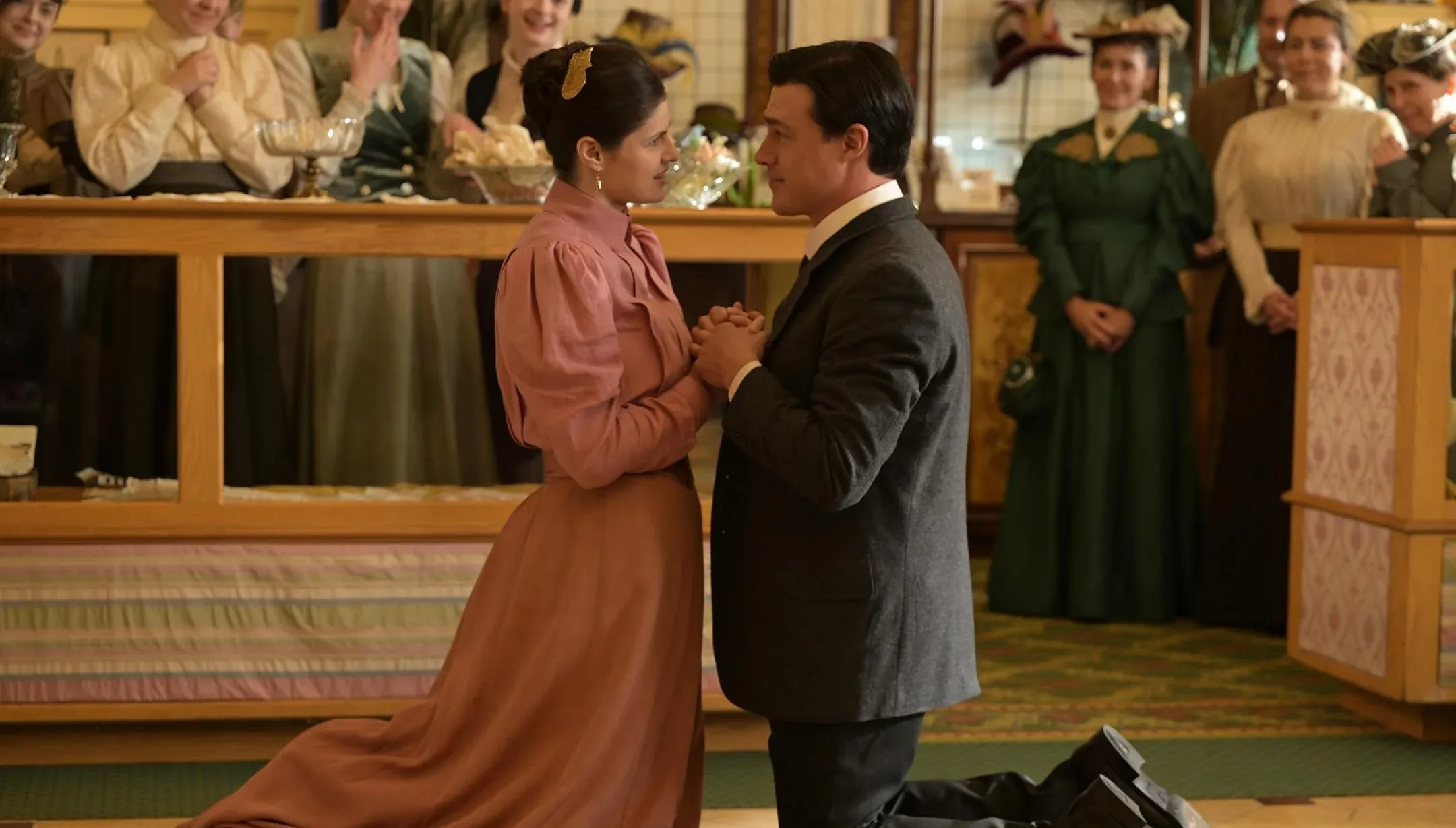
The courtship offers a welcome reason to enjoy the company. Alexandra Daddario’s Kitty Sweeney credits caramels with helping her overcome shyness, a pleasantly unabashed introduction to a romance happy to announce its intentions.
Daddario brings a poised presence, and the affection between Kitty and Milton provides some relief from the business milestones. I liked the film best when it allowed their attraction to be uncomplicated. A marriage can be interesting without constant quarrels, and their obvious pleasure in each other gives the story an emotional starting point that deserves room to grow.
Kitty’s account of the career she has built suggests a person with ambitions and routines of her own. Leaving that life to marry Milton should give the relationship a substantial choice to absorb. Instead, her support for him soon becomes her defining activity, interrupted by episodes of illness. The issue is how little the film develops the independent life it has already introduced. Her encouragement tells us that Milton is loved, while her illness tells us that he has something to lose. There is less attention to how she experiences the life they are making together.
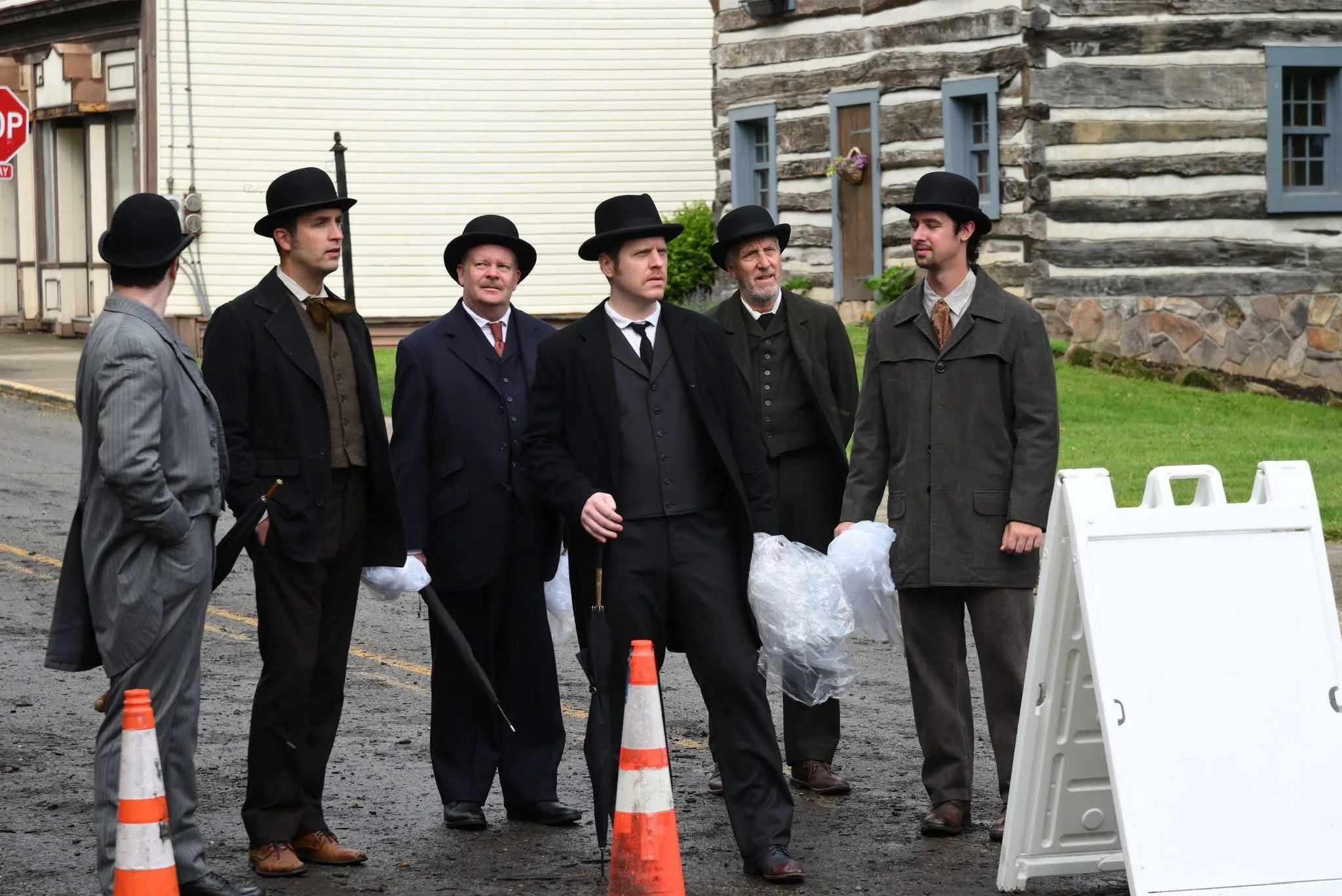
Even the aging makeup works against a convincing sense of shared experience. Wittrock acquires gray hair and increasingly pronounced signs of age while Daddario remains strikingly unchanged. Makeup is one of the basic cues through which a film makes elapsed years visible, especially when it covers decades in a short running time. Here, the two leads seem to receive different amounts of time. Kitty’s handsome period wardrobe supplies a real visual pleasure, but her consistent appearance leaves the marriage looking oddly suspended while Milton’s biography keeps moving.
The film’s assurances extend from the household to the town. Milton resists the prospect of reducing wages under financial pressure, and he initially objects when Kitty suggests naming the town after him. These scenes establish generosity and modesty in easily readable terms.
They also show how little resistance the portrait permits. The wage dilemma might reveal the practical strain of keeping a principle; the naming exchange might expose a complicated relationship with recognition. Both chiefly confirm qualities the film has already taught us to admire. Its version of American enterprise makes the founder’s good character sufficient reassurance about the world forming around him.
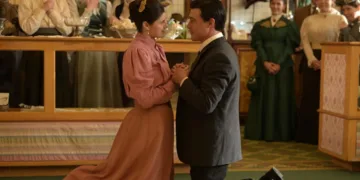
The Titanic episode exposes an awkward limit to that perspective. Learning that they have escaped traveling aboard the doomed ship, Milton and Kitty dance in celebration. Relief makes sense, particularly for a couple already living with illness. The choice to express it through a celebratory dance, however, directs our attention toward their personal good fortune at a moment defined by other people’s deaths. The scene invites us to accept another happy reprieve without reckoning with the scale of the event supplying it. For once, the film’s eagerness to reassure creates an unsettling distance from its central couple.
Their inability to have children offers a different route into the philanthropic legacy. Founding a school for orphaned boys gives their disappointed hopes a purpose outside the marriage, and this connection has an emotional clarity the business episodes often lack. We can understand why these particular people might want their resources to become somebody else’s security.
The difficulty lies in the preparation: Kitty’s career, illness, and support for Milton have received so little sustained development that the school must carry much of the relationship’s emotional meaning. An institution meant to express what they have lived through together becomes the place where the film finally asks us to feel the accumulated years.
Hershey is an American biographical drama film scheduled for theatrical release by Angel Studios on November 25, 2026. Directed by Mark Waters, the film follows Milton S. Hershey as he overcomes repeated financial failures to build a legendary global chocolate empire alongside his devoted wife, Catherine.
Where to Watch Hershey (2026) Online
Full Credits
Title: Hershey
Distributor: Angel Studios
Release date: November 25, 2026
Rating: PG
Running time: 1 hour 50 minutes (110 minutes)
Director: Mark Waters
Writers: Bubba Fulcher, Will Hardy, Timothy Michael Hayes
Producers and Executive Producers: Sharon Paul, Mark Tilghman, Mary Aloe, Joshua Harris, Will Hardy
Cast: Finn Wittrock, Alexandra Daddario, Alan Ruck, Richard Kind, David Costabile, Heléne Yorke, Francesca Faridany, Daniel David Stewart
Director of Photography (Cinematographer): Ed Wu
Editors: Travis Sittard
Composer: Rolfe Kent
The Review
Hershey
Milton’s setbacks resolve before they can test him, and Kitty’s independent life fades behind her role as supporter. The affectionate courtship and handsome costumes offer modest pleasures, but the school’s emotional promise arrives with too little shared experience behind it. Mark Waters makes the milestones clear while leaving the choices between them underdeveloped. I could follow the rise of the business far more easily than I could feel the years inside the marriage.
PROS
- An expressive opening match cut.
- Warmth in Milton and Kitty’s courtship.
- Kitty’s handsome period wardrobe.
CONS
- Convenient resolutions weaken the business setbacks.
- Kitty’s independent identity receives little development.
- Uneven aging makeup undermines the passage of time.
- The Titanic celebration jars with the surrounding tragedy.