





























Bea Gravel’s parents have chosen a pet fish to soften the news that they are separating. The fish dies almost immediately, requiring a toilet funeral accompanied by Bea’s off-key flute. Then her father serves fish sticks. Lindsay Lanzillotta’s Purgatory gets an entire domestic crisis into that sequence: the parents cannot make the announcement painless, the child tries to give another loss some dignity, and dinner carries on with spectacularly poor judgment. The comedy depends on what each person thinks the occasion requires.
Ruby McGurrin, making her feature debut as thirteen-year-old Bea, gives the funeral the seriousness it deserves from its chief mourner. Her commitment lets the flute be funny without making Bea’s feelings ridiculous. John Reynolds’ Joe, meanwhile, is attending to the practical business of feeding his daughters while missing the emotional association on their plates. I like how little explanation the joke needs. We understand his inadequacy through a task he is actually attempting, and the sequence leaves room for affection toward a father who has badly misjudged dinner.

Set in 1983, Christine Speer’s script gives Bea a suitably analog method of addressing the separation: rent The Parent Trap and study it. She and her younger sister Chloe, played by Lauren MacRae, have returned from Catholic summer camp to find their home for sale and their mother moving out.
A film promising that children can arrange a parental reunion offers Bea a wonderfully attractive explanation of her circumstances. The adults have created a problem; perhaps the right plan can reverse it. Her assurance to Chloe that she can repair the family gives that hope a listener who believes her.
This is where the storytelling becomes less assured. An episodic film builds through separate encounters, relying on changes accumulating between them rather than one steadily developing scheme. Purgatory adopts that loose shape across Bea’s eighth-grade year, but the reunion plan keeps suggesting comic activity that never receives much sustained development. Refusing her desired outcome makes sense.
Giving her attempted intervention so little dramatic momentum is less satisfying. The Christmas play produces a similar frustration: her investment establishes the importance of the auditions, yet the disappointing outcome passes with scant attention to what it costs her. Individual disappointments register, then the film is ready for the next incident.
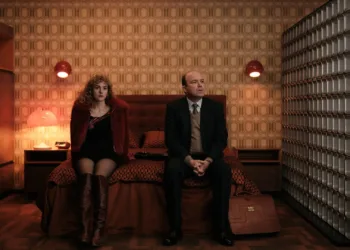
Lanzillotta is better at giving Bea’s isolation a visible shape. A wide shot keeps a person and a substantial stretch of their surroundings in view; here, the distant framing in school hallways and the passage between the kitchen and living room at Joe’s house makes familiar spaces feel unhelpfully large. Bea has room around her without much power over what happens there.
Chloe supplies a different pressure. Her trust means Bea’s repair campaign involves someone else’s expectations, and her presence can interrupt her older sister’s absorption in her own distress. The home contains two children experiencing the same disruption at different speeds.
The confessional scenes give the film a firmer sense of progression. Early on, Bea reports her hostile thoughts about a teacher who pronounces her name “Beat-Rice.” McGurrin plays the confession with an earnestness that makes everyday irritation sound like a serious lapse requiring professional attention.
As Father Malone, J.K. Simmons meets her uninhibited disclosures with restrained reactions. He gives her room to speak, and the humor comes from the distance between the gravity of her report and his reception of it. Their rapport allows the conversations to become increasingly difficult without losing their ease.
Outside those conversations, Bea keeps encountering people whose authority exceeds their good sense. Jennifer, the babysitter hired while Joe goes on a date, smokes indoors, takes Bea and Chloe to meet her boyfriend, and urges Bea to steal nail polish.
The sequence makes Bea’s confusion about responsibility concrete: the person entrusted with supervising her is encouraging the behavior she is supposed to resist. School and PTA gossip apply a related injustice to the separation, turning decisions made by her parents into something Bea must carry into school. Her friendship with Margot becomes vulnerable to Margot’s mother’s gossip. Private unhappiness acquires an audience.
Those experiences change the purpose of confession. Bea starts by submitting her own thoughts for inspection and eventually challenges the system doing the inspecting. When she tells Father Malone she no longer wants to be Catholic, his acknowledgment that parents and religion are imperfect preserves the honesty of their exchanges.
He cannot restore her certainty, and he does not pretend he can. Simmons makes listening feel like a useful adult action in a film crowded with adults explaining themselves badly. The title gains meaning through Bea’s uncomfortable wait for decisions she cannot control, accompanied by shame she has done little to earn.
Her mother remains the film’s hardest person to understand, sometimes productively and sometimes through insufficient development. Marianne, played by Abby Elliott, says she married and had children young and now needs to discover who she is. Her continued school runs and visits complicate Bea’s experience of being left behind.
Marianne is still performing parental duties while rejecting the arrangement Bea associates with being a family. Her developing relationship with school administrator Richard Thompson, played by Jack Innanen, gives Bea another immediate grievance. Elliott’s pained expression helps communicate the discomfort Marianne’s explanation cannot contain, particularly in a community so eager to discuss her choices.
Keeping the story close to Bea makes that explanation feel appropriately inadequate to a child. The difficulty is that their later encounters supply too little fresh understanding of the woman delivering it. We can recognize Marianne’s unhappiness without learning enough about how it developed, and the confrontations settle into friction rather than deepening the relationship.
Elliott provides visible feeling where the writing supplies limited particulars. The continued visits are especially rich material: Bea has to watch her mother remain involved, available for familiar tasks, yet unwilling to resume the life Bea wants back. Their contact keeps that contradiction present, but the film rarely lets the conversations reach far enough into it.
Purgatory had its world premiere in the Discovery program at the Toronto International Film Festival on September 12, 2026. Directed by Lindsay Lanzillotta in her feature debut, the 1980s-set coming-of-age dramedy follows a sheltered suburban tween who questions her Catholic faith and tries to force things back to normal after her mother suddenly moves out to “self-actualize”.
Full Credits
Title: Purgatory
Distributor: Brave Jayne Films (Currently seeking wider U.S. theatrical/streaming distribution following its festival run)
Release date: September 12, 2026 (Toronto International Film Festival)
Running time: 1 hour 44 minutes (104 minutes)
Director: Lindsay Lanzillotta
Writers: Christine Speer
Producers and Executive Producers: Lindsay Lanzillotta, Simone Kirlew, Aldo Lanzillotta, Deniz Gumustas, Mark O’Neill, Gus Murray
Cast: Ruby McGurrin, Abby Elliott, Lauren MacRae, John Reynolds, J. K. Simmons, Jack Innanen, Mary Walsh, Julianne Arrieta, Marcus Ngo, Gemma Rosaria Rae
Director of Photography (Cinematographer): Evelin Van Rei
Editors: Justin Oakey
Composer: Andrew Staniland
The Review
Purgatory
I’m fond of how Purgatory lets an off-key flute or an awkward confession explain feelings the adults struggle to address. Ruby McGurrin’s earnest comic timing and J.K. Simmons’ attentive restraint give Bea’s uncertainty warmth and specificity. The larger story needs that same care: her reunion scheme loses momentum, and Marianne remains insufficiently understood. It’s an affectionate coming-of-age film whose individual encounters often achieve the emotional clarity its family drama keeps reaching for.
PROS
- Ruby McGurrin’s sincere, finely judged comic performance.
- Funny, evolving confessional exchanges with J.K. Simmons.
- Domestic humor that preserves the children’s emotional stakes.
- Wide framing gives Bea’s isolation a visible form.
CONS
- The parental reunion scheme receives little sustained development.
- The Christmas audition disappointment gets scant emotional follow-through.
- Marianne’s motives and her relationship with Bea remain underdeveloped.