























Slavoj Žižek finds an uncomfortable afterlife for the revolutionary imagery of V for Vendetta. The Guy Fawkes mask passes into Occupy’s vocabulary of resistance; the spectacle of an assault on Parliament acquires a different association after January 6. These connections unsettle the pleasure of watching authority overthrown.
They also require distinctions that visual resemblance cannot supply. A rebellion’s political meaning depends on the power its participants possess and the order they want to establish. Žižek’s objection to an uprising without articulated goals is persuasive precisely because a crowd’s appearance tells so little about the society it would make.
Kylie Jenner’s Handmaid’s Tale-themed birthday party takes this circulation of images into another register. A representation of women’s subjection becomes an occasion for expensive amusement. No investigation of Jenner’s private beliefs is necessary to see the cultural transaction: oppression supplies a recognizable look, available for consumption once its dramatic warning has been detached.
Yet Žižek himself appears in the red costume, submitting to a comic recreation of the series’ violence. The documentary invites laughter through the same imagery whose conversion into entertainment it scrutinizes. Its claim to insight must rest on what that laughter makes visible.
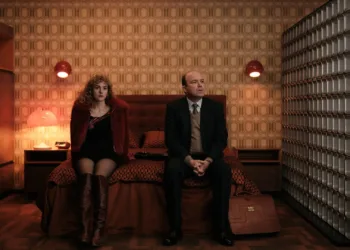
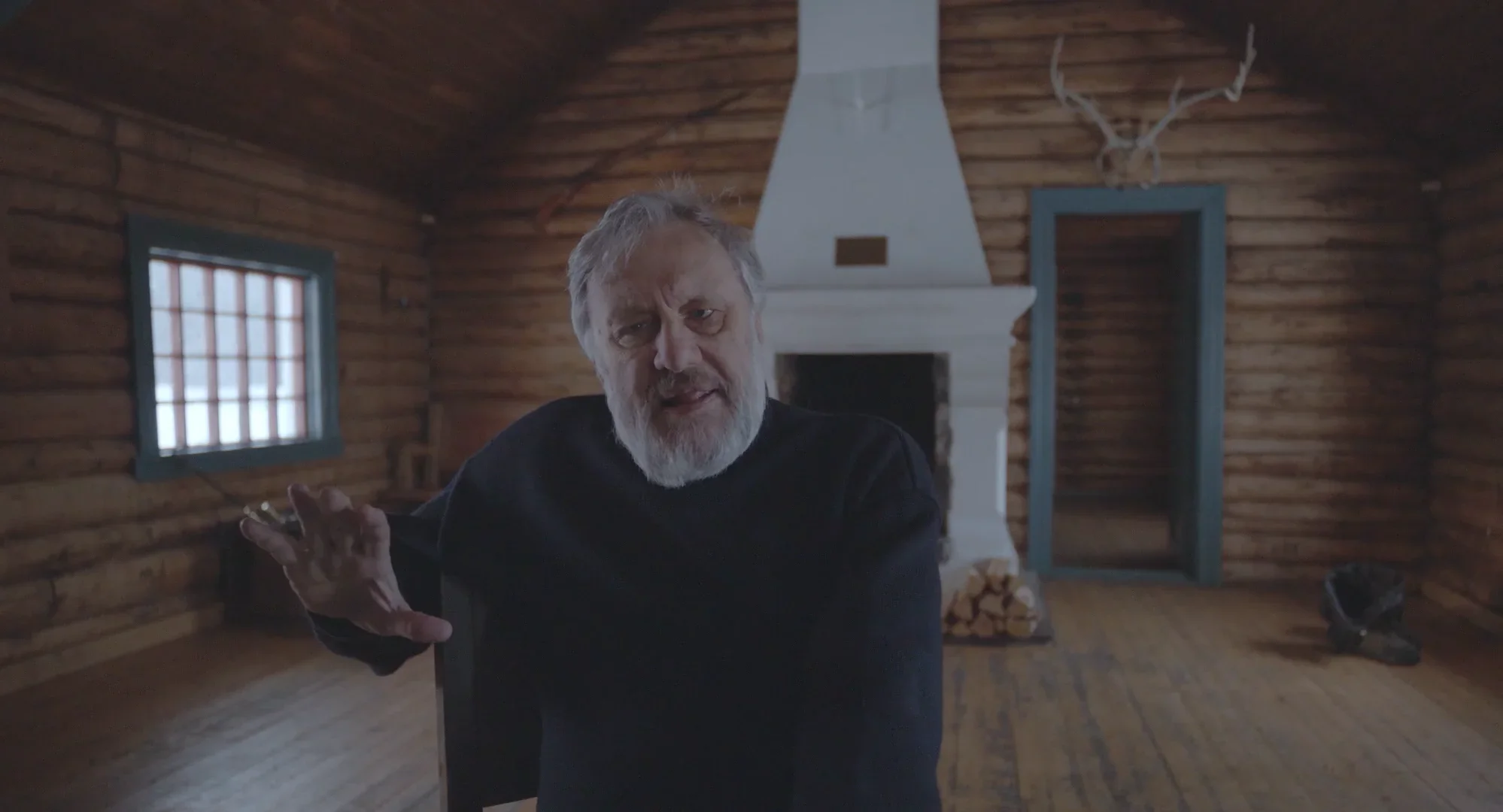
Sophie Fiennes understands the attraction and the danger of giving philosophy a body. In The Pervert’s Guide to Utopias, her third collaboration with Žižek in this series, production designer Miha Knific’s reconstructed screen environments let the commentator enter the worlds he interprets. His presence disturbs their solemnity and makes their arrangements available for inspection.
Watching him inhabit these borrowed positions is funny because the fit is so conspicuously imperfect. Across roughly two hours of film excerpts, political footage, and commentary, that visible artifice gives the documentary an inviting theatrical intelligence. Interpretation becomes something performed before an audience, with all the authority and seduction performance can acquire.
The title’s utopias emerge through the costs of keeping an attractive picture intact. Žižek’s use of The Prestige gives this inquiry its clearest mechanism. A magician makes a canary disappear, killing it in the process, then presents another bird as the restored original.
The audience receives the satisfaction of recovery because the substitution conceals the death. Applied to assurances of prosperity and freedom, the trick directs attention toward the people whose suffering has been excluded from the account. The image is effective because the comforting outcome and the hidden injury belong to the same operation.
That relationship becomes materially specific in the discussion of Congo’s exploited mineral labor and the devices it helps produce. The phone then changes function as Palestinians use it to record destruction in Gaza and circulate testimony beyond established news channels.
Here the film resists the convenience of declaring an object politically contaminated and leaving it there. Exploitation in production coexists with the capacity to expose violence. The recordings retain their value; the conditions of manufacture remain. Žižek’s method is especially useful when it holds both facts in view without granting the viewer the satisfaction of an innocent position.
Fiennes’s editing gives these connections an urgency a filmed lecture would struggle to achieve. The cut from Gaza’s destruction to Greta Thunberg challenging fantasies of endless economic growth brings the management of catastrophe into focus: images of suffering meet an accusation against the language used to excuse inaction.
The transition carries considerable force, while the histories and causes of these crises remain distinct. This is the film’s recurring intellectual gamble. A juxtaposition can expose a habit of looking away, yet its emotional momentum can outrun the explanation linking its materials. The canary identifies a useful question; it cannot answer every political question that follows.
The reading of Jeanne Dielman, 23 quai du Commerce, 1080 Bruxelles reveals a sharper problem with the guide’s authority. Žižek interprets Jeanne’s sexual response late in the film through the possibility of pleasure within submission and control. Human attachment to oppressive arrangements is a serious subject, resistant to flattering accounts of freedom.
But the passage from a bodily response to an explanation of someone’s relationship with subordination needs particular care. Pleasure cannot establish consent, allegiance, or a settled desire to remain subject to power. The interpretation becomes less convincing as those distinctions disappear beneath its confidence.
Fiennes places Žižek at Jeanne’s recreated kitchen table, giving his account the strange intimacy of an explanation delivered from inside someone else’s home. The set lends him proximity without resolving the uncertainty of the experience he describes.
This is a limit of the series’ ingenious staging: occupying a character’s space makes an interpretation vivid, but supplies no further access to her interior life. His account can illuminate the attachments through which domination persists. It becomes restrictive when ambivalence is treated as sufficient confirmation, leaving the woman’s experience with little room to trouble the theory brought to explain it.
The film gains emotional depth when its attention turns from interpreting another person’s submission to the wish to punish oneself. Through the burning house in Tarkovsky’s The Sacrifice, Žižek considers suffering chosen as a payment for the suffering implicated in one’s existence.
This extends the canary’s concealed injury into the spectator’s conscience. Recognizing the cost of comfort can produce a private demand for atonement, with no necessary benefit to the person who bore that cost. The sequence gives the documentary’s account of complicity a painful intimacy: even the refusal to feel comfortable can become absorbed in the management of one’s own moral condition.
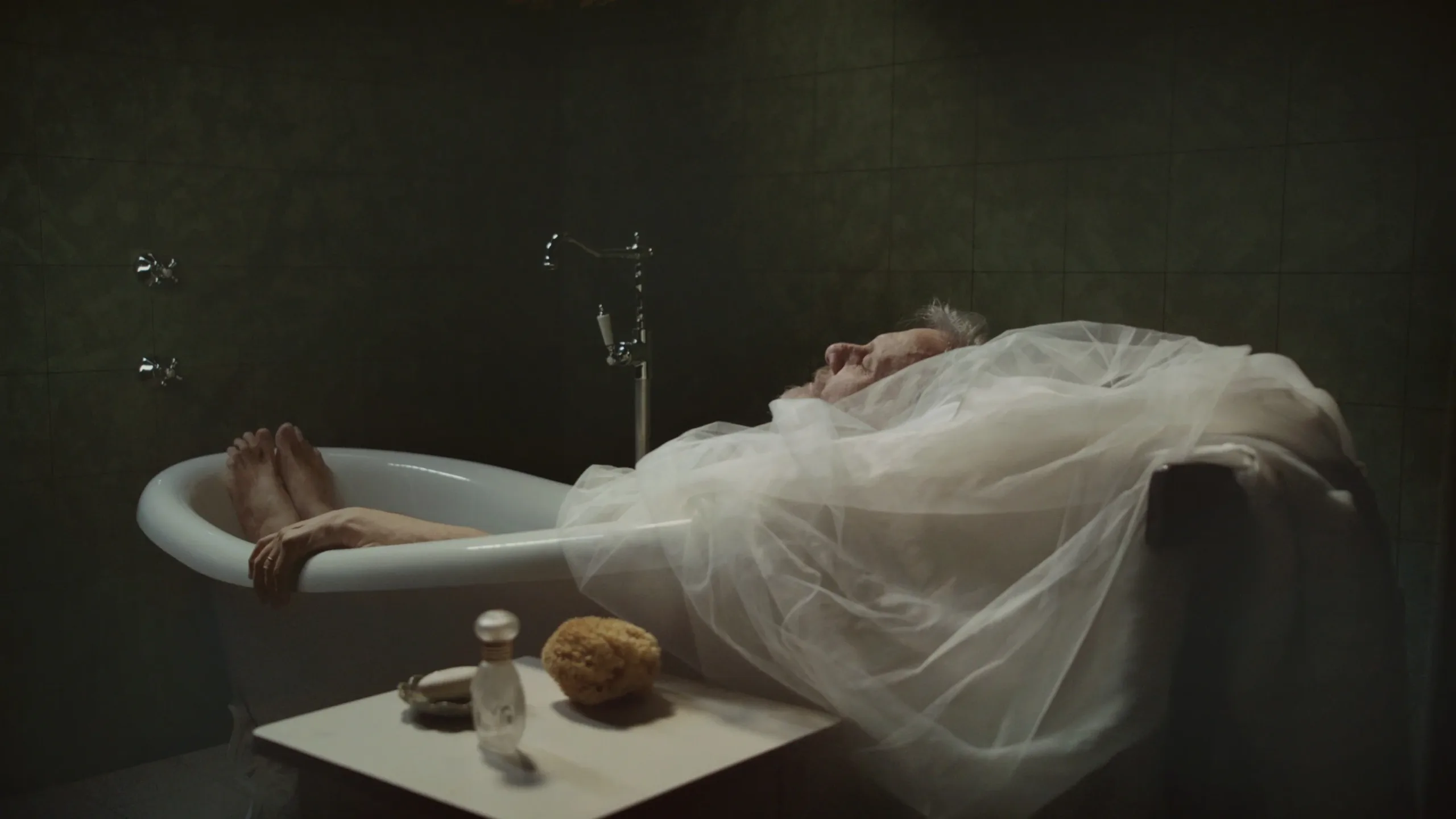
Melancholia offers a different response to catastrophe. Žižek finds in Justine’s composure before the approaching planet a clarity unavailable to those desperate to preserve the world they recognize. Fiennes lets this grave proposition coexist with the absurdity of the philosopher recreating Kirsten Dunst’s bath image.
His exposed body takes some grandeur out of the position of the thinker explaining humanity’s fate. The comedy allows the argument to breathe, and the account of composure has real tenderness. The familiar obligation to offer reassurance falls away; terror no longer dictates the only imaginable response to the end.
Žižek reads that ending as a release from political repression and proposes pessimism as the necessary beginning of struggle. The connection remains incomplete. Justine’s calm concerns an event that abolishes every future, including the futures in which domination might be challenged.
Political pessimism must still accommodate other people’s needs, disagreements, and persistence in time. The film gives lucid expression to the relief of abandoning false reassurance. Its earlier question about rebellion’s unnamed goals remains active within that relief, requiring a future in which people can still act together, make demands, and live with what their actions produce.
The Pervert’s Guide to Utopias had its world premiere out of competition at the 83rd Venice International Film Festival on September 7, 2026. Directed by Sophie Fiennes and featuring philosopher Slavoj Žižek, the documentary serves as the final installment in their trilogy, utilizing classic film analysis, music, and archival material to map the utopian illusions of the modern era.
Full Credits
Title: The Pervert’s Guide to Utopias
Distributor: Keeper Pictures, P Guide, SPOK Films, The Film Kitchen, Mattima Films
Release date: September 7, 2026 (Venice International Film Festival)
Running time: 2 hours 13 minutes (133 minutes)
Director: Sophie Fiennes
Producers and Executive Producers: Katie Holly, Evan Horan, Martin Rosenbaum, Shani Hinton, Sophie Fiennes, Jožko Rutar, Miha Černec, Ineke Kanters, Lisette Kelder, Andrew Grant, Greg Martin, Charlotte Cook, David Williams, Andy Baynes
Cast: Slavoj Žižek
Director of Photography (Cinematographer): Remko Schnorr
Editors: Sophie Fiennes
Composer: Magnus Fiennes, Horace Fiennes Tummings
The Review
The Pervert's Guide to Utopias
Sophie Fiennes gives Žižek’s political provocations an inventive theatrical life, turning borrowed screen worlds into places where comfort, freedom, and complicity can be examined together. The phone’s passage from exploited labor to Palestinian testimony captures the film’s intelligence at its most generous. Its confidence becomes restrictive in the reading of Jeanne Dielman, while the final embrace of pessimism leaves collective action insufficiently explained. The pleasure of this encounter remains considerable, provided the guide’s authority receives the scrutiny he directs at everyone else.
PROS
- Inventive reconstructions make interpretation theatrical and funny.
- The smartphone discussion preserves difficult political contradictions.
- Editing connects cinematic images with contemporary suffering.
- The final movement finds tenderness in facing catastrophe.
CONS
- Political analogies sometimes outrun their explanations.
- The Jeanne Dielman reading compresses distinctions within desire.
- Pessimism’s connection to collective action remains incomplete.