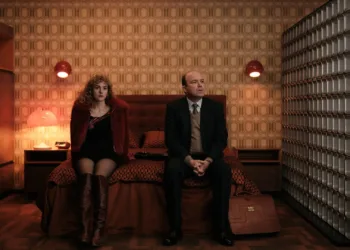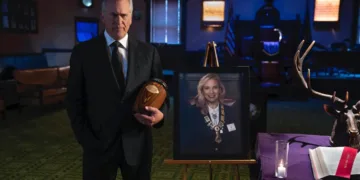



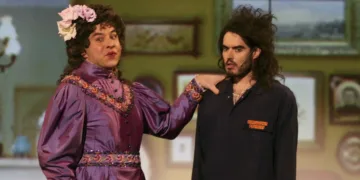

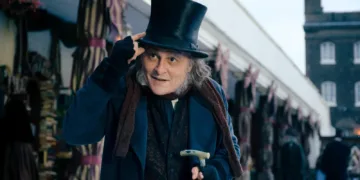






















Watching his old pear commercials, Ernie Tyler has access to a version of himself that still knows what to do. His name remains familiar around Pear Valley, Oregon, where he made his living selling fruit. At home, following the death of his wife Emma, he drinks too much and lets the house deteriorate. Bruce Campbell, who writes, directs, and plays Ernie in Ernie & Emma, establishes the character through that uneven survival of his old identity. The advertisements preserve a man with a purpose. Outside them, he has trouble organizing a day.
Campbell’s sarcasm keeps Ernie from becoming an anonymous sad widower waiting for the screenplay to improve his circumstances. He swears, talks to objects, and retains the abrasive confidence of someone accustomed to being recognized. Those habits give his solitude a particular texture.
He can still be funny company while living badly. Campbell allows both conditions to occupy the same character, which matters once the film begins asking him to change. His comic personality does not have to disappear for the grief to become credible, and his capacity to entertain does not establish that he is coping.
Emma supplies the plot’s practical intervention. Before her death, she prepared letters directing Ernie to scatter portions of her ashes at specified locations and complete other requests. After 33 years together, she appears to have understood that an obligation to her might get him out of the house before any concern for himself would. It is a familiar device, but a useful one for this protagonist. Ernie needs something to do before he can imagine something to want. The instructions give individual scenes clear objectives while leaving him free to resent what they bring up.
The first destination, the hospital where Emma died, makes the task awkwardly literal. Her ashes must be carried back into the place associated with losing her. Other stops complicate the relationship he is remembering. At her former workplace, Ernie complains about the time she spent on the job instead of with him.
A bar he thought she knew nothing about unsettles his confidence in the private arrangements of their marriage. These locations perform different dramatic jobs. The hospital confronts him with an absence; the workplace preserves a grievance; the bar suggests that Emma’s understanding of their life may have exceeded his account of it. The itinerary earns its length through those changes in pressure.

Robin McAlpine’s voice gives the letters a continuing human presence. Emma can still set the terms of an encounter, and Ernie can still object. This is an effective way to keep the marriage active without turning every recollection into evidence that it was perfect. The workplace complaint is especially useful because it permits an ungenerous thought to survive inside his devotion. He misses her and still thinks she allocated some of their time badly. The script finds emotional substance in the persistence of an old argument after the possibility of resolving it has gone.
Campbell’s strongest dramatic opportunity comes when Ernie lashes out at Emma for dying first. The accusation is impossible to answer fairly, yet the performance makes its emotional logic intelligible. His anger gives his grief someone to address, even as it exposes the unfairness of asking her to take responsibility for his abandonment.
The sarcasm established earlier now belongs to a man whose resentment cannot produce the response he wants. Campbell has a specific contradiction to play: Ernie needs the person he is blaming. That is firmer dramatic ground than a succession of solemn reminders that he loved his wife.
The arrangement is tidy enough to keep the film’s larger direction readily apparent. Emma has supplied destinations, duties, and opportunities for renewed contact; the story offers limited uncertainty about the purpose of the exercise. Its interest depends on the differences between Ernie’s responses.
The humor helps keep those encounters from adopting a uniform therapeutic tone. A security guard’s unexpectedly permissive reaction to the scattering of ashes turns a potentially solemn ritual into a collision with someone else’s ordinary working day. Ernie may be carrying the central fact of his existence, but the people he meets have their own ways of responding to it.
The account of a wedding proposal read from a Wendy’s receipt serves a related purpose within the marriage itself. It gives affection an undignified, specific history. The comedy belongs to the life Ernie remembers, so laughter can continue that relationship without canceling the loss.
The broader dispensary humor, complete with conspicuously green marijuana smoke, is less revealing about the couple. It works as a diversion, though the proposal supplies the stronger connection between a joke and the people involved. Campbell is most persuasive when the comic detail tells us something that a declaration of love would leave vague.
The tango lesson with Ted Raimi’s exacting instructor gives the return to company its clearest physical demand. Ernie must attempt something unfamiliar under the direction of someone who has standards for how it should be done. His local reputation offers little assistance. For a character introduced watching an accomplished version of himself on television, becoming a beginner is a meaningful change of position. Emma’s request can explain why he arrives, but learning requires his participation once he is there. The lesson creates room for a choice inside the itinerary: he has to let another person teach him something.
Ernie & Emma premiered in Medford, Oregon, on February 14, 2026, before embarking on an independent theatrical roadshow tour across the United States throughout 2026. Written, directed by, and starring Bruce Campbell, the comedy-drama follows a widowed pear salesman who embarks on a heartfelt road trip to scatter his late wife’s ashes across the meaningful locations she left behind.
Where to Watch Ernie & Emma (2026) Online
Full Credits
Title: Ernie & Emma
Distributor: Independent / Self-distributed (Roadshow tour)
Release date: February 14, 2026 (Limited theatrical release and tour)
Rating: R
Running time: 1 hour 28 minutes (88 minutes)
Director: Bruce Campbell
Writers: Bruce Campbell
Producers and Executive Producers: Bruce Campbell, Ida Gearon
Cast: Bruce Campbell, Cerina Vincent, Robin McAlpine, Ted Raimi, William Earl Ray
Director of Photography (Cinematographer): Kurt Rauf
The Review
Ernie & Emma
Ernie & Emma gives a familiar recovery plot enough friction to feel personal. Emma’s letters organize the action, while Campbell’s sarcasm and anger keep Ernie from becoming a passenger in his own rehabilitation. The destination is easy to anticipate, and the dispensary comedy contributes little to the marriage’s texture. The stronger scenes let affection coexist with grievances that death cannot settle, then give renewed participation a concrete shape in a tango lesson.
PROS
- Campbell makes sarcasm, resentment, and grief belong to the same person.
- Each major destination exposes a different pressure within the marriage.
- Emma’s voiced letters sustain an active relationship after her death.
- The tango lesson turns renewed participation into a visible action.
CONS
- The recovery plot’s direction is readily apparent.
- Dispensary gags reveal less about the central relationship.