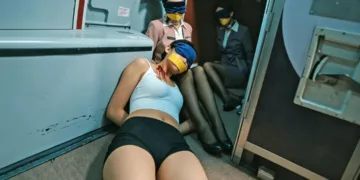




























The airplane lavatory is barely big enough for someone to change their clothes, yet watching Hong Shuang and Jingjing Qu fight inside one produces an almost giddy sense of excitement. Every exchange seems to exhaust the physical possibilities of the space until the performers find room for another strike. There’s a wonderful feeling of disbelief that accompanies good martial arts cinema, and this sequence sustains it through the sheer inventiveness of its choreography. It also happens to be one of the best scenes in a movie starring Ashton Chen and Iko Uwais, which should tell you something about the talent involved.
Co-directors Chen and Qin Pengfei understand the entertainment value of an unlikely fighting arena. They build the gloriously ridiculous Fists on a Plane: Wings of Dread around Gu Chaoyang (Chen), a Chinese air marshal whose flight home becomes the target of a hijacking orchestrated by the dangerous Paquet (Uwais). The aircraft’s layout presents a series of physical problems for Gu, each requiring a slightly different application of his considerable fighting abilities.
For anyone who misses the uncomplicated pleasures of martial arts cinema, this is an easy recommendation. The film has some painfully awkward comedy and characters whose emotional lives could fit comfortably on a boarding pass. Yet its 86 minutes contain the kind of inventive physical spectacle that deserves attention from action fans unfamiliar with China’s streaming productions.
Part of the fun is how quickly you start looking at the airplane differently. A sequence in first class sees a fighter climb the seats and use the overhead compartment to launch a flying kick. Suddenly, the furnishings of the cabin become objects of anticipation. You start wondering what somebody might do with the next seatback or armrest. Even turbulence becomes an opportunity for physical spectacle through the filmmakers’ use of wire-assisted stunt work, sending bodies flying through the cabin.
Chen and Qin also understand how important it is to let viewers appreciate the performers. The camera stays close to the exchanges, moving fluidly with the fighters, and individual shots usually last long enough for the physical relationships between bodies to register. The rapid cutting occasionally makes exchanges harder to follow. Yet the directors frequently find an interesting perspective, including shots that travel past the aircraft’s small windows to reveal the violence inside. That outside perspective briefly restores an awareness of the ridiculous situation in which all these people find themselves.
The aircraft itself occasionally stretches credibility. Anyone accustomed to flying economy might feel a little envious of the space these passengers have available for martial arts.
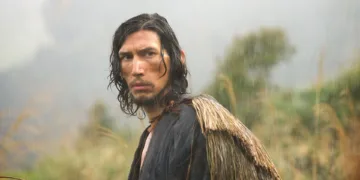
There is a different kind of excitement attached to the arrival of Uwais. Fans of The Raid will naturally spend the earlier portions of the film anticipating what happens when he gets physically involved. His role as Paquet keeps that anticipation simmering for roughly half the movie, giving Chen time to establish Gu’s speed, precision, and resourcefulness against the other hijackers.

Their eventual confrontation in the cargo hold is particularly satisfying because it changes the physical rhythm of the film. After so many encounters in narrow aisles and cramped compartments, the comparatively open space allows both performers to express their individual strengths. Chen’s quick, clean movements meet the heavier aggression of Uwais, whose grounded fighting style gives his attacks a nasty sense of force. The availability of golf clubs, baseball bats, and luggage handles introduces fresh possibilities into their exchanges.
Where The Raid creates an exhausting sense of physical desperation, this film finds much of its appeal in the playful absurdity of its encounters. Uwais fits surprisingly well into that register. His menacing physical presence gives the violence some necessary severity, although his apparently dubbed dialogue creates an unfortunate disconnect whenever Paquet has something to say.
The screenplay has considerably less imagination. Gu’s troubled relationship with flight attendant Dong Lu should give his professional obligations a personal cost, especially since his attempts to repair their relationship bring him aboard her flight. Unfortunately, their disagreements have the exaggerated emotional register of a melodrama working through its material at double speed. Gu’s repeated declarations about the responsibilities of Chinese air marshals make him a particularly difficult character to connect with on a personal level.
The early comedy fares even worse. A wealthy passenger desperately needing the bathroom provides the kind of comic business that makes the wait for the hijacking feel unnecessarily long. Paquet’s poorly explained motivations present a different problem: there’s plenty of immediate danger once the criminals take control, but little reason to become invested in the specifics of their scheme.
What carries the tension through these shortcomings is the clarity of Gu’s immediate objective. His fellow officers possess useful skills of their own, and their involvement makes the resistance feel like a coordinated effort. The film gets a lot of mileage from the simple uncertainty of how a handful of capable people can protect an entire aircraft full of vulnerable passengers. It helps that several of those passengers eventually have ideas of their own.
There’s an especially gratifying release of tension when the crew and ordinary travelers begin fighting back. After spending so much time seeing the cabin occupied by threatening figures, watching the people inside reclaim that space produces a feeling of collective triumph. The filmmakers distribute their climactic action across Gu’s confrontation with Paquet, the remarkable lavatory fight, and the passengers’ struggle against the remaining criminals. Each encounter offers a different scale of action, and moving between them keeps the excitement fresh during a stretch that could easily have become tiring.
I particularly appreciate how much room the finale makes for the supporting performers. A production built around the appeal of Chen and Uwais could have comfortably reserved its most imaginative choreography for those two. Instead, Hong Shuang and Jingjing Qu get to execute an extraordinarily demanding fight of their own. The pre-credits behind-the-scenes footage offers an opportunity to appreciate the work involved in getting those performers and a camera into that tiny space.
Fists on a Plane: Wings of Dread (Wan Mi Wei Ji) originally premiered in China on July 3, 2026, before releasing on digital platforms in the United States on November 24, 2026, via Well Go USA Entertainment, ahead of its subscription streaming debut on Hi-YAH! on December 4, 2026. Co-directed by and starring Ashton Chen alongside martial arts star Iko Uwais, the high-altitude action thriller follows air marshal Gu Chaoyang as he battles a ruthless gang of hijackers at 30,000 feet to protect the passengers aboard his flight.
Full Credits
Title: Fists on a Plane: Wings of Dread (Wan Mi Wei Ji / 万米危机)
Distributor: Well Go USA Entertainment, Hi-YAH!, iQIYI Pictures
Release date: July 3, 2026 (China release), November 24, 2026 (U.S. digital release), December 4, 2026 (Hi-YAH! streaming debut)
Running time: 1 hour 26 minutes (86 minutes)
Director: Ashton Chen, Qin Pengfei
Writers: Gao Bing, Qiu Mingjia, Wang Haoyi
Producers and Executive Producers: Wang Haoyi
Cast: Ashton Chen, Iko Uwais, Qu Jingjing, Liu Fengchao, Xia Ruoyan, Hong Shuang, Ren Tianye, Tao Hai, Gao Yi, Huang Tao
The Review
Fists on a Plane: Wings of Dread
Fists on a Plane: Wings of Dread delivers the infectious excitement of martial arts cinema at its most inventive. Ashton Chen and Iko Uwais make an excellent pairing, yet some of the greatest thrills come from the supporting performers and their creative use of the aircraft. The awkward comedy, shallow characterization, and muddled villain motivation leave much to be desired. Still, there's something immensely satisfying about watching filmmakers extract so many entertaining possibilities from such restricted surroundings. Action enthusiasts should make room for this one.
PROS
- Inventive close-quarters fight choreography.
- Excellent physical performances from Chen and Uwais.
- Creative use of the aircraft's interiors.
- Dynamic camerawork that respects the performers.
- Exhilarating finale featuring the supporting cast.
CONS
- Awkward comedy and exaggerated melodrama.
- Underdeveloped characters and villain motivation.
- Distracting patriotic declarations.
- Occasionally excessive editing speed.