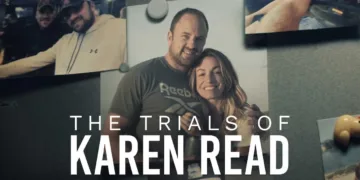














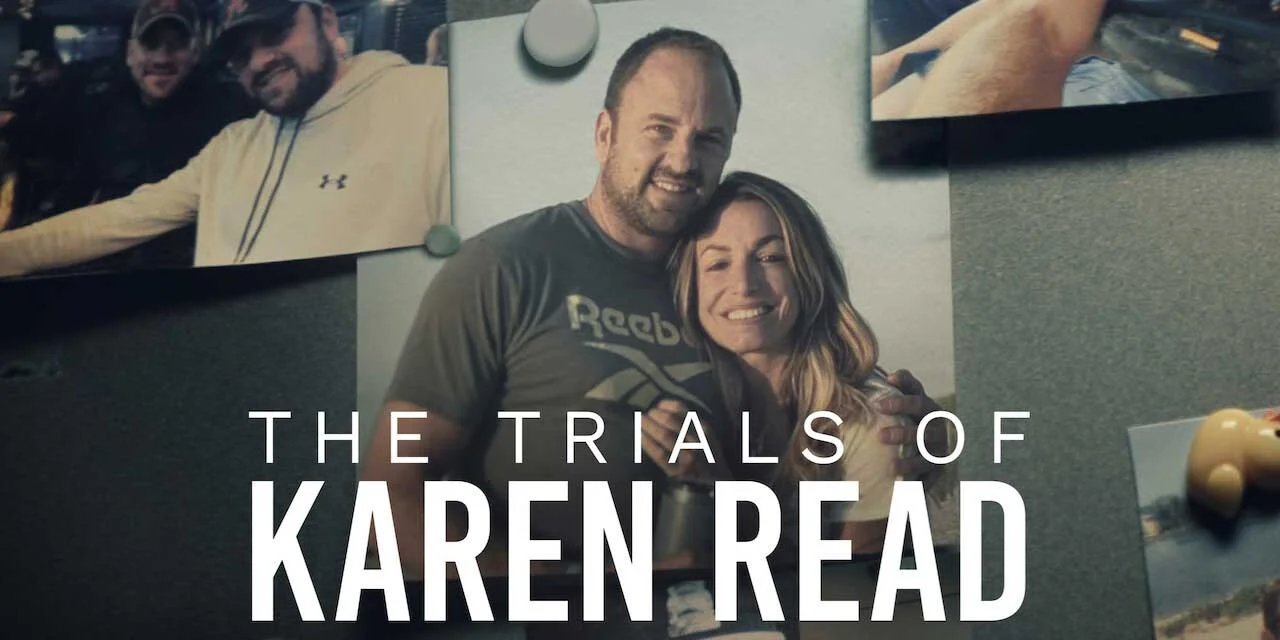

The most impressive trick in The Trials of Karen Read is also the one that makes me suspicious of it. Netflix’s three-part documentary teaches viewers to question an apparently convincing account of a man’s death, yet it achieves this by carefully controlling when we encounter information that challenges our assumptions. I enjoyed watching that process unfold, especially as the evidence became increasingly difficult to reconcile. By the final episode, however, I found myself applying the same skepticism to the filmmakers’ decisions.
Directed by Danielle Johnson Cutts, the series examines the death of Boston police officer John O’Keefe, who was discovered unresponsive in the snow outside another officer’s home in Canton, Massachusetts, on January 29, 2022. His girlfriend, Karen Read, became the central suspect after investigators alleged that she had struck him with her vehicle and left him outside. Fragments of a broken taillight formed part of the prosecution’s case, but questions about police conduct and conflicting accounts eventually transformed the investigation into a national controversy.
The documentary is easy to recommend for viewers interested in true crime, particularly those who appreciate seeing complicated evidence explained with care. Its presentation of competing timelines and forensic arguments is consistently engaging, and several sequences demonstrate how effective documentary filmmaking can be when it makes difficult information understandable. My reservations concern the moments when that careful explanation gives way to emotional persuasion.
The first episode establishes the prosecution’s account through testimony, timelines, and investigative findings that initially create a coherent picture. This is where Cutts employs a technique called controlled disclosure. Instead of presenting all the available information at once, a filmmaker introduces details in an order designed to influence how viewers interpret what came before. It is familiar territory for mystery films, but documentaries carry an additional responsibility because the material concerns real people and actual evidence. Here, the approach works remarkably well. The explanation surrounding O’Keefe’s death seems plausible until subsequent information forces us to reconsider details we might have accepted too readily.
What I particularly appreciate is how the central mystery changes shape. At first, the question concerns the circumstances of O’Keefe’s death and Read’s possible responsibility. As conflicting statements and concerns about the investigation emerge, attention shifts toward the reliability of the people gathering and interpreting the evidence. Troubling text messages and allegations of police misconduct become significant because they affect confidence in the investigation itself. The filmmakers do not need to establish every alternative theory as credible for those questions to matter.
The second episode takes the documentary somewhere considerably stranger. The criminal investigation becomes entangled with an enormous online controversy, and the series incorporates livestream recordings, social media reactions, and footage of the campaign surrounding Read. Online personality Turtleboy emerges as an influential figure, alongside communities promoting competing explanations for O’Keefe’s death. Watching these developments, I was struck by how quickly discussion moved away from assessing individual pieces of evidence and toward defending a preferred account at almost any cost.
Cutts makes an effective visual choice by allowing footage from the online controversy to occupy so much of this episode. We move from organized testimony and carefully presented timelines into a world of immediate reactions and personal confrontations. The courthouse scenes are particularly uncomfortable. Crowds cheer and boo with the enthusiasm usually reserved for sporting events. The audience outside can celebrate a favorable development or condemn an unfavorable one, then go home. O’Keefe’s relatives have to live with the loss that prompted the case in the first place.
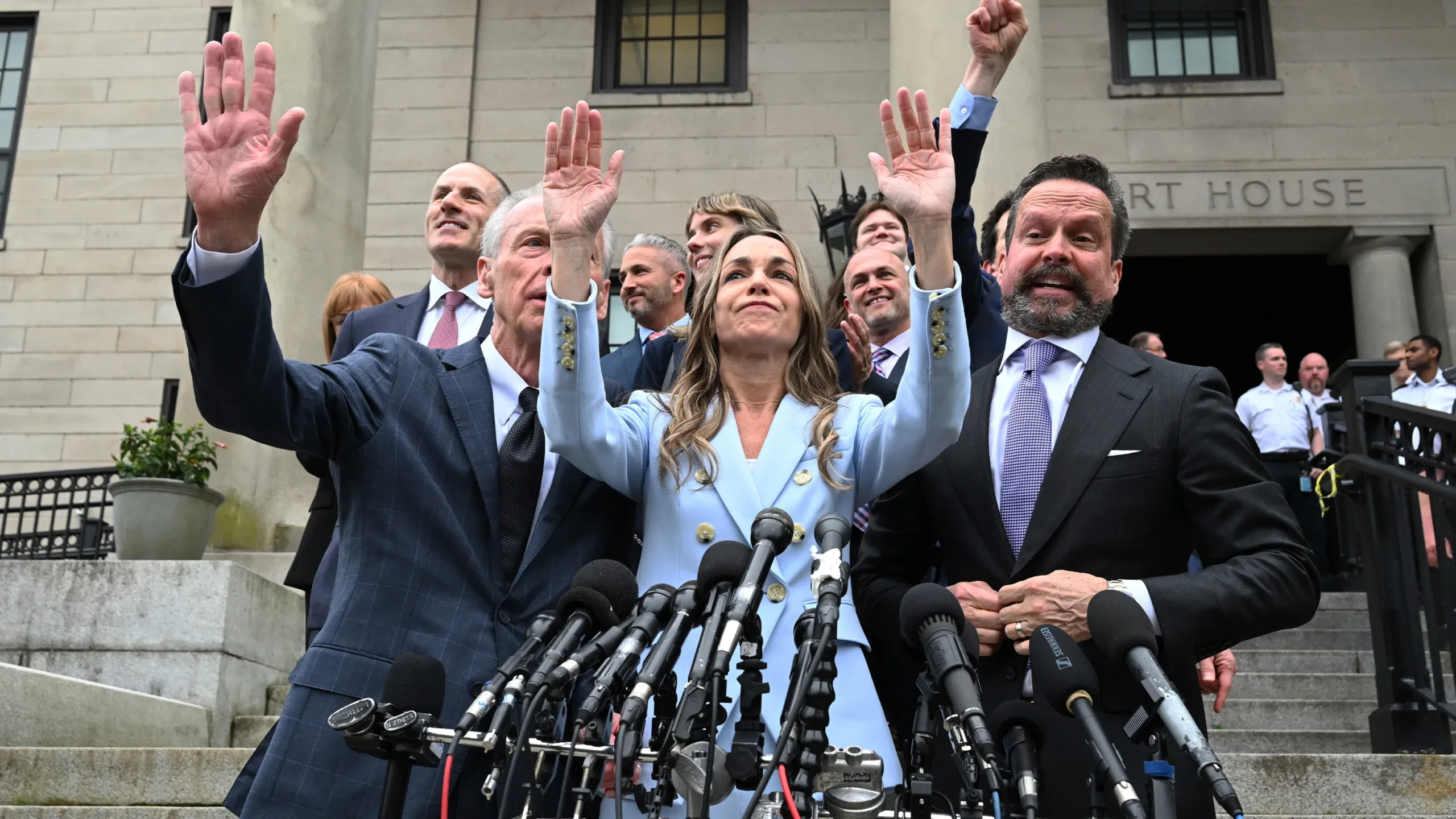
Public scrutiny of police investigations is necessary when officers’ conduct raises serious questions. Yet the online response shows how allegations can spread through repetition rather than evidence. The livestream confrontations make that danger visible, giving the episode a force that a conventional interview about misinformation would lack.
The third episode returns attention to the courtroom, and this is where the documentary’s technical presentation becomes especially impressive. Diagrams, reconstructions, and practical demonstrations translate complex arguments into visual information. I was especially enthusiastic about the treatment of cellphone data, where separate records are brought together to clarify the disputed timeline. Technical evidence can become exhausting when presented as a collection of numbers and explanations. Here, its organization gives viewers a much better understanding of the questions being tested.
The demonstrations involving a reversing vehicle and its potential impact on a human body are equally valuable. They turn an abstract forensic disagreement into a physical problem we can examine. A practical demonstration can communicate the implications of an argument far faster than several minutes of competing testimony, though it requires care: showing how an event might occur does not prove that it happened that way. The visual explanations help us understand the questions at issue during the proceedings.
Read was eventually acquitted. That outcome matters, though it cannot establish a complete account of everything that happened. The prosecution must prove guilt beyond a reasonable doubt, which makes investigative credibility and disputed evidence central to the proceedings. Cutts provides enough material for viewers to understand those legal stakes without pretending to settle the circumstances of O’Keefe’s death.
The interviews offer a range of perspectives, although the selection of participants introduces limitations. People connected to the night in question, O’Keefe’s relatives and friends, and members of the jury contribute their accounts. Read does not participate through a newly filmed interview, so the documentary relies on previously recorded material. Some prominent figures associated with her defense and the online campaign are similarly absent from direct participation. Those gaps narrow the opportunities to test their interpretations against the documentary’s other accounts.
The filmmaking also exposes a weakness through its use of music. During the reading of the verdict, a conspicuous musical cue introduces an emotional emphasis that feels unnecessary after so much careful examination of the evidence. This is nondiegetic sound, audio added for the audience rather than originating within the recorded event. Filmmakers use it to shape our responses, sometimes so subtly that we barely notice. Here, I found the intervention frustrating. After spending three episodes encouraging us to question how evidence is presented, the documentary seems unwilling to trust our response to the verdict itself.
There is another concern as the series progresses. O’Keefe sometimes risks becoming a collection of forensic details rather than a person. So much attention goes toward vehicle damage, cellphone records, investigative misconduct, and competing theories that his life can disappear behind the arguments. Interviews with his family and friends provide a necessary correction. We learn about his responsibilities toward his niece, whom he cared for following the deaths of her parents, and gain a clearer understanding of the relationships disrupted by his death.
I found those details especially affecting after watching the crowds outside the courthouse. The public controversy has turned O’Keefe into the subject of an argument that strangers can enter and abandon whenever they choose. His relatives have no comparable freedom. The three-episode format keeps the investigation moving at an absorbing pace, but I wish the filmmakers had given these voices some of the space devoted to the online personalities. O’Keefe’s niece has lost someone who took responsibility for raising her, and the legal proceedings cannot restore the ordinary life that disappeared with him.
The Trials of Karen Read premiered on Netflix on November 23, 2026, with all three episodes streaming on the platform. Directed by Danielle Johnson Cutts and produced by Sandpaper Films, the true-crime docuseries examines the 2022 death of Boston police officer John O’Keefe in Canton, Massachusetts, covering the investigation, two high-profile trials, cover-up claims, and the viral online media storm surrounding Karen Read.
Where to Watch The Trials of Karen Read Online


Full Credits
Title: The Trials of Karen Read
Distributor: Netflix
Release date: November 23, 2026
Running time: 3 episodes (limited series)
Director: Danielle Johnson Cutts
Producers and Executive Producers: Susannah Price, Henry Singer
Cast: Karen Read, John O’Keefe, Jennifer McCabe, Chris Albert, Blue Paint Welcher, Ian Whiffin, Jeff Lemay
The Review
The Trials of Karen Read
The Trials of Karen Read is a gripping, thoughtfully constructed documentary that makes complicated evidence surprisingly accessible. I particularly enjoyed how its timelines, forensic demonstrations, and courtroom material gradually challenge our assumptions. The examination of social media's influence is equally absorbing, although an unnecessarily dramatic musical cue and limited attention to John O'Keefe's personal life weaken its approach. Some important perspectives are missing, too. Even with these shortcomings, Danielle Johnson Cutts delivers an intelligent, engaging true-crime series that encourages viewers to examine how evidence shapes our understanding of justice.
PROS
- Excellent presentation of complex forensic evidence
- Cleverly constructed, evolving timelines
- Gripping courtroom demonstrations
- Insightful examination of social media influence
- Affecting interviews with O'Keefe's family
CONS
- Manipulative musical cue during the verdict
- Missing firsthand perspectives
- O'Keefe's personal story receives limited attention
- Online personalities sometimes dominate the narrative