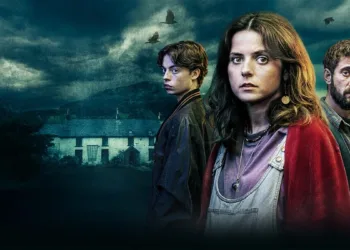




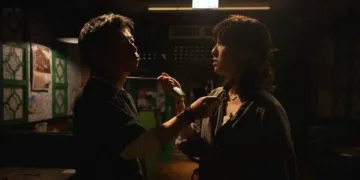

























Classical noir often makes guilt difficult to locate. Light conceals one face, exposes another, and leaves the audience to decide who deserves the darkness. The opening confrontation in Less of a Stranger offers a simpler arrangement: musicians onstage, authorities determined to silence them, and a forbidden song that turns a concert into a police matter. The moral geography seems settled before the music stops. Yet the man resisting the state proves quite capable of making life miserable for people who have never tried to censor him.
Jan Borysewicz, the guitarist behind Lady Pank, is a promising subject for a film about freedom and responsibility in Communist-era Poland. Kristoffer Rus’s biographical drama offers a fascinating historical setting, energetic music, and affecting family material. Unfortunately, it retreats too often into the standard rock-star biography. As a study of moral contradictions, it is too cautious to recommend beyond viewers with a particular interest in Borysewicz or the band.
After the 1983 concert confrontation, the narrative returns to Jan’s childhood, where an ill mother encourages him, an emotionally distant father offers considerably less, and his brother Andrzej gives him a guitar. That gift carries the most interesting irony in the early material. A relationship rooted in care provides the instrument through which Jan begins to define himself independently of everyone around him.
As his ambition grows, the bond with Andrzej suffers, and his brother’s death leaves the musician with grief he cannot simply play his way out of. The father-son conflict follows a familiar pattern, but the guitar gives the family story a tangible object: Jan’s freedom begins with someone whose loss he cannot undo.
An early traumatic encounter with a priest explains Jan’s hostility to religious authority. Later conversations about God turn that history into a recurring question of suffering, but those speeches rarely probe the connection. The film announces spiritual conflict much more readily than it dramatizes it.
Political authority, at least, has a physical presence. The opening concert stages a direct confrontation between performers and officials who can stop the performance itself. This visual arrangement assigns power unmistakably: the musicians may be provocative, but the state decides who gets heard. Elsewhere, martial law, curfews, and military presence establish the pressures of ordinary life, and Jan and his collaborator Mogiel channel anger at those conditions into songs. Rebellion has a purpose beyond a guitarist’s appetite for trouble.
Yet the political environment occasionally slips into decoration. Officials’ efforts to ruin Jan’s reputation intensify his difficulties, but his drinking, drug use, and hostility toward friends cannot all be laid at the government’s door. Political persecution is an effective way to establish an artist as a hero. It explains far less about his treatment of those close to him. A censor cannot be blamed for every broken relationship, though Jan might appreciate the administrative convenience.
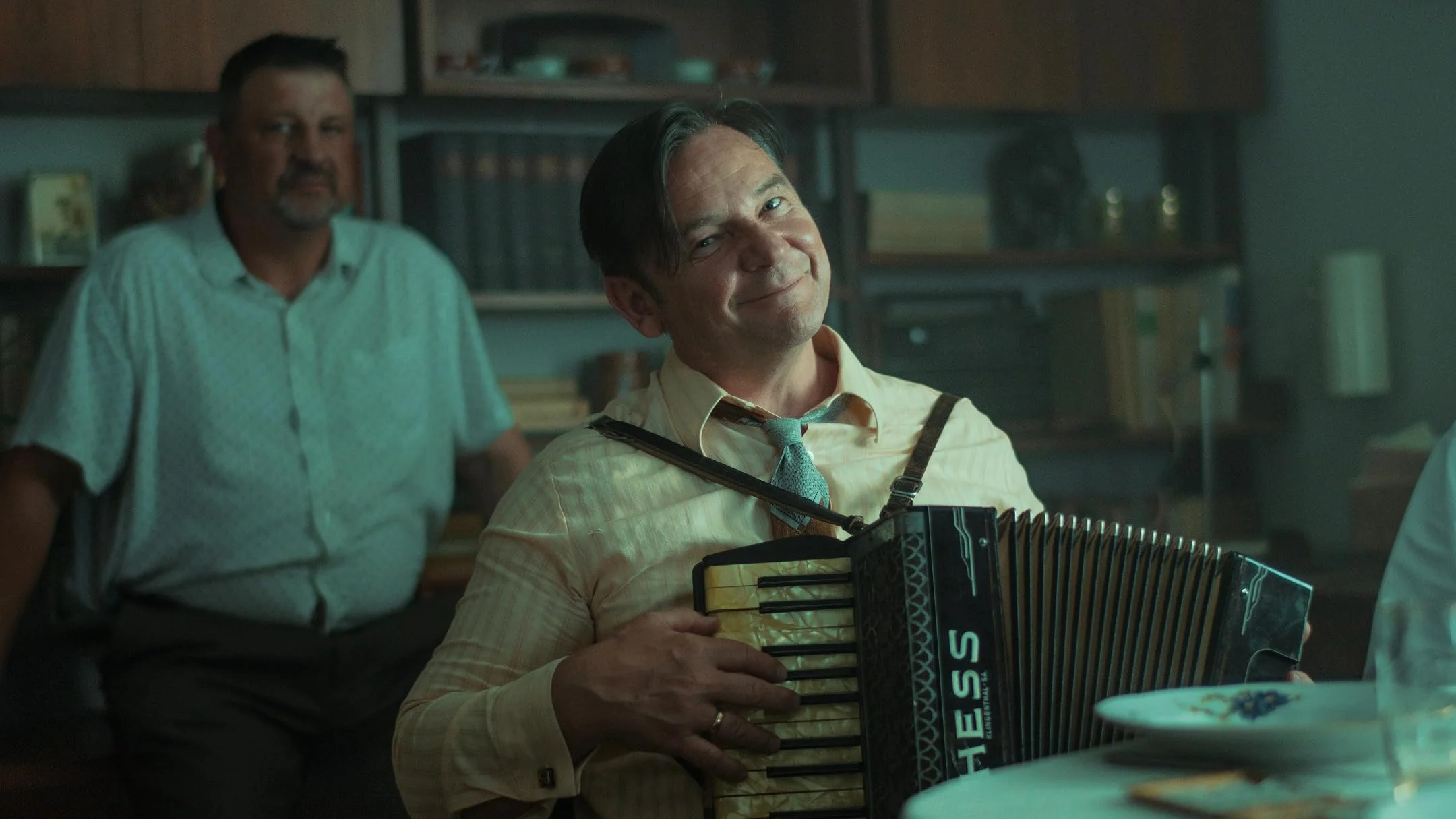
Rus’s persistent blue and yellow color grading presents another moral shortcut. Color can serve as expressive lighting, filtering a setting through a character’s distress rather than simply recording it. Here the repeated tints make Communist Poland appear pre-judged, as though the image must keep reminding us that the period was oppressive. The palette flattens a society whose cultural energy the music is supposed to reveal. Costumes, interiors, and hairstyles already identify the period convincingly; a few unpersuasive wigs are a minor distraction beside this inability to let the image change emotional temperature.
The music supplies some of that missing variation. Lady Pank’s performances carry an energy that the historical reconstruction alone cannot produce, and Jan’s growth as a guitarist makes his ambition intelligible. There is pleasure in seeing ability turn into confidence, then apprehension as confidence becomes entitlement. The central portrayal makes his magnetism credible alongside his capacity to exhaust those who support him. His artistic obsession becomes interesting when professional success places his worst instincts in public view.
Mogiel believes in Jan’s musical future, works with him, and eventually tires of the behavior accompanying it. Their conflicts supply a practical measure of Jan’s freedom: making music with others demands patience and trust, neither of which sits comfortably with his determination to answer only to himself. Yet Lady Pank remains strangely peripheral as a collective. Janusz Panasewicz and the other musicians receive little room in a story that needs their contributions to explain how Jan’s private ambitions became a public phenomenon.
The soundtrack reinforces that imbalance. Lady Pank’s recordings supply a specific cultural identity; recurring American rock selections establish Jan’s tastes and influences. The familiar songs offer international viewers an easy point of entry, but sometimes distract from the band whose music the film ought to make indispensable. A trip to America briefly opens another line of inquiry, suggesting the commercial pressures awaiting a musician who has already fought political control. The film scarcely pursues it.
Time is a greater problem. The childhood flashback propels Jan through grief, artistic discovery, success, estrangement, and escalating excess with the efficiency of a case file. His disastrous Children’s Day performance follows behavior already established, yet the film hurries through so many intermediate consequences that this public collapse feels like another required milestone. The audience knows what happened. It has fewer opportunities to observe how one mistake changes the next decision.
The voice-over compounds the compression. Presented as someone speaking rather than an omniscient narrator dispensing history, it has a plausible personal function. Too often it explains emotions already evident in the action. Ambiguity requires room to judge an expression, a choice, or a silence. The narration arrives like a museum guide worried that visitors might miss the exhibit.
Leaving Lady Pank’s later international recognition largely outside the film is defensible. A triumphant montage would do little to settle the injuries inside Jan’s family, and the final family encounter contains a far less comfortable mixture of affection, regret, and unresolved hurt. It is one of the film’s strongest decisions, particularly after so many scenes eager to assign causes and motives. But it also reveals what the preceding rush has cost. The people who knew Jan before the applause finally have room to matter, just as the film runs out of time to remain with them.
Less of a Stranger (Mniej obcy) premiered on Netflix on October 7, 2026, and is available to stream on the platform. Directed by Kristoffer Rus, the Polish biographical drama follows guitarist and composer Jan Borysewicz, founder of the rock band Lady Pank, as he shapes a generation with his music while navigating personal rebellion, band tensions, and family tragedies.
Where to Watch Less of a Stranger (2026) Online


Full Credits
Title: Less of a Stranger (Mniej obcy)
Distributor: Netflix
Release date: October 7, 2026
Running time: 2 hours (120 minutes)
Director: Kristoffer Rus
Writers: Wiktor Piątkowski, Joanna Kozłowska
Producers and Executive Producers: Kristoffer Rus, Mikołaj Wit, Dariusz Goczał, Ákos Erdős, Agnieszka Knysak-Sandecka
Cast: Mikołaj Bukrewicz, Patryk Pietrzak, Hubert Miłkowski, Krzysztof Oleksyn, Mikołaj Matczak, Marcel Barra, Konrad Kąkol, Kinga Preis, Ireneusz Czop
Director of Photography (Cinematographer): Marian Prokop
Editors: Marcin Konarzewski
Composer: Jan Borysewicz, Karim Martusewicz
The Review
Less of a Stranger
Onstage, Jan Borysewicz faces censors who make the moral lines easy to see. Offstage, those lines become harder to draw, and Less of a Stranger rarely has the patience to follow them. Lady Pank's music crackles, the family material carries genuine hurt, and the opening confrontation gives repression a physical force. Yet relentless color grading, explanatory narration, and hurried biographical milestones flatten the ambiguity. The film knows how to spotlight an injustice. It is less sure what to illuminate after the police leave.
PROS
- Energetic Lady Pank musical performances
- Affecting family relationships and unresolved grief
- Effective opening confrontation with political authority
- Convincing portrayal of Jan's talent and destructive personality
CONS
- Predictable musical biopic structure
- Excessive blue and yellow color grading
- Rushed emotional developments and character arcs
- Explanatory voice-over and underdeveloped band members