











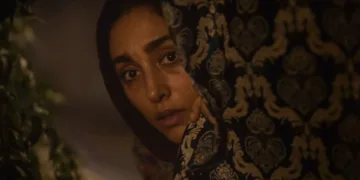












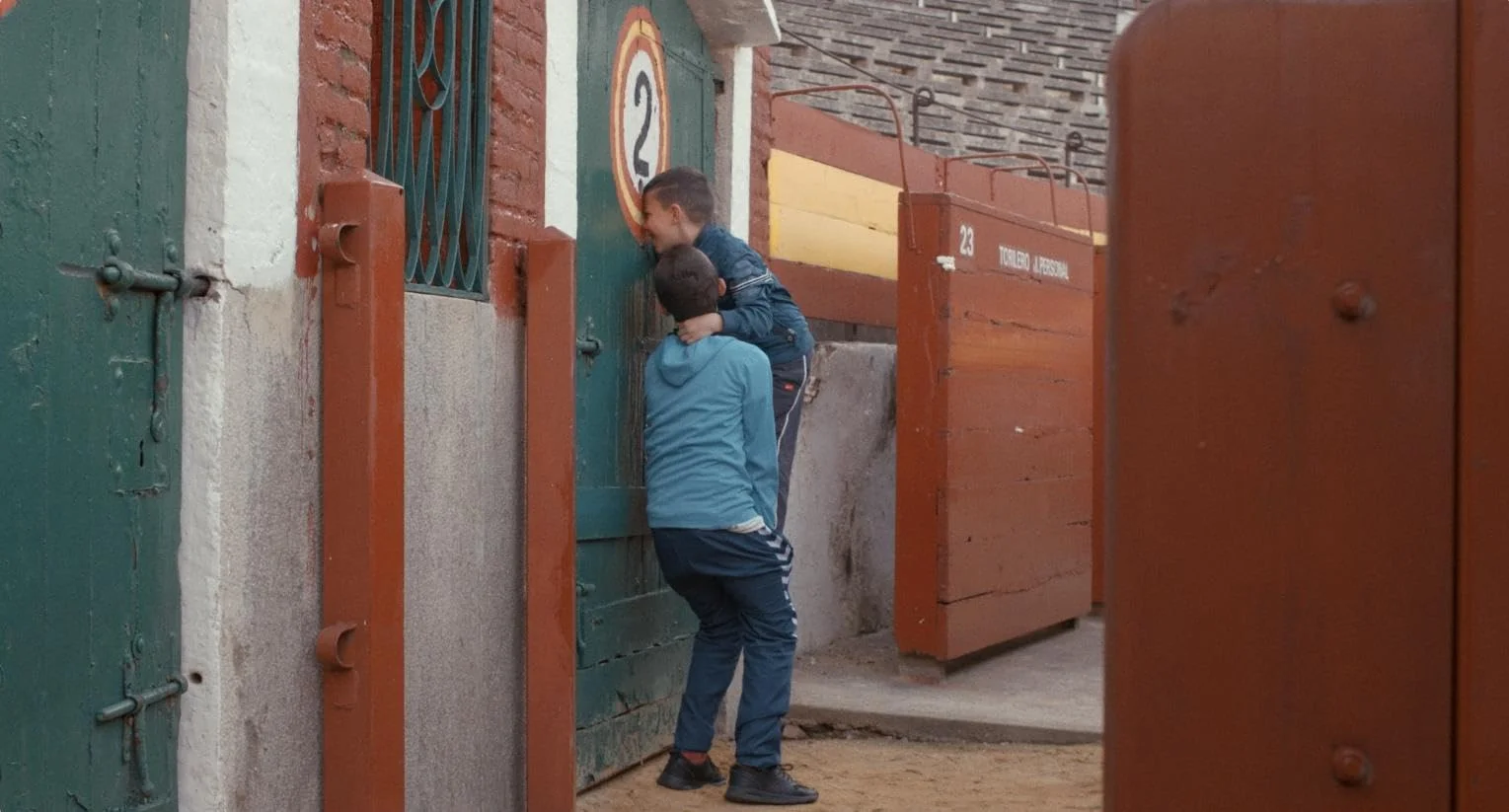

Inma de Reyes has made a tender, disquieting documentary about a boy being loved toward a life he may not want. The Boy and the Suit of Lights finds its sadness in ordinary gestures: a grandfather correcting a stance, a mother watching from the stands, a child rehearsing an adult ceremony with his toys. Five years pass under the director’s patient gaze, and those gestures slowly change meaning. It is an affecting film, one I would recommend, though its devotion to observation eventually leaves the most painful part of its subject’s experience beyond our reach.
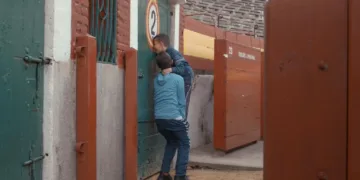
In Castellón, where bullfighting carries the authority of a local inheritance, young Borja Miranda grows up surrounded by instructions about the man he might become. His grandfather, Matias, teaches him to handle the muleta and studies his movements with the attentiveness of someone inspecting a possibility he once lost. Matias never became the bullfighter he hoped to be.
Now the dream has another body to inhabit, younger and still capable of being shaped. The tenderness between them is real, and de Reyes has the good sense to let it remain real. Yet there is something troubling in the ease with which an unfinished life can become a child’s assignment. Borja has barely reached the age of choosing when his future already has a costume.
That costume is beautiful, and expensive. Borja’s mother, Raquel, negotiates payments for the ornate suit of lights, committing money the family can scarcely spare to a profession that might one day rescue them from financial insecurity. The promise of prosperity gives every stitch a certain gravity. We can admire a mother’s determination and still feel the terrible arithmetic beneath it: the present must be made harder so that a distant future might become easier.
De Reyes never needs to make Raquel cruel or demanding for that pressure to be felt. Her sacrifices are visible in the practical business of arranging payment, in the act of watching her son perform, in the hope she must keep alive because so much has been committed to it.
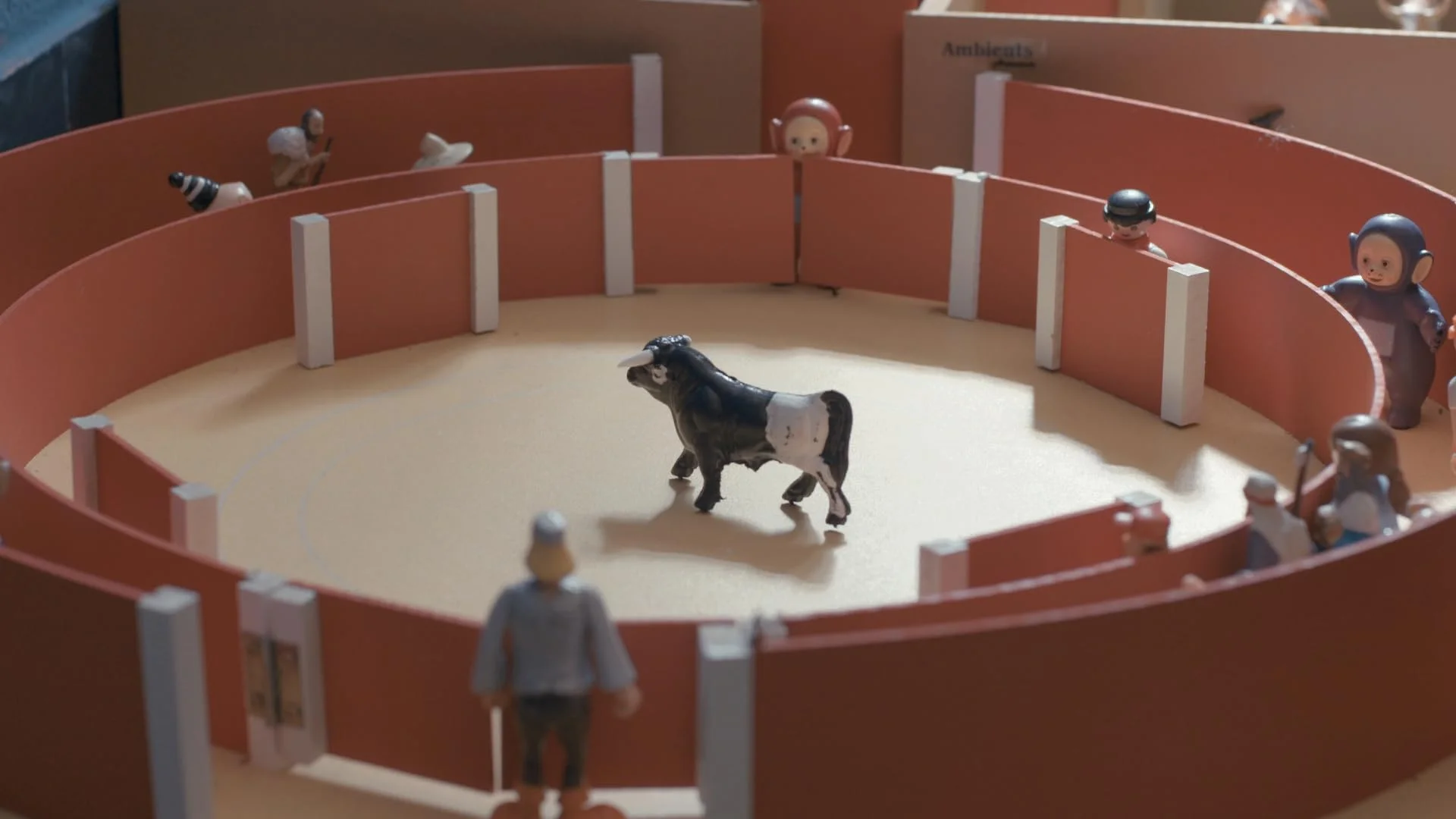
Inside the children’s games, the future looks almost harmless. Borja and his younger brother Erik assemble small bullrings from assorted toys, turning familiar play figures into spectators and participants; they practise with a bull’s head on wheels. Their small hands arrange a world in which every object already has a place, and every game points toward the arena.
The film keeps returning to people looking at one another. Matias watches Borja practise; Raquel watches from the stands; Borja studies the older matadors whose authority he hopes to acquire. Each gaze carries a different wish, and none gives us complete access to the person being watched.
De Reyes’s observational method is especially eloquent here, since the family’s closeness does not guarantee that anyone can fully recognize what the boy is becoming. They know his posture, his technique, his place in the family story. His private life is harder to see. It is possible to sit beside someone for years and still mistake the role they are playing for the person inside it.
Erik brings an unguarded energy that Borja seldom displays. He joins the rehearsals, asks questions, and takes part in quieter family routines, including washing his grandmother’s hair. That last domestic gesture belongs to a different kind of inheritance, one made of care rather than public achievement. Its modesty matters. At times Borja’s silence feels like a right he has preserved. At others it feels like a door the film never finds a way to open. Erik’s questions give the family another voice when Borja says so little about himself.
Over five years, childhood slips away in ways no one can negotiate or rehearse. Borja grows taller, loses the softness of his younger face, and acquires a deeper voice. De Reyes allows these changes to register through the simple continuity of watching him learn, practise, and live among his family. The early toy bullrings grow stranger in retrospect.
The child who once arranged miniature figures is becoming old enough to stand in the arena imagined by those games, but age offers no assurance that the person will still want what the child was taught to want. The alteration of a wish leaves scarcely any trace unless someone speaks of it. The camera can record the boy’s deepening voice; it has much less to show us of his changing convictions.
Borja lacks the financial advantages available to better-supported aspirants, and the community’s reverence for bullfighting cannot overcome that inequality. For people with limited resources, a dream can become a calculation about survival, even when the odds remain stubbornly unfavorable. Among Borja’s friends, ordinary employment exists as a possibility beside the allure of earning money in the ring.
There is another unease at the edge of the frame. Protesters denounce bullfighting, and young people discuss political parties according to their positions on the practice. De Reyes shows the controversy surrounding the tradition but avoids depicting explicit violence against bulls.
The choice keeps our attention on Borja as a child rather than turning him into a symbol to be condemned. I value that refusal to punish him for the world into which he was born. Still, the creatures whose deaths make the ceremony possible remain largely absent from the film’s emotional reckoning. The demonstrators appear, object, and recede.
Perhaps the same loyalty explains the film’s most significant weakness. As Borja grows older, his ambition changes, and his eventual movement away from bullfighting arrives with too little understanding of what has happened within him. I cannot say how much of that change belongs to a young person discovering his own desires, how much to the barriers around him, or how much to feelings he never wanted to share.
De Reyes cannot settle the matter for us, and I am not sure she ought to have forced a confession. Even so, the distance that once made her portrait feel gentle begins to frustrate. We have watched a life alter over years, yet we are left outside the moment in which its imagined future loosens its hold. Raquel has already committed money to the suit of lights, an object made to announce Borja’s arrival in the world, even as his reasons for wearing it become harder to understand.
The Boy and the Suit of Lights (El niño y el traje de luces) had its world premiere at Sheffield DocFest on June 14, 2024, winning the Grand Jury Award for Best First Feature, before arriving in UK cinemas on November 27, 2026. Filmed over five years and directed by Inma de Reyes, the documentary follows young Borja in Castellón, Spain, as he navigates family expectations, poverty, and shifting attitudes toward bullfighting.
Full Credits
Title: The Boy and the Suit of Lights (El niño y el traje de luces)
Distributor: Aconite Productions, Syndicado (World Sales)
Release date: June 14, 2024 (Sheffield DocFest world premiere), November 27, 2026 (UK theatrical release)
Rating: 12A (UK)
Running time: 1 hour 21 minutes (81 minutes)
Director: Inma de Reyes
Writers: Inma de Reyes
Producers and Executive Producers: Aimara Reques, Beth Earl, Mark Thomas
Cast: Borja Miranda, Erik Miranda, Raquel Miranda, Matías Miranda
Director of Photography (Cinematographer): Theodor Solin, Nelisa Alcalde, Alana Mejía González
Editors: Colin Monie
Composer: Jonathan Fyfe, Nascuy Linares
The Review
The Boy and the Suit of Lights
The Boy and the Suit of Lights is a tender, quietly sorrowful portrait of childhood shaped by inherited dreams and the fear of poverty. Inma de Reyes finds extraordinary emotional weight in ordinary family gestures, allowing five years of observation to reveal how love can become an invisible burden. Borja's inner world remains frustratingly distant, and the moral cost of bullfighting receives too little attention. Yet the film's compassion and patience leave a lasting impression of a young life slowly escaping the future others imagined for it.
PROS
- Tender, deeply observant family portrait
- Five years of filming give time emotional weight
- Powerful imagery of childhood and inherited ambition
- Compassionate treatment of complicated family expectations
CONS
- Borja's changing ambitions remain insufficiently explored
- Bullfighting's ethical questions receive limited attention