




























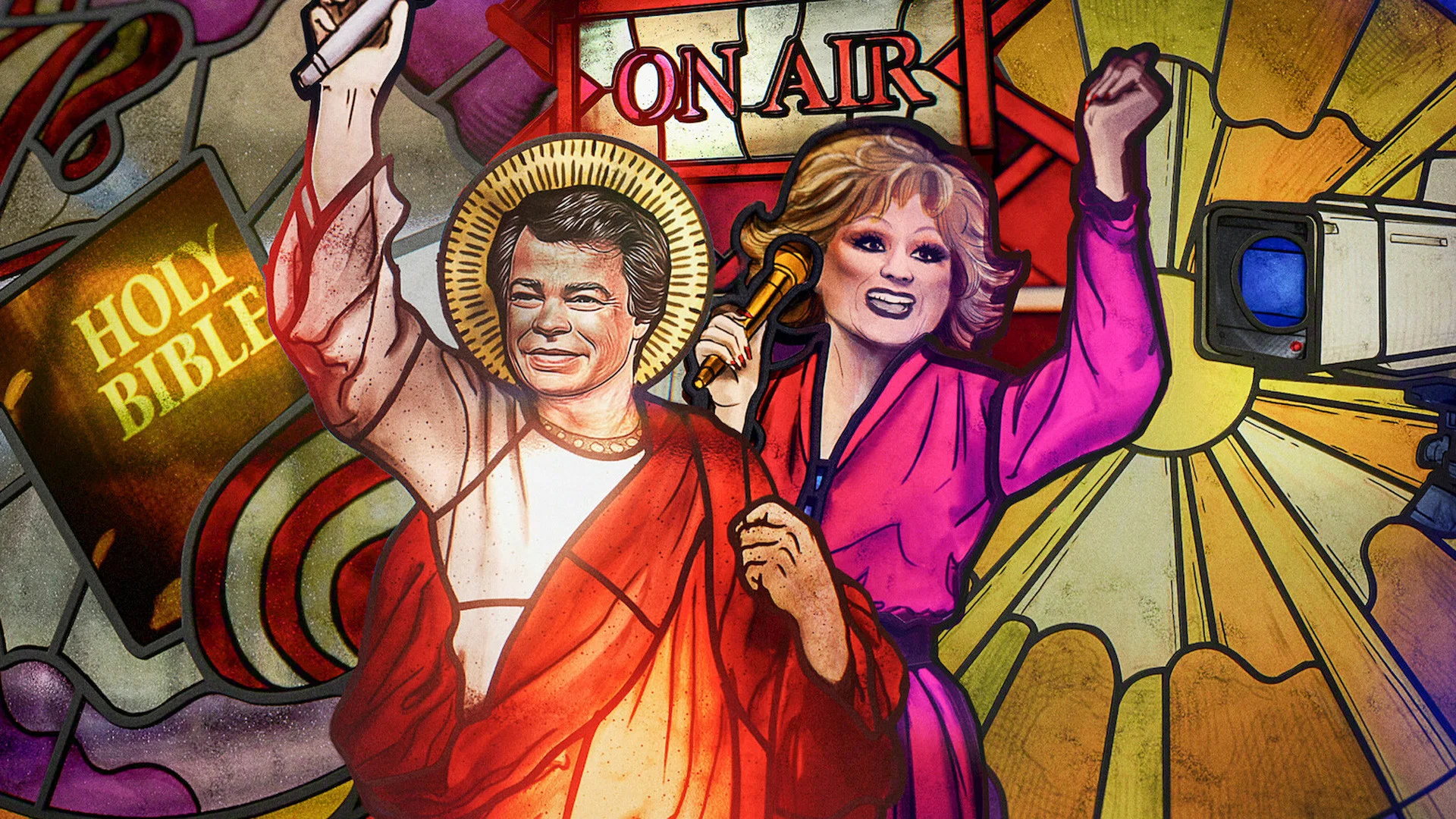

A television pulpit promises to make faith visible, yet the images preserved in Primetime Preacher$ reveal something rather less spiritual: a business asking to be mistaken for a calling. The preacher stands before the camera, addressing viewers in their homes and inviting donations, and the composition lends the transaction the ceremonial authority of a sermon. The congregation cannot question a neighbor or see where the money goes. It can only look at the man on the screen.
Joe Berlinger’s documentary traces the rise and collapse of Jim Bakker’s Praise the Lord empire, the cable-era ministry that turned Jim and Tammy Faye Bakker into religious celebrities. The archival television material is its most persuasive witness. Elaborate clothing, extravagant hairstyles, and conspicuous prosperity surround a ministry financed by ordinary believers.
Wealth becomes part of the televised performance, acquiring an uglier significance once former employees and investigators explain how donations supported the Bakkers’ luxurious lifestyle. The stage presentation matters because it transforms financial success into an apparent qualification for spiritual leadership. The audience is encouraged to admire the very extravagance it has been paying for.
Berlinger makes that deception easy to understand, and Primetime Preacher$ is worth watching, especially for anyone unfamiliar with the scandal. It is also a disappointingly cautious investigation. The facts of Bakker’s fraud are sufficiently damning, but the repeated accumulation of revelations gradually replaces the deeper inquiry this material deserves.
The legal record supplies a formidable backbone. Bakker was convicted on 24 felony counts of fraud and conspiracy in 1989, following revelations about the ministry’s finances and a sexual scandal that had already damaged his standing. Berlinger brings in former PTL employees, attorneys, investigators, and reporters from The Charlotte Observer, whose work exposed the enterprise.
Their testimony stays close to the practical mechanisms of corruption: money solicited from believers, promises attached to those donations, and private luxuries financed through the ministry. These witnesses are particularly effective because they can distinguish the sincerity of religious belief from its exploitation. The documentary’s strongest investigative passages recognize that the people sending money were participants in a relationship of trust, one carefully cultivated through television.
An archival confrontation with Ted Koppel provides a particularly effective reversal of the televised pulpit’s usual arrangement. Bakker, accustomed to a medium that gave him extraordinary control over his public image, faces a broadcaster prepared to challenge him directly. The moral significance lies in the change of purpose. The same screen that once amplified an appeal for trust becomes an instrument of accountability. For a moment, the investigation has the pressure of a good procedural, with public testimony threatening to dismantle a carefully maintained identity.

Then the procession of scandals resumes. Jimmy Swaggart’s rivalry with Bakker and subsequent sexual disgrace, Jerry Falwell’s intervention in the PTL crisis, and the tawdry particulars of Bakker’s conduct are all relevant. Yet each new embarrassment tends to confirm what the previous one established. At nearly two hours, the documentary begins to confuse quantity of exposure with depth of insight. The audience is repeatedly invited to witness prominent men discrediting themselves. There are limits to the detective work required.
The film becomes richer when it permits a human being to remain difficult to classify. Tammy Faye’s televised interview with a gay pastor diagnosed with AIDS is one of its most revealing archival passages. Consider the visual politics of that encounter. A woman whose flamboyant stage persona belonged to a conservative religious entertainment empire uses the same broadcast medium to offer compassion to someone vulnerable to condemnation within that world.
The choice of whom she places before her audience matters as much as her appearance. In this instance, the television platform that helped construct the PTL spectacle gives visibility to a person who might otherwise have been excluded from its religious community.
That encounter makes Tammy Faye difficult to dismiss as another grotesque ornament of the Bakker enterprise. It should also invite sharper scrutiny of her involvement in its financial arrangements. Berlinger allows her warmth to register but leaves the extent of her knowledge of the misconduct largely unsettled. Compassion toward one person cannot establish innocence in another matter. Apparently, the accounting department has better dramatic credentials than ambiguity.
The Bakkers’ son Jay introduces a different kind of evidence. He was thirteen when his father went to prison, and his testimony brings the cost of public fraud inside a family. Now a pastor himself, he describes his acceptance of LGBTQ people as a major source of friction with his father. That disagreement carries an implication the earlier scandal material struggles to articulate: a religious institution can collapse, its founder can be convicted, and its inherited beliefs can remain contentious long afterward. Jay has lived with those consequences in a form no court record can adequately measure.
Elsewhere, Berlinger has something considerably larger in view, if only intermittently. Archival footage of Bakker interviewing Ronald Reagan places the televangelist’s authority alongside presidential power. That televised association is another politically charged act of image-making. The preacher no longer occupies the visual position of a religious figure addressing followers; he shares a public platform with the nation’s political leadership.
The association offers a kind of institutional legitimacy that no sermon could secure by itself. Jerry Falwell, whose Moral Majority connected conservative Christianity to organized political action, belongs to this dimension of the story. His intervention in the PTL collapse reveals a movement engaged in contests for influence as well as arguments about sin. Swaggart’s rivalry suggests an entire industry of broadcasters competing to speak with religious certainty.
These glimpses expose the documentary’s narrower ambition. The plural title promises a picture of an entire media ecology, yet Berlinger’s attention repeatedly contracts around Bakker’s downfall. That decision produces an intelligible true-crime narrative, with the familiar satisfactions of misconduct uncovered and a guilty man exposed. It also directs attention away from the broadcasting structures and political relationships that survived his disgrace.
There is a particularly uncomfortable historical continuity here. Bakker’s later promotion of questionable COVID-related products and apocalyptic survival supplies demonstrates how easily religious broadcasting could accommodate new anxieties and new merchandise. The sales proposition changed; the appeal to fearful believers remained recognizable. Berlinger has enough material to pursue that continuity, yet gives the personal scandals far greater attention. The film’s treatment of the wider system feels curiously timid beside its willingness to examine intimate misconduct.
The investigative thriller traditionally derives tension from the gradual recovery of concealed information. Berlinger adopts that movement, but the information in this case has already entered the historical record, and the audience’s understanding rarely develops as quickly as the catalogue of offenses. Classical noir offers a useful comparison because exposing an individual criminal seldom restores order to the compromised society around him. That darker possibility is present whenever the documentary turns toward Falwell’s political influence or the religious authority inherited by Bakker’s family. It receives less sustained attention than the details of who betrayed whom during the PTL collapse.
The journalists established what Bakker had done, and the courts imposed a penalty. Those events give Berlinger a clear ending to his criminal investigation. Jay Bakker’s testimony suggests a different temporal scale. Decades after the fraud conviction, he is still describing the conflict created by his acceptance of LGBTQ people, a disagreement that followed the Bakker name from the television ministry into another generation.
Primetime Preacher$ premiered on Netflix on November 20, 2026, following its world premiere at DOC NYC, and is available to stream exclusively on the platform. Directed by Joe Berlinger, the documentary chronicles how three of the 1980s’ most influential televangelists—Jim Bakker, Jerry Falwell, and Jimmy Swaggart—built sprawling media empires before greed, rivalry, and explosive sex scandals triggered their public downfall.
Where to Watch Primetime Preacher$ (2026) Online


Full Credits
Title: Primetime Preacher$
Distributor: Netflix
Release date: November 20, 2026
Rating: TV-14
Running time: 1 hour 53 minutes (113 minutes)
Director: Joe Berlinger
Producers and Executive Producers: Joe Berlinger, Rachael Profiloski, Jason Bateman, Michael Costigan, Emma Ho, Alana Goldstein, Nasar Abich, Tom Cappello, Jon Kamen
Cast: Jim Bakker, Tammy Faye Bakker, Jerry Falwell, Jimmy Swaggart, Richard Dortch
Director of Photography (Cinematographer): Jeff Hutchens
Editors: Cy Christiansen
The Review
Primetime Preacher$
Joe Berlinger's Primetime Preacher$ exposes the corruption behind Jim Bakker's televised ministry through revealing archival footage and credible firsthand testimony. Tammy Faye's compassion and Jay Bakker's reflections give the film welcome moral complexity. Yet its fixation on familiar scandals leaves the machinery of religious and political influence insufficiently examined. The evidence is damning, the investigation competent, and the deeper questions inconveniently unattended. Worth watching for its historical revelations, though its true-crime construction rarely escapes the familiar spectacle of a fallen preacher.
PROS
- Revealing archival television footage
- Credible journalists and firsthand witnesses
- Tammy Faye's morally complex portrayal
- Jay Bakker's affecting personal testimony
- Effective examination of televised authority
CONS
- Repetitive accumulation of scandals
- Limited scrutiny of religious and political power
- Tammy Faye's financial complicity left unresolved
- Underdeveloped connections to later exploitation
- Predictable true-crime structure