





















True-crime documentaries usually promise that the dead can be approached through evidence. A photograph survives, a witness remembers, a recording restores some fragment of a voice, and the terrible distance between past and present seems to diminish.
Riccardo Giacconi’s Memories of Lightning offers a far less comforting experience. The closer its investigation comes to a forgotten murder, the less certain its evidence becomes. Images disappear, testimonies lose their voices, and ordinary sounds acquire an oppressive presence. Watching it feels like entering a place where something terrible has happened and discovering that the silence left behind has become part of the landscape.
The film concerns the murder of Gianna, a fourteen-year-old girl abducted and burned alive by four young men in an Italian village in 1982. Her niece Sibilla, played by Sibilla Scinti Roger, returns decades later to investigate the killing for a radio documentary. She was born ten years after Gianna died, so the loss she attempts to understand belongs to a time she never experienced. She knows Gianna through people reluctant to remember her. Sibilla has inherited the consequences of a death, yet the memories through which she might understand that inheritance remain inaccessible to her.
Giacconi turns this predicament into an unsettling and often beautiful cinematic experiment. Its affecting treatment of sound gives the investigation a gravity conventional reconstruction might have diminished. The film deserves the attention of viewers receptive to patient, experimental cinema, even if its fascination with its own construction occasionally makes the murdered girl feel disturbingly distant.
One of its earliest encounters with the crime establishes an uncomfortable relationship between testimony and performance. Sibilla asks an actor to read a confession attributed to one of Gianna’s killers. As he voices the account, he becomes visibly distressed. The words describe an act whose cruelty resists explanation, but the man speaking them has no direct connection to their original utterance. His emotion is genuine within an obviously artificial situation. The actor can reproduce the confession. He cannot recover the experience behind it, a distance his visible distress makes difficult to ignore.
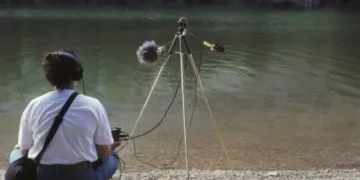
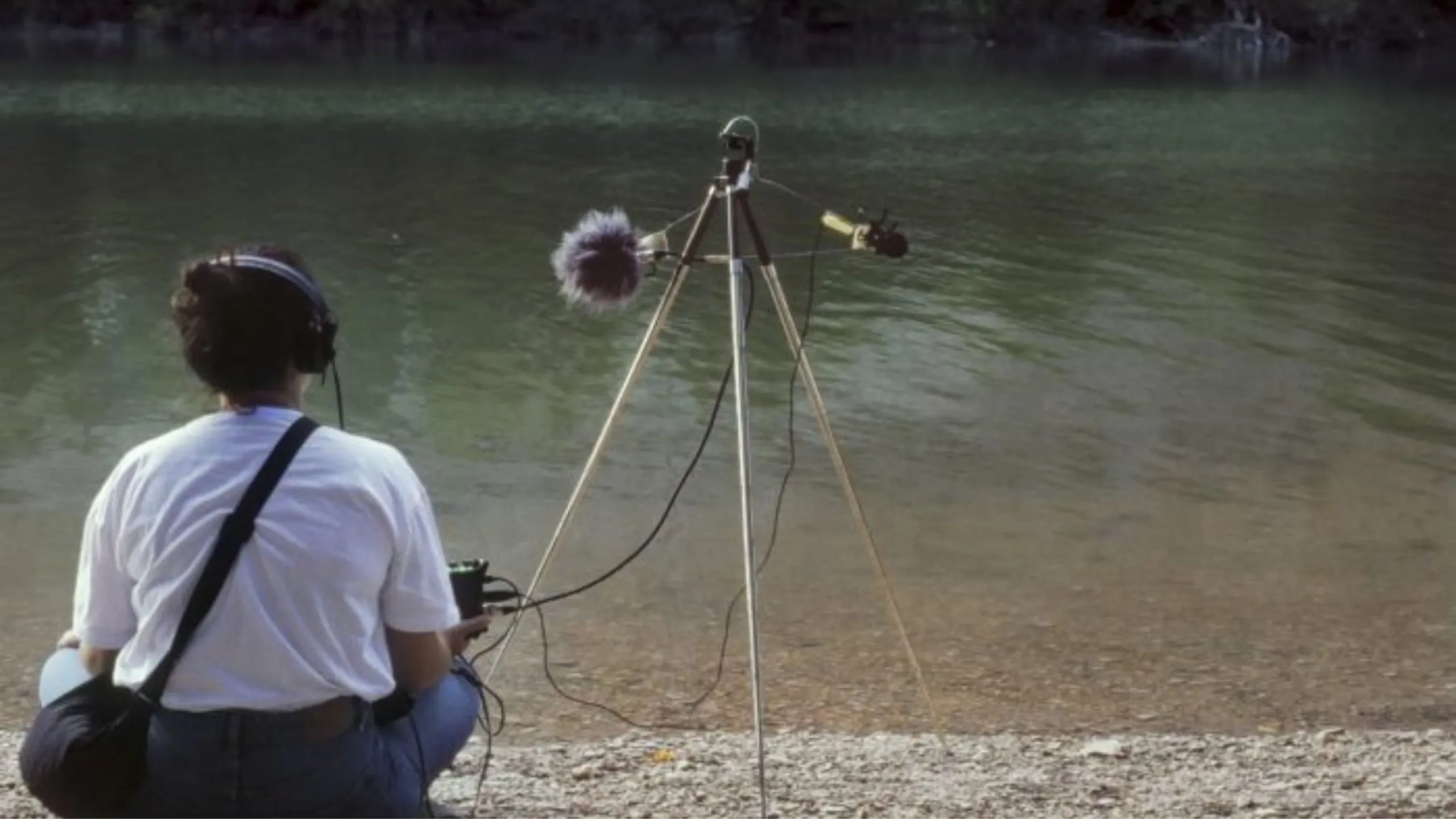
As Sibilla continues interviewing inhabitants of the village in Le Marche, speech itself seems to withdraw. Older residents resist discussing the murder. Younger people profess ignorance. Their answers carry the weariness of a subject best left undisturbed. Following one painful conversation, Sibilla and her interviewee sit in silence to record the ambient sound of the room. Nothing apparently significant happens, yet the stillness becomes extraordinarily uncomfortable. Two people occupy the same space, surrounded by everything they have said and everything they have avoided saying.
The recording equipment remains attentive after language has failed them. Elsewhere, cicadas scrape against the quiet, a dog barks, keys click, and a pen moves across paper. Breathing becomes audible. These sounds possess the stubborn regularity of a world that has continued existing long after Gianna’s death. They are indifferent to the horror Sibilla seeks to recover. People retreat into silence, but the environment continues its meaningless disturbances. Giacconi makes that indifference almost unbearable. The village seems full of life, yet Sibilla’s attempts to reach its inhabitants repeatedly encounter emotional vacancy.
The most disturbing variation arrives when an interview has apparently been conducted without Sibilla activating her recorder. We can see the person she is questioning, but the expected voice is absent. Eventually, Sibilla supplies the missing words herself, speaking over the image of another human being. Reconstruction preserves the information but loses something essential. The particular sound of a person’s voice, with its hesitations and involuntary betrayals, belongs to a body that cannot be replaced. Sibilla’s substitution preserves the account at the expense of the speaker’s audible individuality.
I cannot decide if this act constitutes a form of rescue or a quieter kind of erasure. The film leaves that uncertainty intact.
The community’s response to Gianna’s murder gives these acoustic experiments their human significance. Sibilla encounters a place whose inhabitants have apparently learned to protect their ordinary lives through collective avoidance. Her own family left after the killing, and a telephone conversation suggests that her mother would prefer the investigation not to proceed. One interviewee becomes vaguely threatening when pressed about the past. Their discomfort accumulates into something resembling a communal agreement. Silence helps them live together, separating them from the memory of a murdered child.
A friend of Sibilla’s mother offers a rare departure from this pattern. Speaking in a theatre, she recalls the tragedy with a willingness that several other interviewees cannot summon. In a place associated with performed emotion, she speaks with unusual directness. The village itself bears traces of other disappearances: an earthquake, the flooding of a settlement to create an artificial lake, a theatre destroyed by fire. Houses vanish beneath water; familiar places become inaccessible. These losses give fractured memories a physical counterpart; the disasters need no causal link to Gianna’s murder.
Yet Memories of Lightning gradually becomes suspicious of its own apparent authenticity. Sibilla describes newspaper headlines found on microfiche, but we never see them. When she recalls a photograph of Gianna taken shortly before her death, the screen turns black, leaving her voice to describe an image the audience cannot examine. She visits a supposedly blue house with a former ground-floor grocery store, although the building before us does not visibly correspond to her description.
The documentary appearance becomes impossible to accept at face value. Scinti Roger is herself an actress and co-screenwriter, and Giacconi’s film occupies the unstable territory between documentary observation and fictional construction. The missing photograph is especially troubling. There is no face to contemplate, no expression in which to search for a surviving personality. Only a voice speaking into darkness. We feel the force of an absence yet cannot establish the history supposedly behind it.
Still, Giacconi occasionally presses the experiment further than its emotional material can sustain. Once the audience recognizes the pattern of missing or contradictory evidence, some later disruptions become demonstrations of an established method. The film risks turning the suffering of an adolescent girl into an elaborate problem of representation. The black screen deepens the loss; repeated reminders of artificiality interrupt our connection to it.
That difficulty becomes especially apparent in the film’s uneasy relationship with true-crime storytelling. A radio producer rejects Sibilla’s proposed documentary because she cannot identify a sufficiently engaging narrative. Once Sibilla reveals her personal connection to Gianna, the producer says, “You should have led with that.” The exchange exposes a cruelty in the commercial treatment of suffering: the death apparently lacks appeal until it acquires a convenient emotional perspective. Sibilla’s own project employs ominous music and dramatic narration to attract listeners. The film recognizes those seductions and occasionally yields to them.
Scinti Roger’s performance gives this construction much of its credibility. She moves between documentary naturalism and theatrical control, maintaining a reserve that suits a woman approaching a family tragedy through other people’s memories. Her unease during interviews and her persistence in the face of reluctant witnesses suggest feelings she rarely permits herself to express directly. Her inner experience sometimes seems entirely concealed, as she searches for a relationship through incomplete recordings and recollections.
Near the end, a disturbing burst of visual intensity interrupts the restraint. Yet the quieter images trouble me: Sibilla’s mother resists the investigation; an interviewee’s words survive in someone else’s voice; Gianna’s photograph remains unseen. When Sibilla and her interviewee sit silently before the recording equipment, the machinery continues gathering the sounds around them, preserving a room in which two people have temporarily run out of words.
Memories of Lightning (Memoria del lampo) had its world premiere at the Venice Film Festival’s Giornate degli Autori section on September 5, 2026, before making its international premiere at the International Documentary Film Festival Amsterdam (IDFA) in November 2026, where it won the Best Film award in the Envision Competition (international sales are handled by La Bête ahead of wider distribution). Directed by Riccardo Giacconi, the experimental hybrid documentary follows radio journalist Sibilla Scinti Roger as she travels to an almost deserted village in central Italy to record an audio documentary about the 1982 murder of a 14-year-old girl tied to her family’s past.
Full Credits
Title: Memories of Lightning (Memoria del lampo)
Distributor: La Bête (International Sales)
Release date: September 5, 2026 (Venice Film Festival – Giornate degli Autori world premiere), November 2026 (IDFA international premiere)
Running time: 1 hour 13 minutes (73 minutes)
Director: Riccardo Giacconi
Writers: Riccardo Giacconi, Sibilla Scinti Roger
Producers and Executive Producers: Fabrizio Polpettini, Riccardo Giacconi
Cast: Sibilla Scinti Roger
Director of Photography (Cinematographer): Ahmad Al-Zu’bi, Giulia Marzin
Editors: Riccardo Giacconi, Gabriel Gonzalez
Composer: Sibilla Scinti Roger, John DeLore, Massimiliano Borghesi
The Review
Memories of Lightning
Memories of Lightning finds its deepest sorrow in the sounds that survive when human voices fall silent. Riccardo Giacconi transforms an investigation into a haunting meditation on memory, absence, and the uneasy responsibility of remembrance. Sibilla Scinti Roger's restrained performance gives this fragile construction its human weight. The film occasionally becomes too absorbed in its formal experiments, allowing intellectual distance to weaken its emotional force. Yet its most powerful moments linger like sounds heard through an empty house, reminders of lives that can neither be recovered nor entirely forgotten.
PROS
- Haunting, exceptionally expressive sound design
- Inventive interplay between sound and absent images
- Sibilla Scinti Roger's restrained performance
- Profound examination of collective silence and grief
CONS
- Repeated formal disruptions lose some impact
- Emotional distance occasionally overwhelms the tragedy
- Ominous audio cues undermine its critique of true-crime sensationalism