

























How much suspense can a film sustain when its opening has already exposed the institution responsible for everything that follows? That is the structural challenge facing Kiwi Chow’s Deadline, a school-set thriller that establishes its central conflict with impressive efficiency.
The first stretch lays out an educational system so comprehensively hostile to individual needs that the anonymous suicide threat arriving shortly afterward feels almost inevitable. Chow understands how to construct an oppressive environment and populate it with people whose lives are shaped by its rules. His difficulty comes later, when a story that has made its argument so effectively must find something new to say.
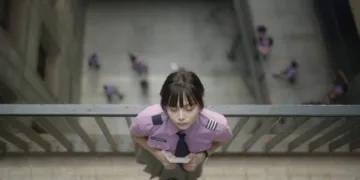
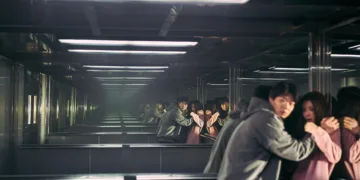
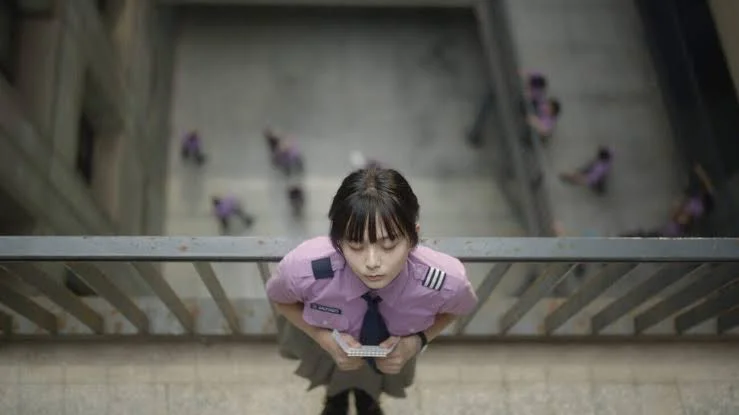
En Shan High School is a prestigious private institution where academic achievement determines practically every aspect of student life. Pupils march through sterile corridors in regimented lines, their purple uniforms standing out against the grey glass-and-steel surroundings. AI recognition panels monitor attendance, disciplinary records, and academic rankings, while classroom surveillance measures how closely students pay attention to their teachers.
The system evaluates educators alongside pupils, ensuring that everyone has somebody above them demanding better results. Chow and cinematographer Szeto Yat Lui establish this hierarchy through the building’s physical arrangements and technology. The visual storytelling is particularly economical. A student approaching a recognition panel tells us about the institution’s priorities before anyone needs to explain its philosophy.
Seven days before the final examinations, hundreds of leaflets appear during a school gathering. Their anonymous author threatens to die by suicide on examination day unless the administration changes its practices. The letter supplies an immediate deadline and a central mystery, transforming what could have been a static institutional drama into a thriller with a clear narrative engine. It is an excellent premise, and Deadline remains an absorbing, worthwhile film despite its later shortcomings. The problem is that Chow’s command of the opening raises expectations for a level of dramatic progression the screenplay cannot consistently maintain across its nearly two-hour running time.
The mystery initially works because identifying the letter’s author requires examining the people who inhabit this unforgiving environment. Principal Mr. Kung (Anthony Wong Chau-sang), teachers Miss Tien (Allison Lin) and Mr. Gao (Huang Di-yang), student leader Jay Mo (Michael Chang), and several troubled classmates become part of an investigation that exposes their competing priorities. Each potential suspect offers another perspective on the school’s demands. The approaching examinations provide urgency, but the richer dramatic question concerns how many students have been pushed close enough to desperation that such an act becomes plausible.
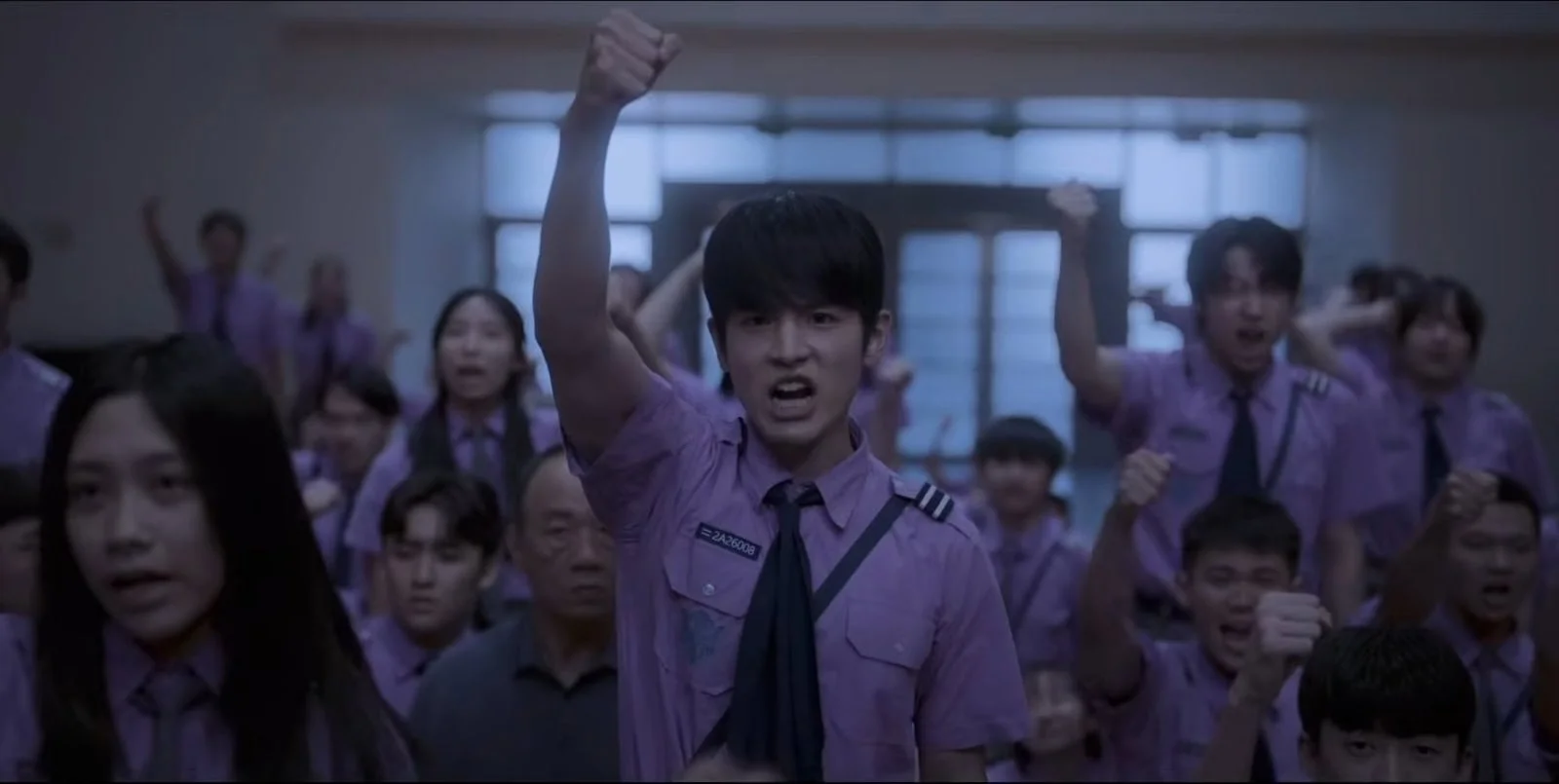
Chun (Jimmy Liu) provides the clearest challenge to the school’s definition of success. He has little interest in following the prescribed route through academic excellence and prestigious university admission, preferring the possibility of becoming a farmer. His affection for plants makes the school’s decision to deny him access to its garden particularly revealing.
Because Chun performs poorly academically, he loses the opportunity to pursue something he genuinely values. The punishment exposes a contradiction within an institution supposedly dedicated to developing young minds. Liu makes Chun’s resistance credible by presenting him as a young man with interests extending beyond opposing authority. The screenplay needs that individuality because a rebellious student can easily become a convenient spokesperson for everything the filmmaker wants to criticize.
Heng (Bai Run-yin) offers a considerably more painful demonstration of how institutional rules shape behavior. A student with ADHD, he receives additional examination time intended to accommodate his needs. His classmates respond with bullying, making that assistance a source of humiliation rather than reassurance. Heng eventually rejects the support because accepting it marks him as different.
The progression is persuasive because the screenplay connects the school’s competitive culture to a specific decision with damaging personal consequences. Bai’s performance conveys Heng’s vulnerability beneath his efforts to conform, giving a character who might otherwise exist primarily to demonstrate an injustice the emotional specificity the screenplay needs.
Ruoyan (Shao Yi-mei) presents the opposite response. Coming from a financially disadvantaged background, she regards exceptional grades as her best opportunity for a secure future. Her rivalry with fellow high achiever Peiching intensifies that desperation. She uses attention-enhancing drugs and resorts to cutting her legs with a craft knife as the pressure becomes unbearable.
Ruoyan cannot dismiss achievement as easily as Chun because the promised rewards carry greater material significance for her. Shao becomes increasingly persuasive as the character’s distress intensifies, although her earlier scenes are less assured. The screenplay gives her a recognizable motivation, but its extreme expressions sometimes threaten to reduce her suffering to another demonstration of the school’s brutality.
These three characters give Deadline its strongest dramatic foundation. Chun wants an alternative to the institution’s prescribed future, Heng wants to escape the social punishment attached to his differences, and Ruoyan believes she must succeed within the system to survive economically. Their conflicting interests prevent the student population from becoming a collection of interchangeable victims. They also allow the film to examine the cruelty students inflict upon one another, including bullying and manipulation of the school’s competitive arrangements.
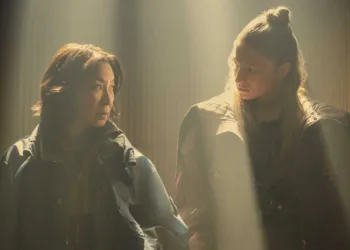
The adult characters extend that examination. Wong plays Mr. Kung as an authoritative figure whose responsibility for maintaining order has become inseparable from his resignation to the existing system. The screenplay gives Kung the familiar role of an administrator defending an institution whose failures are increasingly difficult to ignore; Wong’s restrained expressions of vulnerability suggest a man painfully aware of those failures.
Lin is similarly effective as Miss Tien. Her concern for student welfare must coexist with demands imposed upon the teaching staff, and her attempts to help sometimes cause harm. Mr. Gao’s differing response to those pressures prevents the educators from becoming a single undifferentiated obstacle.
The controversy surrounding performance-enhancing drugs offers some of the screenplay’s most productive complications. Students seek chemical assistance to improve examination results, creating concerns about safety and fairness.
Some parents oppose the practice, others support measures that might improve their children’s prospects, and teachers face uncomfortable choices when helping an anxious pupil could mean endorsing something harmful. This conflict grows naturally from the school’s ranking system, which rewards measurable results and encourages families to regard examination outcomes as determining future opportunities.
Chow’s formal control helps maintain this complexity during the film’s stronger passages. Szeto’s desaturated cinematography makes the school resemble a technologically sophisticated detention facility, with the purple uniforms offering the few concentrated areas of color.
The recognition panels and surveillance equipment contribute directly to the storytelling because they explain how the institution measures and restricts its occupants. Editor Allen Leung gives the early sequences considerable momentum, moving from the school’s regimented routines to the sudden disruption caused by the anonymous letter.
The political implications are clear, particularly considering Chow’s earlier documentary Revolution of Our Times and the refusal of Hong Kong authorities to approve Deadline for exhibition on national security grounds. Filmed in Taiwan, the drama examines surveillance, enforced conformity, and the consequences of challenging authority. Its most effective political observations emerge from concrete arrangements such as Heng’s examination accommodations or Chun’s exclusion from the garden. These examples show the system operating through ordinary decisions.
Unfortunately, repetition becomes increasingly apparent once the film moves beyond its first third. By that point, the opening has established the school’s methods, the anonymous threat has created a deadline, and the principal student storylines have demonstrated several consequences of institutional pressure.
The middle stretch continues introducing troubling circumstances, but some revelations reinforce ideas the audience already understands. The screenplay begins administering refresher courses in material its viewers passed considerably earlier. What initially feels like a carefully escalating investigation occasionally settles into another demonstration of an argument that required little further proof.
The problem becomes particularly noticeable as the narrative approaches its final stretch. The countdown promises that each successive development will alter the situation, narrow the mystery, or force characters into increasingly consequential decisions. Some developments achieve those goals. Others increase the severity of events without substantially changing the underlying conflict.
Deaths and increasingly extreme behavior introduce greater tragedy, yet the movement toward melodrama can make certain developments feel calculated to produce an immediate emotional response. The final act sometimes treats calamity as a substitute for further character development. The screenplay has started mistaking volume for movement, despite having already shown through Heng and Ruoyan that ordinary decisions within the school can carry devastating consequences.
The eventual identification of the anonymous letter writer supplies the answer the mystery has promised, but it adds little to the picture of the school assembled during the opening third. The institution’s failures remain unresolved, an outcome consistent with the film’s political concerns. Dramatically, the revelation has a smaller job to do than the countdown initially suggested: identify the author of a warning whose causes the film explained long before examination day.
Deadline (自殺通告) first opened in Taiwan on November 7, 2025, before making its international premiere at the 2026 International Film Festival Rotterdam, its North American premiere at the Seattle International Film Festival in May 2026, and arriving in United Kingdom cinemas on October 16, 2026, via DOVC UK. Written and directed by Kiwi Chow and starring Anthony Chau-Sang Wong, Allison Lin, and Jimmy Liu, the Mandarin-language suspense drama takes place at an elite high school where an anonymous warning threatening suicide on final exam day sparks panic among students and faculty, exposing the crushing toll of academic authoritarianism.
Full Credits
Title: Deadline (自殺通告)
Distributor: DOVC UK, Benchmark Films Co., Ltd. (International Sales)
Release date: November 7, 2025 (Taiwan theatrical release), January/February 2026 (International Film Festival Rotterdam international premiere), May 8, 2026 (Seattle International Film Festival North American premiere), October 16, 2026 (United Kingdom theatrical release)
Rating: 15A (Ireland IFCO)
Running time: 1 hour 58 minutes (118 minutes)
Director: Kiwi Chow
Writers: Felix Tsang, Frankie Chung, Kiwi Chow
Producers and Executive Producers: Peiyi Lin, Frankie Chung, Kiwi Chow
Cast: Anthony Chau-Sang Wong, Allison Lin, Jimmy Liu, Yi-mei Shao, Run-yin Bai, Michael Chang, Di-yang Huang, Ya-zhi Tai, Chie Tanaka, Wang Tzu-chiang
Director of Photography (Cinematographer): Szeto Yat Lui
Editors: Allen Leung
Composer: Lu-Ming Lu
The Review
Deadline
Deadline builds its strongest case before its mystery has properly begun. Kiwi Chow's precise visual storytelling establishes a disturbing educational hierarchy, while Jimmy Liu, Bai Run-yin, and Anthony Wong Chau-sang give the institutional criticism convincing human dimensions. The seven-day countdown provides an effective thriller framework, but the screenplay gradually substitutes repetition and melodramatic escalation for meaningful developments. Its final revelation cannot recover the momentum lost along the way. Even so, the opening's remarkable efficiency and the strength of its character work make this a worthwhile, frequently unsettling drama.
PROS
- Excellent visual establishment of the school's oppressive hierarchy
- Strong performances, particularly Bai Run-yin and Anthony Wong
- Distinct student perspectives deepen the institutional criticism
- Effective initial mystery and countdown structure
CONS
- Middle section repeatedly reinforces established arguments
- Melodramatic escalation weakens the later storytelling
- Final revelation offers limited dramatic payoff
- Uneven pacing across the nearly two-hour runtime