













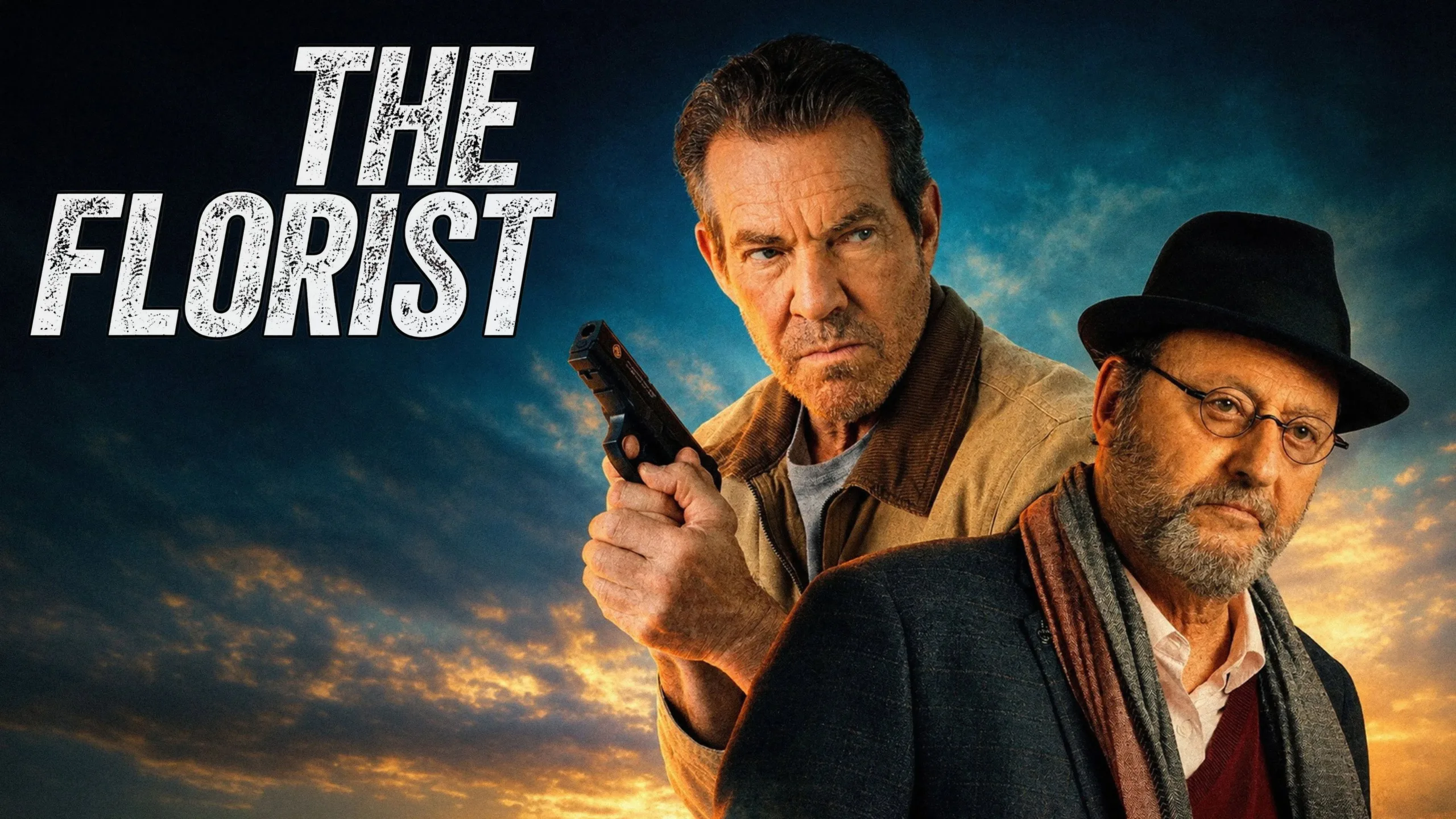

The sight of Carl Rikker furiously washing his hands after an assassination creates an uneasiness that the violence itself cannot quite match. He has already demonstrated how efficiently he can kill, yet back in his greenhouse, he seems desperate to remove something that soap cannot reach. It is a small moment, but it makes you curious about the man behind the gun. Does he regret what he does? Or has killing become such an ordinary part of his life that even his guilt has turned into a routine? The Florist briefly makes these questions feel worth asking.
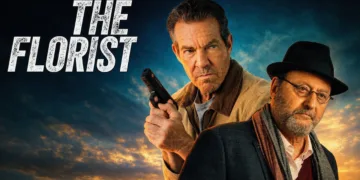
Dennis Quaid plays Carl, an aging horticulturalist who operates a New York flower shop with his longtime friend Charlie (Jean Reno). Their business provides the perfect cover for a second profession. Under the direction of a mysterious contact named Hicks (Anna Annissimova), Carl carries out contract killings, returning afterward to the relative peace of his plants. Charlie assists with their criminal activities, though he seems equally interested in coaxing his withdrawn partner into something resembling a social life. His invitations to play cards suggest a friendship that has survived years of Carl keeping everyone at a distance.
Unfortunately, director Babak Najafi never develops that early curiosity into a satisfying experience. The Florist is a disappointing action thriller whose occasional warmth cannot overcome its predictable story, weak antagonists, and surprisingly lifeless confrontations. Fans of modest, old-fashioned crime pictures might enjoy spending time with Quaid and Reno, but there is little here I would recommend to anyone seeking genuine suspense.
The film’s strongest opportunity arrives through Layla (Sky Katz), a teenager searching for her missing brother. She first encounters Carl while distributing missing-person posters, an interaction that establishes her vulnerability before she becomes entangled in his violent profession.
During an assignment at a motel associated with drug trafficking and prostitution, Carl eliminates several criminals, unknowingly killing a corrupt police officer. Layla is connected to the same operation through a drug delivery, making her a liability for Detective Woodrock (Leonidas Gulaptis), whose cartel connections could be exposed. When Woodrock moves to silence her, Carl offers protection, placing his carefully concealed existence at risk.
There is something genuinely touching about the possibility of these two lonely people finding stability together. Carl has never recovered from the loss of his sister, and Layla’s search for her brother gives their relationship an emotional connection the screenplay could have explored with sensitivity. Quaid’s subdued performance suggests a man who has forgotten how to become close to anyone, while Katz brings a youthful openness that makes Layla’s need for security understandable. Their moments around the greenhouse offer glimpses of the quieter film hiding beneath the gunfire.
I wanted that relationship to work. You can see the ingredients for a moving story when Carl begins allowing Layla into a private world previously reserved for his plants and Charlie. Yet the writing keeps turning their connection into an argument about trust. Carl alternates between protecting Layla, suspecting her of dishonesty, and questioning her ability to look after herself. These shifts could have revealed the difficulty of caring for someone after years of emotional isolation. Instead, they often seem designed to manufacture conflict until the next dangerous encounter arrives. His changing attitude tells us surprisingly little about how his feelings are developing.

Charlie offers another glimpse of what the film could have become. Reno has an easygoing presence beside Quaid’s guarded intensity, particularly through Charlie’s attempts to draw Carl into ordinary companionship. His card-playing invitations reveal a friendship with room for humor and affection, and Layla’s arrival could have transformed their arrangement into an unconventional family. But Charlie spends much of the film on the sidelines. By the time he gets a major moment of his own, we have seen too little of what the three could mean to one another.
If you have a soft spot for aging assassins who rediscover their humanity through protecting someone vulnerable, you will probably recognize the influence of Léon: The Professional. Reno’s involvement makes the comparison especially difficult to ignore. The earlier film understood how the emotional connection between its central characters could make approaching danger frightening. Here, Carl’s considerable abilities and the predictable behavior of his enemies leave little uncertainty about how most confrontations will unfold.
That missing fear becomes the film’s most damaging weakness. Woodrock and his fellow corrupt officers should represent an immediate threat to Layla, especially after the motel killing risks exposing their criminal connections. Yet their efforts to protect themselves are so familiar, and their personalities so thinly developed, that their scenes struggle to generate anxiety. Gulaptis never establishes Woodrock as an especially formidable opponent. The repeated attention given to the officers’ maneuvering only makes their lack of menace harder to ignore.
The effect on the pacing is considerable. Every return to the corrupt police operation takes time away from the characters who might actually earn the audience’s investment. The film keeps introducing developments, yet the emotional experience becomes strangely static. We understand that the criminals want Layla dead and Carl intends to protect her. What rarely changes is how worried we feel about either of them. By the time Layla makes increasingly questionable decisions under Woodrock’s manipulation, frustration has begun replacing concern.
Najafi occasionally restores some excitement through the action. The opening assassination has a sense of control and efficiency that makes Carl’s professional abilities convincing. Its effectiveness comes partly from the contrast with his behavior afterward, when the controlled killer returns home and compulsively washes his hands. That transition gives the violence an emotional aftereffect. It makes us think about what killing costs him rather than merely counting the people he eliminates.
Unfortunately, the later action rarely achieves a similar impact. A car chase and shootout midway through the film introduce some welcome movement, but the unconvincing digital effects diminish their physical intensity. The editing struggles to maintain momentum as the story shifts between Carl’s activities and the corrupt officers’ increasingly tiresome scheming. Even the anticipated final confrontation lacks the excitement that its prolonged setup demands. Najafi, who previously directed London Has Fallen, demonstrates occasional confidence with violent action, especially when he finally gives Reno a forceful sequence of his own.
It is enjoyable to see Charlie become an active participant after spending so much time supporting Carl, and his late action scene makes his limited involvement elsewhere frustrating. His relaxed friendship with Carl gives the film a personality that its criminals lack. Smaller action thrillers can offer pleasures that expensive spectacles overlook, especially when experienced performers give familiar characters a little life. Quaid’s tired determination, Katz’s vulnerability, and Reno’s warmth occasionally accomplish exactly that, particularly in the greenhouse scenes.
But the screenplay never seems comfortable allowing those feelings to guide the story for long. Carl’s grief over his sister offers a reason for his devotion to Layla, and his compulsive handwashing suggests burdens his professional routine cannot erase. Those details deserve attention because they make his decision to protect someone feel personal. Instead, the film repeatedly returns to its corrupt cops and mechanical confrontations, leaving Quaid to communicate much of Carl’s emotional history through his weary presence. The sadness suggested by those hands in the greenhouse remains there, waiting for a story that understands why Carl cannot stop washing them.
The Florist debuted internationally in late September 2026 before Saban Films released it on digital platforms in the United States on October 9, 2026, with a broader VOD rollout on November 24, 2026, making it available to rent or purchase on services such as Fandango at Home and Apple TV. Directed by Babak Najafi and starring Dennis Quaid, Jean Reno, and Sky Katz, the action thriller follows a mild-mannered New York City horticulturist who moonlights as a lethal hitman alongside his longtime partner until a job goes wrong and he risks exposing his double life to protect a teenage witness from a drug cartel and corrupt police.
Where to Watch The Florist (2026) Online



Full Credits
Title: The Florist
Distributor: Saban Films, Film Bridge International (International Sales), CaliWood Pictures, Midwest, Underdogg Entertainment
Release date: September 24, 2026 (Russia theatrical release), October 9, 2026 (US digital release), November 24, 2026 (wide VOD release)
Rating: MA 15+ (Australia), US MPA rating not publicly specified
Running time: 1 hour 37 minutes (97 minutes)
Director: Babak Najafi
Writers: Eran Creevy, Scott Windhauser, Ethan Suess
Producers and Executive Producers: Jina Panebianco, Ellen S. Wander, Jordan Dykstra, Gabriel Georgiev, Latavius Powell, Ceasar Richbow, Yuri Alves, Jack Christian, Grady Craig, Luke Daniels, Ben Demaree, Kurt Fethke, Blythe Frank, David Gendron, Justin Hawkins, Matthew Helderman, Roman Jankovic, Lucas Jarach, Ali Jazayeri, Denisa Juhos, Stefan Klink, Chad Law, Matt Artisan, John Drawdy, Sally Ernsberger, Theodore Lodato
Cast: Dennis Quaid, Jean Reno, Sky Katz, Leonidas Gulaptis, Dominick LaRuffa Jr., Dylan Flashner, Jim Klock, Anna Schafer, Elsa Mollien, Gabriel “G-Rod” Rodriguez, Anna Anissimova
Director of Photography (Cinematographer): Fredrik Bäckar
Composer: Aldo Shllaku
The Review
The Florist
The Florist offers glimpses of an affecting story about a weary assassin learning to care for someone again, but its predictable plotting and ineffective villains steadily drain the emotion from that premise. Dennis Quaid brings quiet exhaustion to Carl, Sky Katz gives his protective instincts some meaning, and Jean Reno provides welcome warmth. Unfortunately, the disappointing action and underdeveloped relationships leave their efforts stranded in a thriller that rarely makes its danger felt.
PROS
- Quaid's convincing portrayal of a weary assassin
- Katz brings vulnerability and emotional warmth
- Reno's likable presence and standout action scene
- An effective opening assassination sequence
CONS
- Predictable plotting with little genuine suspense
- Weak, unthreatening antagonists
- Underdeveloped central relationships
- Unconvincing effects and disappointing action