

















Animated animal adventures have traditionally made the wilderness a place of freedom, where danger teaches courage and belonging is the reward for survival. Long Long Night offers a far less comforting vision. Its African landscapes are magnificent, but the greatest threats to the creatures inhabiting them come from the human institutions supposedly responsible for protecting life. South Korean director Youm Kyu-bock turns a familiar story of unlikely friendship into an examination of humanity’s contradictory relationship with the natural world, where affection for animals coexists with an extraordinary capacity to destroy them.
That contradiction shapes the life of Norden, a white rhinoceros raised among elephants in a sanctuary. His adoptive family provides affection and security, though his desire to discover others of his species eventually leads him into the wilderness. There, he finds a mate and becomes a father, experiencing the freedom that his protected childhood could never entirely offer. The happiness proves brief. Poachers murder his family for their horns, leaving Norden alone and eventually confined to a zoo.
The contrast between these environments exposes the troubling assumptions behind human stewardship. The sanctuary preserves life through restriction, while the zoo offers survival at the expense of autonomy. Neither can protect Norden from the violence originating beyond its fences. When civil war eventually destroys the zoo’s fragile security, even captivity loses its promise of safety.
The film’s willingness to confront these realities gives its accessible storytelling considerable force. Long Long Night is a moving, visually ambitious family film that deserves a strong recommendation, although its sentimentality occasionally becomes excessive and its moral reasoning is less consistent than its compassionate intentions suggest. Its strongest passages emerge from the relationships that develop after catastrophe, especially the responsibility Norden gradually accepts for a creature whose needs are entirely different from his own.
The elephants who raise Norden make family a matter of care; finding other rhinoceroses later gives him biological kinship. Poaching destroys the mate and daughter with whom he imagines a future, and his friendship with fellow captive Angavu offers only temporary relief. Losing Angavu leaves Norden with scarcely any relationship untouched by violence.
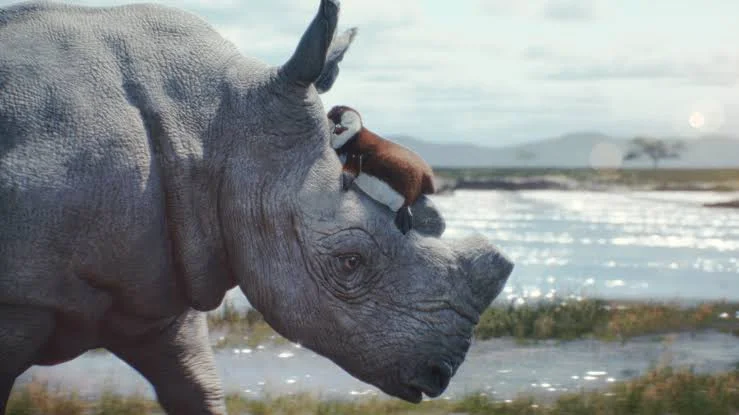
Youm finds a richer emotional direction through Chiku, a penguin attempting to protect an unhatched egg after losing his partner. The image of this small, agitated creature carrying a precious bucket in his beak has an almost absurd tenderness. It brings a welcome change to Norden’s suffering, introducing another survivor whose responsibilities have not disappeared with his happiness.
Their unlikely companionship develops from displacement and mutual dependence. Both have experienced the destruction of their families, yet Chiku still has someone to protect, and that responsibility gradually alters Norden’s relationship with his own grief.
The arrival of the young penguin transforms the film’s understanding of parenthood. Norden, who once searched for members of his own species, must now raise a creature whose natural home is an ocean he cannot inhabit. The young penguin has never experienced that ocean, making its distant existence something that must first be understood through stories.
Norden’s attempts to teach the chick about penguin identity become particularly affecting because his guidance depends on recognizing the child’s difference rather than trying to erase it. Norden cannot recreate the family he lost, but he can give the young penguin knowledge and encouragement that will remain useful beyond their time together.
This approach gains particular significance in a culture accustomed to treating family continuity as a matter of bloodlines and resemblance. The film places a rhinoceros in the position of teaching a penguin how to become a penguin, making the apparent absurdity of its premise the foundation of its most thoughtful observation. Its retrospective narration deepens that idea by allowing memory to shape the account of Norden’s life.
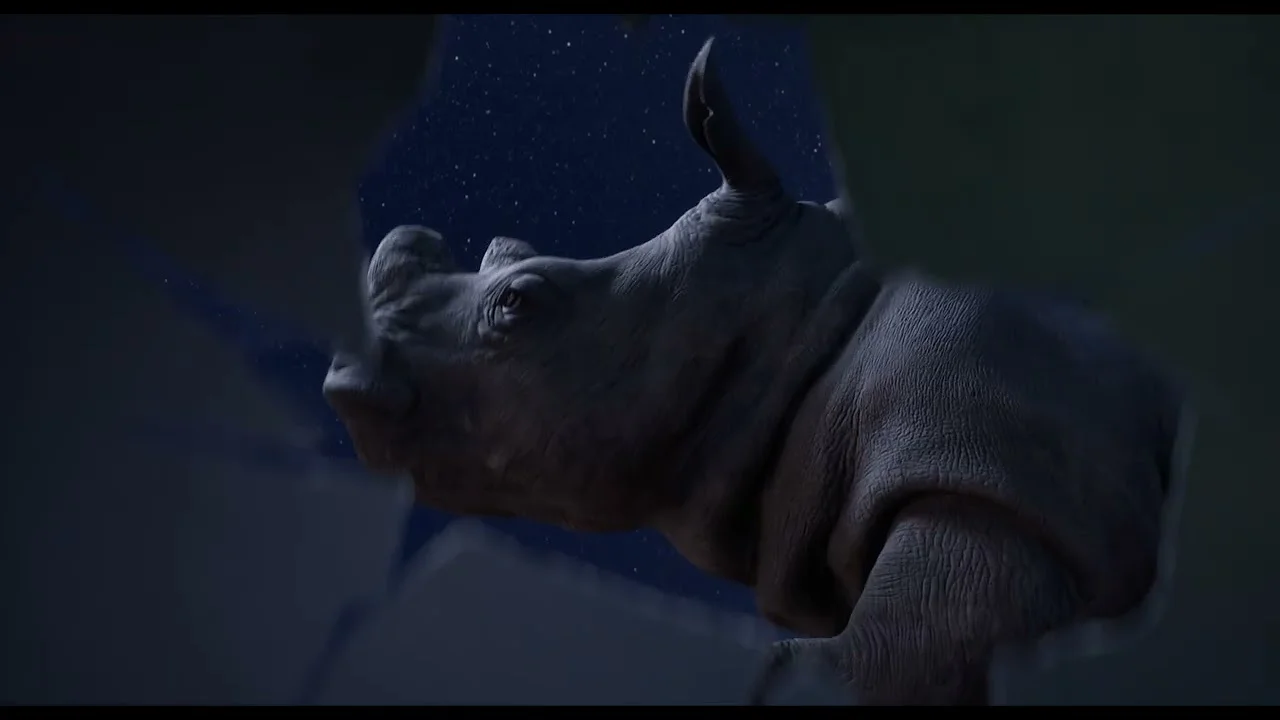
Stories become a form of inheritance, preserving experiences that the next generation could never have witnessed directly. The recurring images of star-filled skies, associated with Norden’s unspoken thoughts, complement this interest in experiences that cannot always be explained through ordinary conversation.
Yet the film’s generosity becomes selective when it considers suffering outside its central relationships. Norden’s rage toward the poachers who murdered his family receives understandable sympathy. During one of his rampages, however, wild-dog pups are trampled, prompting their mother to pursue him in anger.
Her retaliation assumes an antagonistic function, despite arising from the same parental grief that gives Norden’s actions their emotional legitimacy. The film condemns humans for reducing animals to objects of exploitation, yet its own narrative sometimes assigns moral importance according to proximity to the hero. The wild-dog mother’s grief receives little of the patient understanding granted to Norden.
Humanity itself receives a somewhat richer treatment. Poachers and warfare represent the most destructive forces in Norden’s life, but the people who tend to him in old age complicate any absolute division between cruel humans and innocent animals. The sight of an elderly rhinoceros receiving medical attention recalls the sanctuary that protected him in childhood, returning the film to the uneasy relationship between care and control. Human intervention can prolong animal life, even as other human activities make that intervention necessary. The contradiction remains unresolved, appropriately so, given the scale of the damage depicted.
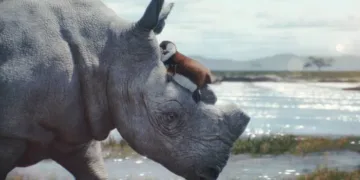
Visually, Youm gives these concerns a persuasive physical presence. Created using Unreal Engine technology, the animation favors naturalistic textures and expansive landscapes. Norden’s heavy, wrinkled skin carries the marks of age, while the delicate eyelashes surrounding his eyes lend surprising vulnerability to his enormous face.
Sunlight warms the grasses, desert dunes stretch into the distance, and tiny movements in the penguins’ rounded bodies create a sense of personality within their realistic forms. These details make the animal characters feel physically exposed to their surroundings. A massive rhinoceros crossing an open landscape can appear painfully small against the territory he must survive.
The realism falters under pressure. A wildebeest stampede and raging-river sequence generate genuine excitement from Norden’s desperation, but the water rendering and mechanical movements expose the technology’s limits. Human figures can look especially artificial, closer to video-game characters than inhabitants of the same landscape.
A greater artistic weakness lies in the film’s determination to produce an emotional response at nearly every opportunity. Norden experiences such a relentless succession of losses that individual tragedies sometimes struggle to retain their significance. The music compounds the problem by emphasizing sorrow already evident in the images. The destruction of Norden’s family requires little additional persuasion, and his exhausted presence in captivity communicates grief through physical vulnerability. When the score insists upon the emotional meaning of these experiences, the film begins to resemble the sentimental entertainment its more serious ambitions ought to challenge.
The comedy creates another difficulty. Chiku’s restless behavior and the young penguin’s tantrums bring necessary warmth, though broader bodily humor sits awkwardly beside the deaths and displacement that dominate Norden’s history. The movement between brutality and playful animal antics leaves the intended audience uncertain. Younger children may be drawn to lively penguins and colorful landscapes, only to encounter killings, warfare, and persistent reminders of mortality. The mature themes deserve a place in family entertainment, but the shifting tone occasionally weakens their development.
For the young penguin, the ocean exists first as a story, something known through descriptions before it can become a physical reality. Norden’s care takes shape in the stories he tells, the dangers he helps the child survive, and his insistence that the distant water belongs to the penguin’s future. After a lifetime in which other creatures have repeatedly determined where he can live, Norden devotes himself to helping someone else reach a place of their own.
Long Long Night (Ginginbam) had its world premiere in the Centrepiece section of the Toronto International Film Festival on September 12, 2026, before screening in competition at the Busan International Film Festival on October 8, 2026, and at the Sitges Film Festival on October 17, 2026, with wider theatrical and streaming release dates pending. Directed by Youm Kyu-bock from Ru Ri’s bestselling children’s book and featuring narration by Bae Suzy alongside the voices of Park Ki-wook and Kim Gyu-na, the South Korean animated adventure drama follows the last surviving White Boulder Rhinoceros and a newly hatched penguin who form a deep bond while crossing a perilous wilderness in search of the ocean.
Full Credits
Title: Long Long Night (Ginginbam / 긴긴밤)
Distributor: Finecut Co. Ltd (International Sales), Geek Pictures (Japan), GoogGoog Studio, Studio Eon, The Contents On
Release date: September 12, 2026 (Toronto International Film Festival world premiere), October 8, 2026 (Busan International Film Festival competition screening), October 17, 2026 (Sitges Film Festival screening)
Running time: 1 hour 39 minutes (99 minutes)
Director: Youm Kyu-bock
Writers: Youm Kyu-bock, Kang Dae-il (based on the book by Ru Ri)
Producers and Executive Producers: Jung Kyoung-hee, Kang Dae-il
Cast: Bae Suzy, Park Ki-wook, Kim Gyu-na (Kim Kyu-na), Um Sang-hyun, So Jung-hwan, Jeon Tae-yeol
Director of Photography (Cinematographer): Cho Sung-in
Editors: Chu Sun-hee
Composer: Kim Hyun-joo
The Review
Long Long Night
Long Long Night finds extraordinary tenderness in a world shaped by human cruelty. Its beautifully rendered landscapes and unconventional portrait of parenthood give the story emotional depth, while its treatment of captivity and animal suffering exposes uncomfortable contradictions in humanity's relationship with nature. The film occasionally mistakes accumulated tragedy for greater emotional significance, and its compassion becomes selective when Norden's actions harm others. Yet the bond between a grieving rhinoceros and a young penguin remains profoundly affecting, offering a persuasive vision of family built through care rather than blood.
PROS
- Touching portrayal of unconventional parenthood
- Richly textured animation and breathtaking landscapes
- Thoughtful examination of humanity's treatment of animals
- Strong emotional connection between Norden and the penguin
CONS
- Excessive tragedy and occasionally manipulative music
- Uneven sympathy toward supporting animals
- Abrupt shifts between comedy and devastating loss
- Occasional stiffness in animation and character movement