


























In the 1960s, American television borrowed the language of the Western to imagine a future in which humanity had supposedly outgrown its divisions. Gene Roddenberry’s concept of a Wagon Train to the Stars emerged from a country struggling with racial inequality, Cold War hostility, and the escalating conflict in Vietnam.
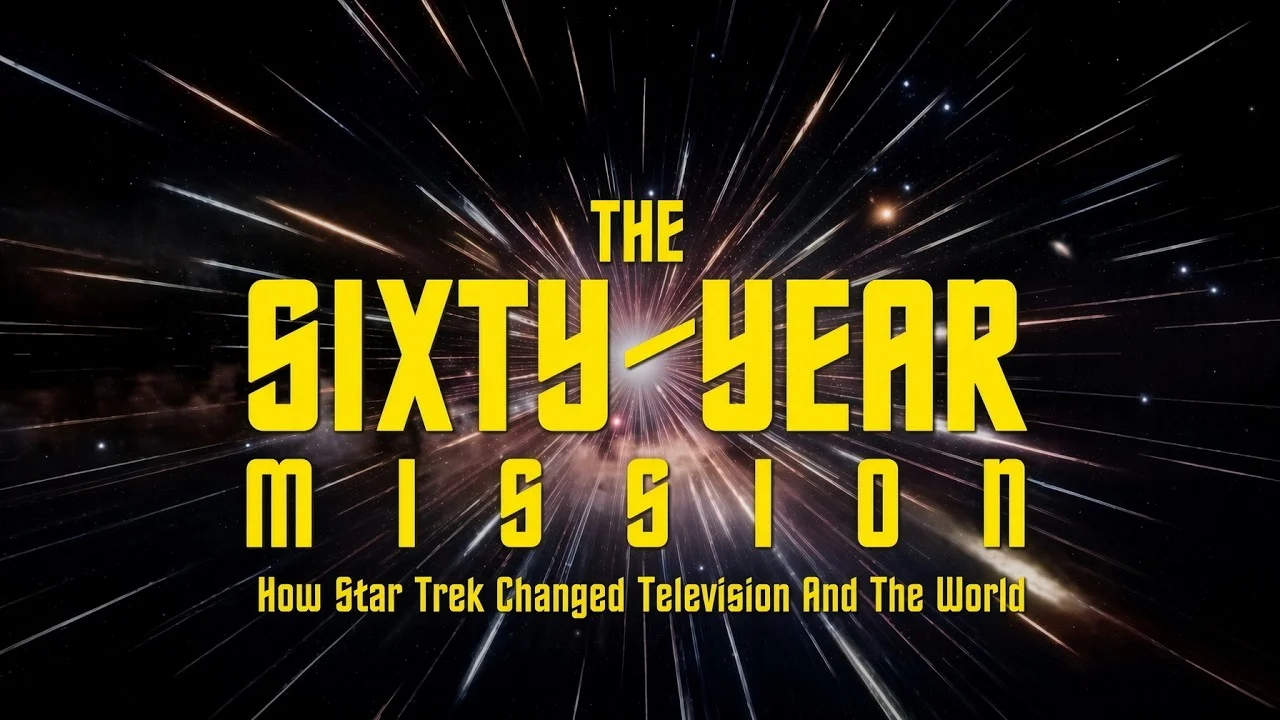
The contradiction was extraordinary: a television industry accustomed to familiar national myths was being asked to present a starship whose crew represented cooperation across those very divisions. Mark A. Altman’s The Sixty-Year Mission: How Star Trek Changed Television and the World returns to that formative moment, examining how an American science-fiction experiment acquired an identity that could travel far beyond its country of origin.
The documentary’s most persuasive achievement is its understanding of the cultural circumstances that made the original Star Trek possible. Altman draws connections between Roddenberry’s ambitions and the television traditions surrounding him, particularly Gunsmoke and Wagon Train. The American Western had long treated the frontier as a territory to be conquered, with expansion often providing its moral justification.
Roddenberry adapted that storytelling framework for a future in which exploration required cooperation among people from different backgrounds. The Enterprise retained the familiar structure of a captain leading his crew into unknown territory, but its composition challenged assumptions about who belonged in the story. That transformation gives Altman’s historical material a significance extending beyond television nostalgia.
It also makes this an absorbing and worthwhile documentary, particularly for viewers interested in the relationship between popular entertainment and cultural change. Altman’s enthusiasm is considerable, and his filmmaking sometimes shares the uncritical affection of the fans he interviews. Yet the archival discoveries and historical connections provide enough substance to justify the celebration. The reservations concern the film’s limited treatment of the six decades promised by its title.
Some of its finest material concerns the difficult process of bringing Roddenberry’s concept to television. The documentary examines the original pilot, The Cage, and the changes that followed its unsuccessful reception. Casting decisions, revised costumes, and alterations to the show’s appearance become evidence of a creative identity taking shape through experimentation.
Archival footage from Desilu Studios and behind-the-scenes material gives these developments a tangible quality. The distinction between the elaborate fictional universe and the ordinary practical work required to construct it is particularly engaging. Sets and costumes that now belong to television history appear as solutions devised by people trying to make an unfamiliar future credible within the production conditions of their time.
Altman strengthens this account through his attention to contributors beyond Roddenberry. Gene L. Coon receives recognition for his creative influence, while cinematographer Jerry Finnerman’s contribution to the show’s visual identity is acknowledged. These details help correct the tendency to explain an entire cultural phenomenon through the intentions of its creator.
Rod Roddenberry’s reflections on his father’s ambitions supply a personal dimension, particularly concerning the resistance Gene encountered while developing the program. Yet the documentary’s production history establishes that those ambitions depended on an extensive collaboration. Its interviews and archival images give the creative process a human scale that the franchise’s enormous reputation can sometimes obscure.
The film becomes especially interesting when it turns toward the political implications of the Enterprise’s multinational crew. Walter Koenig’s Pavel Chekov represents a revealing contradiction within Cold War American entertainment. At a time when the Soviet Union occupied the position of geopolitical adversary, an American science-fiction series imagined a Russian officer participating in humanity’s collective future.

Compare that choice with the antagonistic national identities encouraged by Cold War politics, and the Enterprise begins to look like a deliberate rejection of contemporary international relationships. George Takei’s Sulu and Nichelle Nichols’s Uhura extend this imagined cooperation into questions of racial inclusion. Altman recognizes that their presence mattered because American audiences were accustomed to a television landscape far less willing to imagine such equality.
The documentary reinforces these ideas through familiar examples from the original series. The interracial kiss between Kirk and Uhura confronts the racial assumptions of its American broadcasting environment. Elsewhere, two inhabitants of a divided planet sustain a destructive conflict because their black-and-white facial coloring differs.
The visual simplicity of that conflict allows the episode’s prejudice to appear simultaneously ridiculous and devastating. Altman’s use of historical footage, including material associated with President John F. Kennedy, helps establish the political climate in which such stories appeared. The relationship between contemporary events and science-fiction allegory gives the excerpts a significance that survives their visibly dated production values.
Yet the meanings of these examples change as they cross national borders. For an American audience familiar with the history of segregation, the interracial kiss carries a particular historical charge. Viewers whose cultural reference points involve colonial rule, ethnic conflict, or the aftermath of empire might find the episode about planetary racial hostility a closer expression of their historical experience.
Neither interpretation cancels the other. Indeed, the possibility of different cultural readings helps explain the international appeal of a series created within such specific American circumstances. Altman’s documentary provides persuasive evidence for the original program’s social ambitions, although it offers comparatively little examination of how audiences in different countries actually received those ideas. That omission becomes significant for a film whose title makes worldwide influence one of its principal claims.
Fortunately, the documentary’s extensive interviews give its historical account an appealing human dimension. William Shatner, who also serves as an executive producer, appears alongside surviving original cast members George Takei and Walter Koenig. Their recollections carry a particular emotional weight because the passing decades have made firsthand testimony increasingly precious.
Writers, producers, historians, and enthusiasts add their perspectives, with Wayne Knight and Dana Gould among the recognizable contributors from outside the original cast. Altman approaches these voices with generosity, allowing personal affection to coexist with discussions of production decisions and historical circumstances. The resulting documentary remains accessible to newcomers, even when its participants clearly possess encyclopedic knowledge of the Enterprise and its fictional universe.
The editing plays an important role in maintaining that accessibility. Rather than allowing the interviewees to dominate uninterrupted stretches, Altman moves briskly between their recollections, historical recordings, series excerpts, and behind-the-scenes images. A discussion of the original production can give way to the visual evidence of a changing costume or set, allowing viewers to see the developments under examination.
This approach lends considerable momentum to a documentary constructed primarily from interviews and existing footage. The accumulation of affectionate testimony occasionally becomes repetitive toward the later portions, particularly once the film has firmly established the original series’ historical importance. Another expression of admiration cannot always supply the analytical weight of another archival discovery.
There is something revealing about the enthusiasm itself, however. The contributors approach Star Trek from different positions within its cultural history. Some participated directly in its creation; others inherited the program through repeated broadcasts and subsequent generations of fandom.
The original series lasted only three seasons, but its life in syndication, animation, and eventually cinema gave it opportunities to reach audiences who had never encountered its initial broadcasts. This transformation from a canceled American television production into an enduring international franchise is among the most remarkable developments in its history. The documentary identifies the foundations of that transformation convincingly, particularly through the surviving participants’ recollections of the original production.
Its treatment of everything that followed is considerably less satisfying. Star Trek: The Next Generation, the theatrical films, and later television incarnations receive relatively brief acknowledgment despite their importance to the franchise’s continued cultural development. There is a defensible reason for Altman’s concentration on the original series. Attempting to explain sixty years of television and cinema within a single documentary could easily reduce major creative developments to a collection of familiar milestones. The detailed examination of Roddenberry’s production difficulties, Coon’s contributions, and the series’ political imagination demonstrates what a narrower approach can accomplish.
Still, the international dimension makes the omissions particularly noticeable. The franchise’s expansion across successive generations would offer an opportunity to examine how the ideals of a 1960s American production changed as television itself entered different cultural and political periods. The original Enterprise imagined cooperation during the Cold War; later incarnations inherited that ambition under different circumstances.
The documentary provides extensive evidence for the first proposition but leaves the second comparatively unexplored. For longtime fans whose attachment began with The Next Generation, this emphasis may make the history feel incomplete. Viewers primarily interested in the original series will likely appreciate the attention given to its individual creators and production history.
A mid-credits tease suggesting a possible continuation devoted to the theatrical films makes Altman’s intentions clearer. The documentary’s selective coverage begins to resemble the opening installment of a larger historical project, although that possibility does little to resolve the discrepancy between its expansive title and its immediate subject.
Altman has gathered an impressive collection of memories, archival images, and historical arguments surrounding the Enterprise’s first television incarnation. The proposed cinematic continuation would carry a different responsibility: tracing what happened when that American vision of humanity’s future moved beyond its original television home and encountered new generations of audiences around the world.
The Sixty-Year Mission: How Star Trek Changed Television and the World debuted in limited US theaters on October 9, 2026, following festival screenings such as Sitges, with wider VOD and streaming availability rolling out after its theatrical run. Written and directed by Mark A. Altman and executive produced by William Shatner, the documentary examines six decades of Star Trek, tracing how Gene Roddenberry’s vision shaped television representation, real-world technology, and global fan culture.
Full Credits
Title: The Sixty-Year Mission: How Star Trek Changed Television and the World
Distributor: Galaxie Pictures, Altman Squared Entertainment, Vital Signs Entertainment, Regal Cinemas (US theatrical partner)
Release date: October 9, 2026 (US limited theatrical release)
Rating: R (as listed on select release databases; official MPA rating may vary by territory)
Running time: 2 hours 14 minutes (134 minutes)
Director: Mark A. Altman
Writers: Mark A. Altman
Producers and Executive Producers: William Shatner, Mark A. Altman, Michael S. Broder, Thomas P. Vitale, Aaron Rattner, Daren Dochterman, Ashley Miller, Isaac M. Altman, Alan Pao, Jonathan Frakes, Maximilian Schmige
Cast: William Shatner, George Takei, Walter Koenig, Jonathan Frakes, Brent Spiner, Gates McFadden, Simon Pegg, Robert Picardo, Ethan Peck, Christina Chong, Denise Crosby, Brannon Braga, Chris Black, Steve Bingen, Barbara Bain, Jesse Alexander
Director of Photography (Cinematographer): Maximilian Schmige
Editors: Jon Berry
Composer: Joe Kraemer
The Review
The Sixty-Year Mission: How Star Trek Changed Television and the World
The Sixty-Year Mission: How Star Trek Changed Television and the World offers an engaging examination of how a distinctly American television experiment developed ideas that could speak across national and cultural divisions. Mark A. Altman's archival discoveries, firsthand testimonies, and attention to overlooked contributors give the documentary genuine historical substance. Its affectionate approach occasionally becomes repetitive, and its concentration on the original series leaves much of the franchise's international evolution unexplored. Still, this is a rewarding, accessible account of the creative and political circumstances that made the Enterprise possible.
PROS
- Excellent archival and behind-the-scenes material
- Strong connections between science fiction and 1960s politics
- Valuable testimony from surviving cast members
- Accessible, energetic historical storytelling
CONS
- Later franchise eras receive limited attention
- Global cultural influence remains underexplored
- Repeated expressions of admiration occasionally slow the momentum