









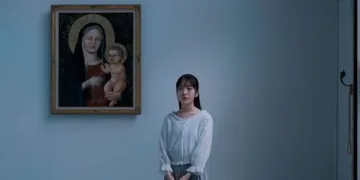
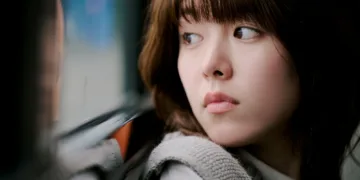







So-ri stands up for Ji-min and becomes a target herself. In Kim Yong-hwan’s South Korean animated film Your Letter, defending another pupil carries a social cost that being right cannot cancel. The girls can at least face the hostility together until Ji-min has to move away. Her departure has no malice behind it, which makes the loss harder to argue with. So-ri is left facing the consequences of her intervention without the companionship that made them bearable. Adapting Hyeon A. Cho’s webtoon, Kim gives this separation enough weight to make the prospect of finding new friends feel risky.
Dong-soon, whom So-ri meets after transferring schools, has learned a different lesson about accepting help. A bully once protected him during a confrontation, leaving him with a sense of obligation that compromises his response to later wrongdoing. Taking the blame for that boy becomes his attempt to settle the debt. The gesture still protects the person responsible. Placed beside So-ri’s experience, his history complicates the reassuring idea that kindness naturally produces further kindness: gratitude can keep someone loyal to a person whose conduct should have broken that loyalty. The two pupils approach friendship with different reasons to distrust its obligations.
The writing is less comfortable letting such difficulty persist between its sympathetic characters. Feelings are explained readily, and disagreements tend to clear before they can substantially disturb a relationship. Dong-soon’s account of his debt gives his behavior a troubling history, yet the film moves briskly toward making that behavior understandable.
Explanation becomes a particularly efficient route to reconciliation. This keeps the scavenger hunt carrying the narrative forward, though it leaves less room for the awkward interval between understanding someone’s reasons and feeling able to trust them. So-ri’s anxiety receives greater patience than the friction a new friendship might generate.
That patience finds its most persuasive expression in the letters hidden around her new school. The first, discovered in her desk, offers information about the place and a clue leading to another. Their usefulness matters. Learning her classmates’ names gives So-ri a foothold among people who would otherwise remain an intimidating collective. A tip for getting Chinese takeaway past the school guards grants access to the unofficial knowledge through which pupils make school tolerable. The welcome includes small pleasures and harmless disobedience. Someone has considered what she might actually want from a day spent there.
The hunt also gives So-ri and Dong-soon something to do together before their friendship has to bear the weight of confession. He knew Ho-yeon, the letters’ writer, whose unexplained absence troubles him. For So-ri, curiosity about the sender grows through each discovery. Their shared search gives both pupils reasons to return to a place and to each other. The arrangement is certainly fanciful, with a considerable amount of care prepared in readiness for its recipient. Still, So-ri must follow the clues herself. Receiving help leaves her with opportunities to act, and the school gradually becomes somewhere she can use rather than merely endure.
Kim makes that change visible when the first letter’s illustrated map springs into motion. Its doodles come alive, carrying So-ri into a drawn account of the grounds. The shift from detailed school surroundings to an inhabitable sketch gives the writer’s attention a spatial form. A building full of unfamiliar people can be pictured through somebody else’s affection for its corners and possibilities. The sequence avoids making the letter a speech about self-confidence. Its animation offers So-ri an inviting version of the place, one she can begin to explore before she feels secure in the actual one.

A forest passage uses the image quite differently. With eyes closed, movement through the surroundings is rendered against blackness, with only fragments becoming visible. The film temporarily removes the reassuring legibility of its everyday settings. Space has to be encountered in pieces; the complete picture is unavailable. This is a precise visual expression of tentative confidence, allowing movement and uncertainty to coexist. Beside the animated map, it gives the film two distinct ways of imagining access to a place: one supplies an inviting picture, while the other makes proceeding without that picture a perceptible experience.
The soundtrack can be less sensitive to continuity. Kim Tae-seong’s gentle, piano-led scoring establishes a soft emotional register, and the switch into electronic pop textures sometimes makes a passage feel separately packaged. A move from that piano atmosphere into a trap beat is particularly abrupt. The issue lies in the handover between musical languages, each drawing a different kind of attention to the scene. Where the map’s change of visual register develops the experience of receiving a letter, these musical shifts can interrupt an emotional current already established. Some of the intimacy gives way to the self-contained impact of a song.
The story has its own tendency to make the emotional design conspicuous. So-ri loses contact with Ji-min; Dong-soon is left wondering about Ho-yeon; the search repeatedly returns to the fear of having disappeared from someone else’s life. These connections give the hunt a purpose beyond discovering its sender, though their symmetry makes the characters’ histories feel carefully arranged to answer the same need. The quick settling of interpersonal tensions further protects that arrangement. The film allows hurt to linger most readily when the person who could answer it is elsewhere.
Ji-min’s eventual letter gives that absence a specific answer. Its arrival establishes that moving away did not erase her attachment to So-ri. The earlier separation remains painful, and the reply cannot restore their daily companionship. It does, however, change what So-ri can understand about the silence that followed. She has spent that interval without access to her friend’s thoughts, carrying the loneliness of their parting alongside the consequences of defending her. When Ji-min writes, So-ri can finally read something of the life that continued on the other side of that separation.
Your Letter premiered internationally on the festival circuit before releasing theatrically in South Korea on October 1, 2025, followed by its North American theatrical release via Crunchyroll on August 17, 2026, and subsequent streaming availability. Directed by Kim Yong-hwan, the South Korean animated coming-of-age drama follows Lee Sori, a bullied middle school girl who transfers to a new school in the countryside and stumbles upon a series of mysterious letters taped under her desk, embarking on a scavenged trail of clues that transforms her life and heals her past trauma.
Where to Watch Your Letter (2024) Online




Full Credits
Title: Your Letter (Korean: 연의 편지)
Distributor: Lotte Entertainment, Crunchyroll
Release date: October 1, 2025 (South Korea) / August 17, 2026 (North America)
Rating: PG-13
Running time: 1 hour 36 minutes (96 minutes)
Director: Kim Yong-hwan
Writers: Cho Hyeon-a (based on the webtoon by), Kim Yong-hwan
Producers and Executive Producers: Studio N, Studio Lico
Cast: Lee Su-hyun, Kim Min-ju, Min Seung-woo, Nam Doh-hyeong
Composer: Kim Tae-seong
The Review
Your Letter
Your Letter gives kindness a persuasive practical form: names learned, places made accessible, and friendship built through shared activity. Its animated map and fragmentary forest passage make renewed confidence visible without demanding instant certainty. The writing is less patient, settling disagreements quickly and arranging several histories around the same reassurance. Abrupt musical shifts can further disturb the intimacy. Its warmth earns affection through attention to what a lonely pupil needs, though its tidy emotional design limits the difficulty those relationships can sustain.
PROS
- Practical, specific portrait of care and belonging.
- Friendship developed through shared discovery.
- Inventive map and forest animation.
- Moving treatment of separation and recognition.
CONS
- Interpersonal tensions resolve too readily.
- Parallel separation stories feel overly arranged.
- Abrupt shifts between the score and pop songs.