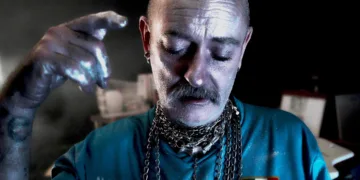























Douglas Gordon keeps giving Finlay Pretsell instructions for the film we are watching. A voicemail complains about how long the project is taking. Elsewhere, Gordon supplies a cue for the next part and requests discretion about his occasionally depleted toilet-paper supply. These interventions have an appealing domestic cheek: the Scottish artist can fuss over his documentary as someone else might fuss over a visiting friend’s dinner. They also make it difficult to settle into listening. Even when he appears to welcome attention, he is busy arranging what that attention should find.
The opening rush of dance music, artwork fragments, and tilted views of his Berlin studio gives that restlessness an infectious rhythm. Coloured lights puncture the darkness; rapid cutting makes the room feel full of possibilities. Then Gordon cracks a bullwhip across the floor, and the filmmakers’ cautious distance changes the invitation. You begin to register the space someone needs to occupy safely around him. The exhilaration has acquired a social cost, felt through the crew’s position as much as through anything Gordon says about himself.
Pretsell spends most of this 89-minute portrait inside that studio, allowing the encounter to determine its shape. Gordon proposes Portrait of a Perilous Character as a title, a piece of publicity that sits amusingly beside his enthusiasm for blowing soap bubbles. His pleasure in playing to the camera is often enjoyable. The difficulty arrives when his interruptions of Pretsell and cinematographer Martin Radich become familiar. An exchange can establish that Gordon resists being managed, then spend further time establishing the same thing. The room keeps producing activity while our understanding of its occupant sometimes stalls.
His temporary withdrawal from the project gives those exchanges an uncertainty the antics alone cannot sustain. When he stops answering Pretsell’s calls, the relationship ceases to be a dependable container for whatever performance he wants to try next. Another filming session has to be secured. That interruption makes the director’s patience matter emotionally: there is a difference between indulging someone who is enjoying your company and trying to recover a conversation they have abandoned. Gordon’s presence becomes something the film can lose, even while his demands threaten to exhaust our appetite for it.
The bubbles acquire a different weight when Gordon talks about having the freedom to behave like a child now, a freedom he says his childhood lacked. That admission gives his playfulness a history without explaining every action away. His tears over his absent children complicate it further. The person enjoying permission to be irresponsible is painfully aware of responsibility toward others. Pretsell lets these incompatible feelings share the portrait, so affection can develop without requiring the viewer to find Gordon easy company. His family remains present through what he says he owes them and how much he misses them.
The most affecting passage involves an apparent phone conversation with his mother. Recollections of Glasgow and the hope attached to blowing bubbles give his longing something small and particular to hold. A detail on the phone screen complicates the apparent exchange, making its status as a live conversation doubtful. The tenderness survives that uncertainty. Watching someone address an absent listener can hurt differently from watching them receive comfort, and the camera leaves us with the words he needs to say. It provides no secure basis for deciding how much of the moment has been prepared for us.

Time supplies a less negotiable pressure. Archive footage shows Gordon accepting the Turner Prize in 1996; present-day filming finds him recovering from a hernia operation, his stomach bandaged. The physical vulnerability matters alongside his account of making moments worth preserving across decades. A person can keep inventing gestures while losing the bodily ease with which he once performed them. Pretsell’s attention to that body gives the idea of preservation an immediate emotional stake. The playful freedom Gordon describes has to be exercised by someone who also needs time to heal.
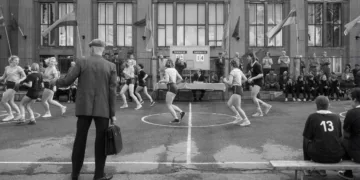
Yet the film leaves a frustrating distance between those impulses and the art they produce. Gordon’s 24 Hour Psycho stretches Hitchcock’s film across an entire day, making duration itself part of the viewing experience. His work also includes the collaborative football portrait Zidane: A 21st Century Portrait. Such reference points help a newcomer understand why his handling of images deserves attention. The brief excerpts and installation cutaways here supply little sustained contact with that handling. They encourage curiosity, then return us to the studio before we can connect many of its activities to a finished artistic choice.
The limited attention to other people narrows that connection too. A meeting with his accountant brings everyday obligation into view, and a friend appears in material Gordon films. His admiration for Lawrence Weiner gives a glimpse of an artistic relationship. These openings receive little room to develop. Someone familiar with Gordon’s practice may supply the connections independently; a newcomer spends longer relying on his moods for a sense of what matters. His loneliness becomes palpable, while the ways he works with, depends on, or responds to other people remain faint.
Near the end, he rubs himself with Vicks VapoRub while separating the caricature he presents as an artist from the human honesty he hopes to convey. The ordinary need for bodily care lends the moment an intimacy that the declaration cannot secure by itself. Gordon is still choosing the terms of our attention, now asking us to recognize the person inside the performance. Pretsell leaves the ointment and the explanation together, an act of tending to himself conducted in front of people whose understanding he continues to seek.
Douglas Gordon by Douglas Gordon had its world premiere at the Berlinale on February 17, 2026. Directed by Finlay Pretsell, the documentary offers an intimate and unconventional portrait of the Turner Prize-winning artist, blurring the boundaries between reality and performance as the dynamic between filmmaker and subject evolves.
Full Credits
Title: Douglas Gordon by Douglas Gordon
Distributor: Autlook Filmsales
Release date: February 17, 2026 (Berlinale)
Running time: 1 hour 28 minutes (88 minutes)
Director: Finlay Pretsell
Producers and Executive Producers: Finlay Pretsell, Sonja Henrici, Estelle Robin-You
Cast: Douglas Gordon
Director of Photography (Cinematographer): Finlay Pretsell
Editors: Kieran Gosney
The Review
Douglas Gordon by Douglas Gordon
Gordon can wear out your patience and still make you care. Pretsell’s portrait finds its strongest emotional footing in family longing and bodily frailty, allowing tenderness to survive the artist’s determination to direct our attention. The studio’s restless energy makes the encounter exciting, though repeated confrontations lose their bite, and fragments of finished work leave his creative choices frustratingly distant. Worth spending time with for its uneasy intimacy, especially if you can accept leaving with affection that exceeds your understanding.
PROS
- Family longing carries genuine emotional weight.
- Music, cutting, and framing make the studio encounter visceral.
- Friction between filmmaker and subject gives the portrait uncertainty.
CONS
- Repeated confrontations sometimes stall insight.
- Brief artwork excerpts reveal little of the creative process.
- Working relationships receive limited attention.