





























Wyatt and Cora bring their boat ashore together, still enjoying the playful uncertainty of a first date. Then Wyatt is pulling it in alone, at a later point in his life. Mark Wilson Sunderland lets an action carry us between periods in Dementium, giving the change an emotional meaning before supplying its explanation. We recognize the activity and notice the missing person. It is an economical way to introduce a relationship: first through the ease of two people talking, then through the space one of them leaves behind.
The film becomes less settled about how its past should appear. Memories sometimes become scenes Wyatt watches, placing him in the uncomfortable position of observing a life he has already lived. A conventional flashback briefly takes over the storytelling to show us something earlier.
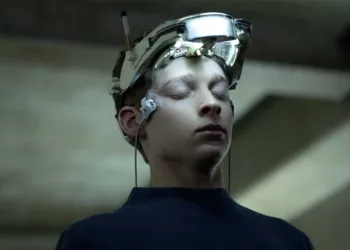
Here, the past can intrude on the person remembering it. I like the discomfort this creates, particularly when Michael Aaron Milligan’s withdrawn Wyatt seems so far removed from the man sharing an outing with Karynn Moore’s Cora. The shifting chronology asks us to keep both versions of him in mind.
His return to the family’s secluded lakeside house, on a Christmas tree farm, carries a purpose: uncovering the truth about his mother’s murder. Yet Sunderland makes Wyatt’s immediate behavior almost as unsettling as that history. He prepares a meal and eats beside an open coffin on the dining table, closing its lid before continuing.
The practical gesture is what troubles me. Something that should make dinner impossible has become an inconvenience to manage. When Wyatt takes DMT and the house becomes the setting for a hallucinatory ordeal, his ordinary routines have already made the place feel deeply wrong.
The sound design pushes that unease through familiar actions. Sizzling food, running water, and a vibrating phone demand an uncomfortable amount of attention. Sound design includes the selection and emphasis of these noises, so an everyday action can acquire a threatening intensity without anything supernatural entering the frame.
Here, the household seems incapable of leaving Wyatt alone. Nathan Rigaud’s close framing and camera pans work on a related problem: how much of the space we can inspect at once. The pans disclose details gradually, making the limits of our view part of the tension inside the dark corridors.
Sunderland is also willing to interrupt that atmosphere with something conspicuously artificial. Doug Dawson appears in black-and-white drug-information sequences as a scientist explaining DMT at a blackboard. The exaggerated delivery provides a peculiar kind of reassurance: someone has arrived to explain the experience, using the visual language of an instructional film.
His warning about the importance of the user’s mental state makes that reassurance short-lived. The interludes give the movie a welcome comic looseness while introducing another reason to distrust the apparent comfort of an explanation.
Dawson’s other role, a witch-like presence within the nightmare, turns that theatrical energy toward intimidation. Cackling near windows and clapping from corners, he makes simple gestures feel like deliberate provocations. These appearances work because another figure seems to be enjoying Wyatt’s distress.

I was less persuaded by the digital black mist accompanying the witch. It stresses the supernatural identity of something already disturbing through placement, sound, and behavior. The actor has given us a presence to watch; the added effect pulls attention toward the decoration around him.
The most substantial interruption, however, comes when the film gives Wyatt and Cora’s relationship an extended stretch of its own. A dialogue-led memory occupies close to twenty minutes of a roughly ninety-minute feature. That duration changes our relationship to the couple.
We spend time with their conversational rapport instead of receiving a few fragments chosen solely to explain his unhappiness. Moore sustains the exchanges with a warmth that makes Milligan a responsive partner, allowing the withdrawn man in the house to acquire a social life and emotional history. Their connection gives his isolation a specific human cost.
It also holds the present-day story in suspension for too long. The difficulty lies in how much narrative attention has to be transferred at once. The cabin mystery has taught us to watch for danger and question Wyatt’s actions; the long memory asks us to set those immediate concerns aside and settle into another dramatic rhythm.
I became invested in the relationship while losing some of my anticipation about the house. Returning to hallucinatory horror then requires the film to rebuild pressure that its intimate material has temporarily displaced. The emotional gain and the pacing problem occupy the same passage.
Milligan helps keep those modes connected. His initial reserve gives way to sadness and anger, and his fear during the nightmare belongs to someone whose vulnerabilities have become clearer. Still, his exposed feeling cannot explain every overlap among memory, apparition, and present action.
As these accumulate, the film sometimes leaves the connection between one disturbance and the next too obscure to sustain curiosity. I could understand Wyatt’s distress while struggling to judge what a new image changed about his predicament. Emotional access remains strongest in the scenes where he has another person to respond to.
That dependence matters to the film’s interest in addiction and recovery. Wyatt’s remembered intimacy with Cora offers an experience of contact beyond the solitary rituals of the house, but memory makes a difficult source of help.
Listening to her last voicemail, he can hear a familiar voice without entering a fresh conversation. The longer passages with Moore give that distinction weight: we have experienced the exchanges between them, including the simple possibility of a response. In the house, Wyatt has the recording and whatever he can bring himself to hear in it.
Dementium released across North American VOD platforms including Amazon Video on August 18, 2026, through Freestyle Digital Media. Directed by Mark Wilson Sunderland, the psychological horror thriller centers on a grieving man who retreats to an isolated cabin on a Christmas tree farm to investigate his mother’s murder, only for a drug-induced hallucinatory trip to force a reckoning with terrifying visions and long-buried family secrets.
Where to Watch Dementium (2026) Online






Full Credits
Title: Dementium
Distributor: Freestyle Digital Media, Amazon Video
Release date: August 18, 2026
Rating: 18+
Running time: 1 hour 33 minutes (93 minutes)
Director: Mark Wilson Sunderland
Writers: Clayton Thompson, Mark Wilson Sunderland, Kyle Sunderland
Producers and Executive Producers: Mark Wilson Sunderland, Andrew Hunter, Sam Sunderland
Cast: Michael Aaron Milligan, Karynn Moore, Doug Dawson, Kristen DeVore Rakes, Adam Boyer, Dani Deetté, Andrew Hunter, Alexa Rachelle Jennings
Director of Photography (Cinematographer): Rigaud
Editors: Mark Wilson Sunderland
Composer: Not publicly specified
The Review
Dementium
Dementium makes ordinary sounds unsettling and uses shifts in time to give Wyatt’s isolation a human cost. I found the relationship between Milligan and Moore its strongest source of feeling, even as an extended flashback lets the cabin’s suspense slip away. Dawson’s theatrical menace needs little digital assistance. The film’s emotional stakes remain clearer than its increasingly tangled mystery, leaving a sincere, resourceful psychological horror drama whose most affecting scenes interrupt its momentum.
PROS
- Early transitions make changes in time emotionally legible.
- Heightened household sounds create persistent unease.
- Milligan and Moore give the relationship warmth and credibility.
- Dawson turns simple gestures into threatening behavior.
CONS
- The extended relationship flashback stalls the cabin’s suspense.
- Overlapping memories and apparitions obscure the developing mystery.
- Digital black mist distracts from Dawson’s physical presence.