




















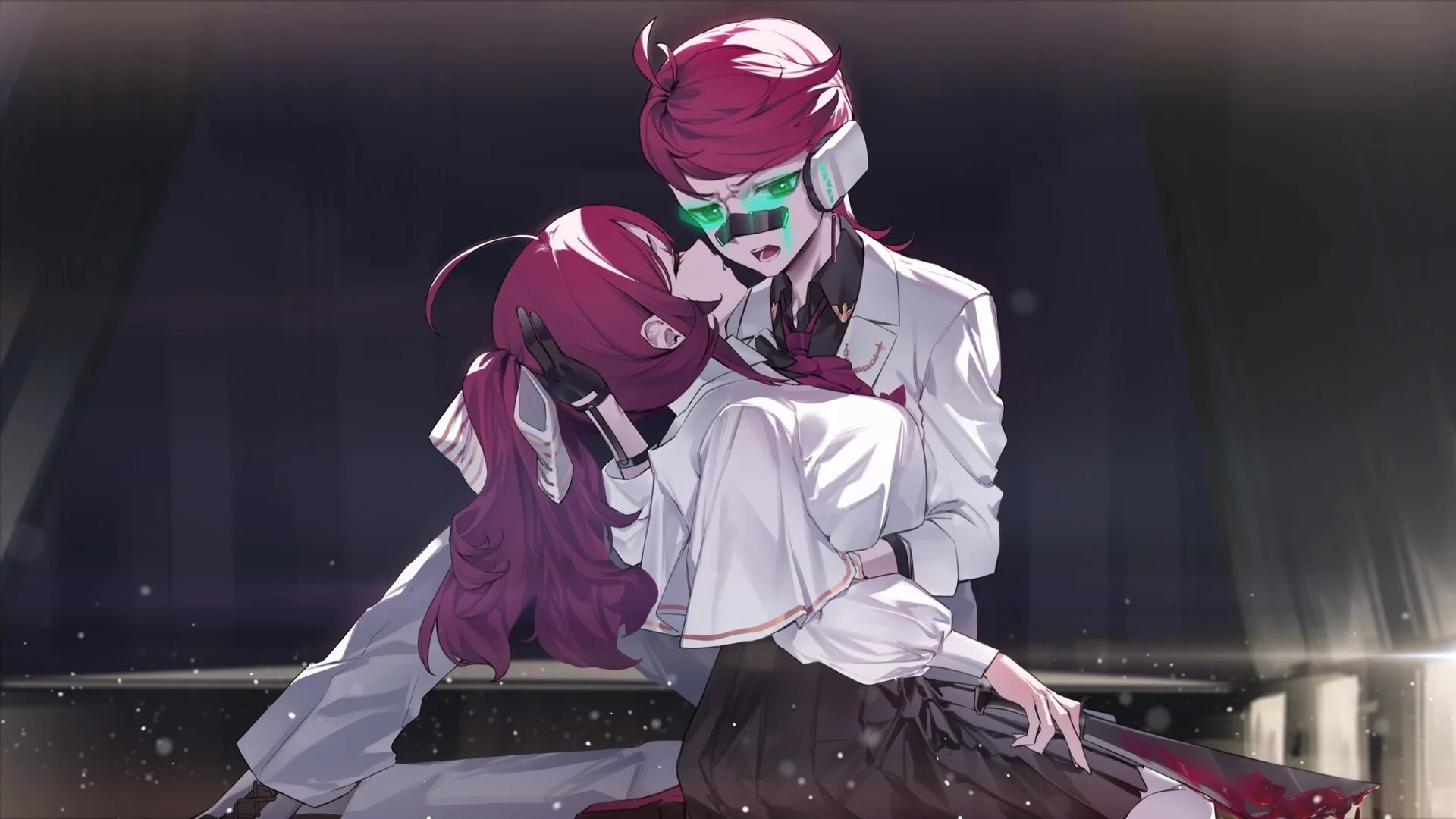

Danganronpa players will recognize the assignment when Psycho Sleuth asks them to complete a comic depicting how a murder happened. Missing panels become slots for the correct images, turning a tangled case into an orderly sequence.
The resemblance extends to timed debates, evidence used to contradict testimony, and elaborate punishments for exposed killers. These borrowings establish a familiar rhythm: collect the facts, challenge the account, reconstruct the crime. Psycho Sleuth’s most interesting contribution concerns how trustworthy those collected facts can be.
Its Pathosync powers allow characters to impose aspects of their own perception on other people. Face-blindness can become a shared limitation, making identification through clothing or voices suddenly consequential. Protagonist Lyle can project sensory illusions convincing enough to deceive himself.
Where Danganronpa gives its participants exceptional talents, this game builds cases around altered access to reality. A witness can speak sincerely and still supply a false account. Before matching evidence to a statement, you have to consider what the witness was capable of perceiving.
The Logic Church gives those powers a murderous application. Thirteen candidates enter its selection process, tempted by the promise of godhood and a fulfilled wish. Among them are Lyle, a conman, and his younger sister Lena, whose welfare governs his decisions.
The selection uses Werewolf rules: an assigned wolf must kill someone and avoid discovery, while the remaining participants investigate and identify the culprit. Assigning the murderer a role changes the incentive structure inherited from Danganronpa. Later additions to those roles become essential to the story’s strongest stretch.
Actually collecting evidence is considerably less complicated than the crimes themselves. Point-and-click investigation takes you through designated interaction points, with the next dialogue arriving once a location has been sufficiently examined.
There is little opportunity to wander between rooms or pursue your own investigative order. Compared with Danganronpa’s location-based searches, this removes the irritation of retracing steps for a missed interaction. It also makes investigation feel like gathering the material for an explanation the game has already carefully arranged. The pleasure lies largely in understanding that explanation as it develops.
Trials preserve that guidance. Evidence choices are often restricted to three options, and direct questions offer similarly narrow selections. Generous health allowances make mistakes survivable, even when the chapter grade is stern about them.
The complicated premise therefore produces a fairly approachable game. Its weaker moments come when a plausible objection fails because the debate accepts one particular evidence-statement pairing. At those points, following the reasoning and finding the required input become separate tasks. The closing comic is useful precisely because it lets you assemble the sequence after those smaller disputes have been resolved.
Pathosyncs supply the extra reasoning that this restricted interaction needs. A participant who cannot register the left side introduces a question about the physical actions that person could perform; shared face-blindness changes the value of an eyewitness identification.
These are productive complications because they alter the use of ordinary clues. The difficulty is establishing the powers’ limits. Participants sensibly conceal their abilities, but a withheld ability and an incompletely explained rule create different kinds of uncertainty. Discovering someone’s secret can reward attention. Learning only afterward how far a power extends makes anticipating the solution less satisfying.

The first two chapters spend too long establishing machinery that genre veterans already understand. Chapter three improves matters by expanding the special roles within the Werewolf selection, changing what participants can do inside the familiar cycle. Later, characters assigned Hero roles can decide to execute an identified culprit or allow that person to become a god.
Finding the killer leaves an important decision outstanding. This gives the trials a different dramatic purpose from merely confirming who committed the crime, and makes the changing rules feel consequential rather than decorative. The game’s five-chapter structure gains momentum once its roles begin producing these complications.
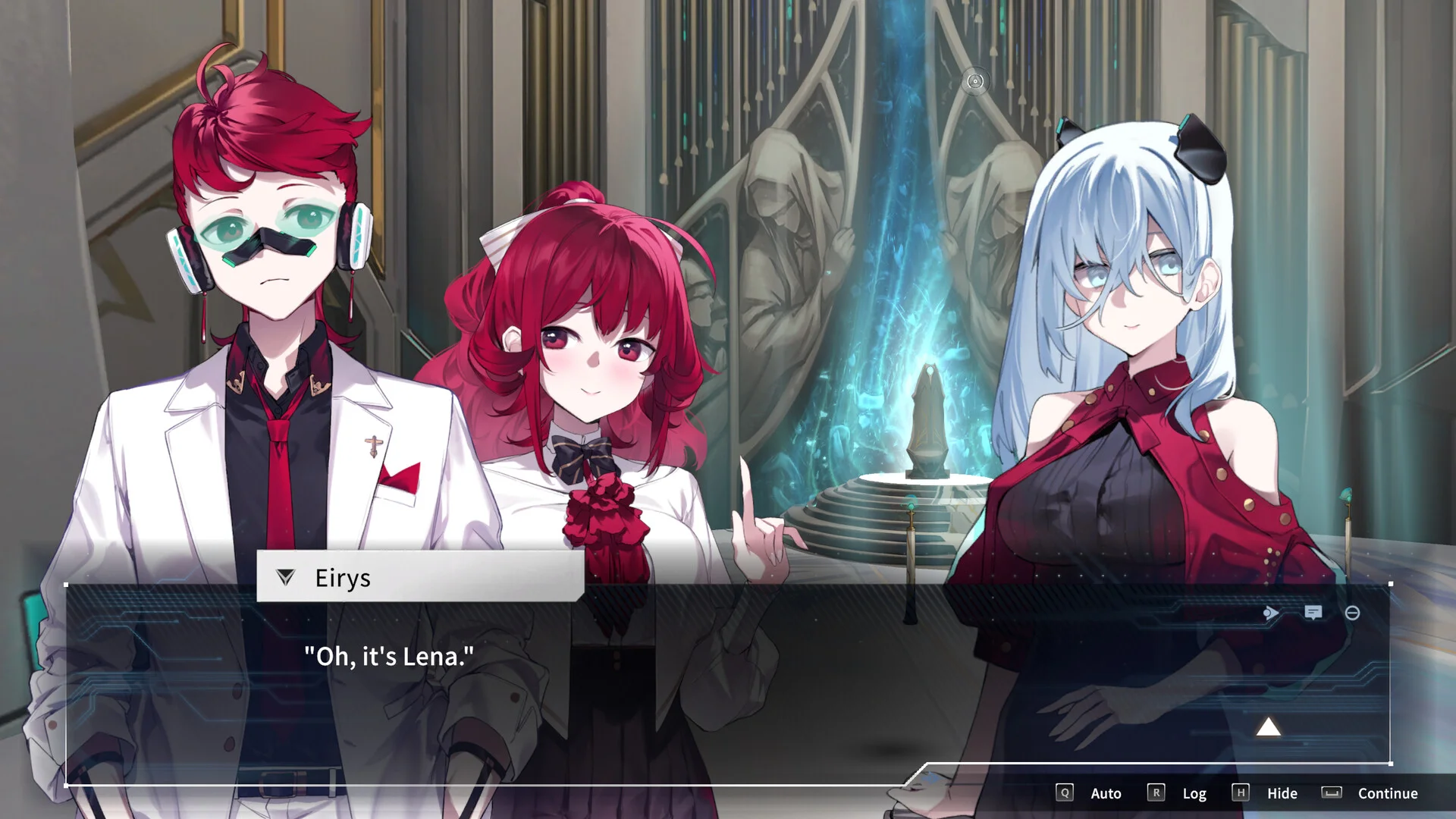
Lyle helps sustain that change because he is an awkward person to trust with the investigation. His professional dishonesty and unreliable senses deny him the comfortable authority of a neutral audience representative. He can manipulate others while remaining vulnerable to his own manipulation.
Lena, who cannot lie and can force nearby people to tell the truth, gives him a particular reason to trust her. Their powers make his dependence intelligible before the script starts explaining his attachment. The repeated jokes about his fixation on his sister are much less useful; they keep reducing a specific dependence to a familiar character gag.
The presentation has its own habit of interrupting serious material. Live2D portraits move with an elastic wobble, sometimes extending to shifting irises and exaggerated breast movement. During tense exchanges, the animation can pull attention away from what someone is saying toward how oddly their body is moving.
Dedicated 2D animated sequences work better, giving key events a visual emphasis that the conversation portraits struggle to maintain. The crime imagery is explicit, including dismemberment and self-mutilation. Reducing the gore through the settings changes some of the display, while leaving those events embedded in the story.
The choice to attach the powers to real condition names needs similar scrutiny. Danganronpa’s exceptional talents provide an openly exaggerated framework for its cast; Psycho Sleuth borrows clinical labels for abilities whose main function is to enable or complicate murders.
Lena is the clearest example. The game associates OCD with her compulsory honesty, then extends that construction into a truth-enforcing power. Its fictional disclaimer acknowledges the distance from reality, yet retaining the label still invites readers to connect the invention to an existing condition. The puzzle benefits from a precise restriction, while the characterization inherits a label the restriction cannot adequately explain.
That limitation does not erase the care within Lyle’s characterization. His lying, protective instinct, sensory uncertainty, and dependence on Lena pull against one another, giving him reasons to act that exceed the requirements of a mystery solution.
Lena receives a narrower dramatic function. Her honesty stabilizes his experience, and her safety supplies his motive, leaving much of her importance measured through what she provides him. The truth-telling power makes that arrangement especially restrictive: the person he depends on for certainty has fewer opportunities to conceal herself, even as his own secrets keep the story moving.
The Review
Psycho Sleuth
Psycho Sleuth borrows Danganronpa’s trial machinery, then gives it worthwhile complications through perception-altering powers and changing Werewolf roles. Its best cases make trustworthy testimony a puzzle, while Lyle’s dishonesty gives the investigation an appropriately unstable guide. Restricted evidence choices, unevenly explained abilities, and a slow opening limit the detective work. The elastic character animation and reductive use of clinical labels create further friction. Genre fans willing to accept those weaknesses will find a death game whose later rules meaningfully change what solving a murder accomplishes.
PROS
- Pathosync powers change how evidence and testimony work.
- Later Werewolf roles give trials fresh consequences.
- Lyle’s dishonesty and unreliable senses strengthen his characterization.
CONS
- Opening chapters linger on familiar genre machinery.
- Unclear power limits weaken opportunities for deduction.
- Rigid rebuttal inputs reject plausible reasoning.
- Wobbly portraits interrupt serious exchanges.
- Clinical labels receive reductive fictional treatment.