



























Every connection you draw in Faraway changes the routes you can still take. Link two stars and you earn points, but the line between them becomes something your next connection cannot cross. A convenient approach can leave another star stranded behind your own geometry.
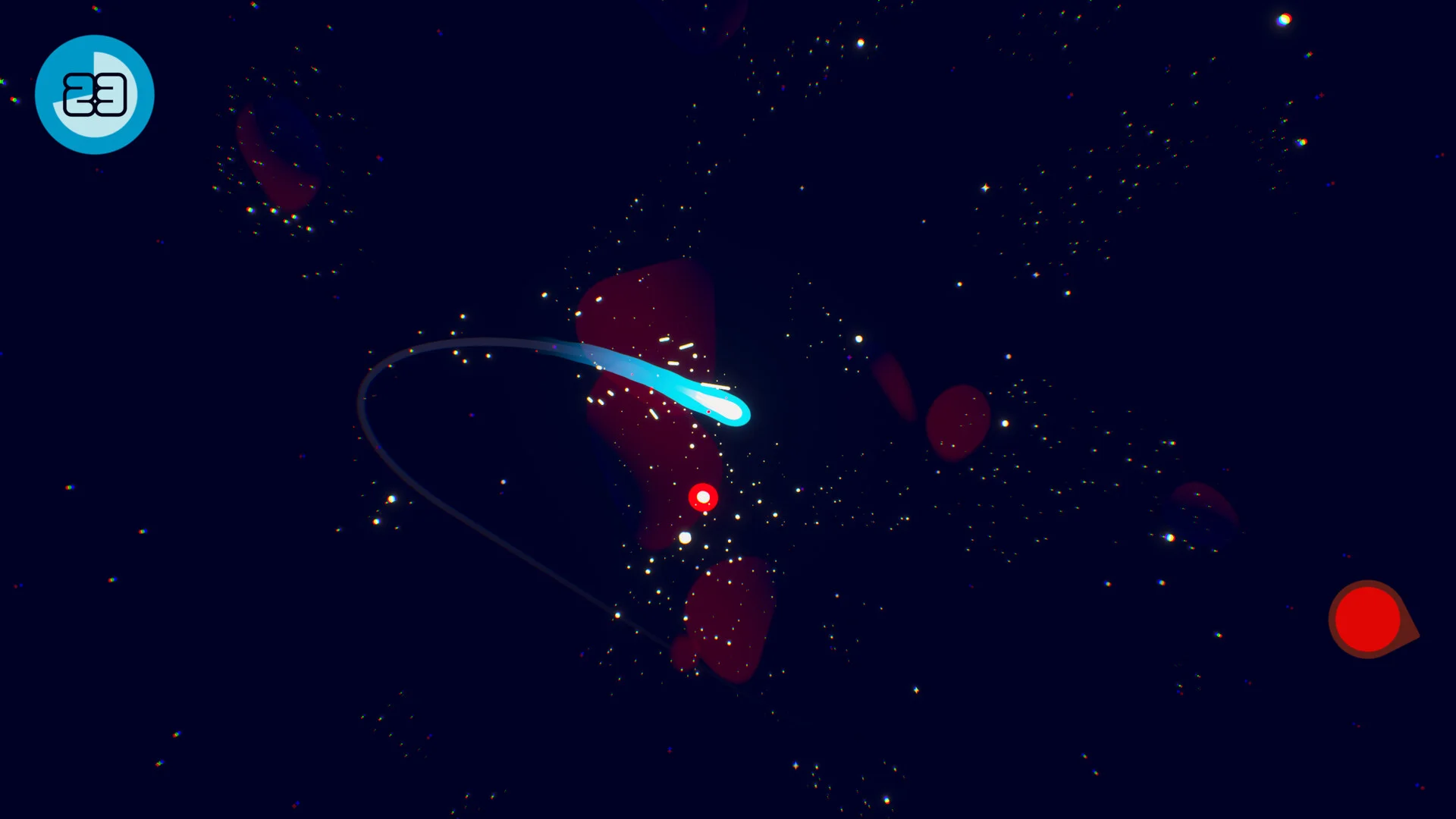
Playing well requires you to think past the next successful attachment and preserve space for the ones after it. Steph Thirion’s constellation-building game, published by Annapurna Interactive, makes that calculation physical: you are a shooting star, constantly moving, using a single button to catch another star’s gravity, orbit it, and release yourself along a new trajectory.
Holding that button keeps you circling; letting go determines your departure. Direction and speed emerge from timing rather than conventional steering, so reaching a star involves judging the orbit that will carry you toward it. Inside circular constellation zones, those movements build a drawing that must accommodate its own construction.
Crossing a line or leaving the zone ends the attempt. You can understand the shape you want to make and still need to solve how to move through it. That separation between a route imagined and a route executed supplies much of the game’s depth, along with its most persistent frustration.
The scoring rules give that spatial problem a useful direction. Closed loops increase your rewards, and incorporating every star earns a completion bonus. Simply touching a few available nodes leaves potential points unused. Starting among the inner stars and working outward can preserve room for further connections, though the arrangement still dictates what is possible.
The satisfaction comes from seeing how one sequence permits several loops where another would close off the remaining space. An apparently awkward cluster becomes workable through a change in approach, without the game needing to introduce another ability or another button.
Those rewards feed the main Faraway mode’s survival loop. Your star has a finite lifespan, and building constellations replenishes time as you progress through procedural space toward larger challenges. Accepting a modest drawing and pushing for complete coverage therefore have consequences beyond leaderboard position.
Better construction buys further opportunities to play. The fleeting-star premise earns its emotional weight through this exchange: the beautiful object left behind is also the means of continuing. There is pleasure in watching the constellation form, followed by the practical need to find somewhere else to make another.
Automatic targeting complicates the connection between those decisions and their outcomes. The button engages a nearby star, but you cannot separately aim at the one your route requires. In crowded groups, an attachment can take you toward an adjacent node instead, altering the drawing before you have completed the intended sequence.
Because each connection changes the remaining routes, that discrepancy can spoil several planned moves. The frustration grows from the specificity of the intention. You may know exactly which star you need, and understand why you need it, while still struggling to make the single input communicate that choice.
This deserves a different diagnosis from missing an exit angle. A poor release gives you a recognizable action to adjust on the next attempt. An unexpected attachment leaves a less obvious lesson about position, timing, or target selection.
Slowing down and studying the attraction indicators helps, and the orbital display communicates speed through a red-to-blue gradient. Careful approaches can make dense arrangements manageable. Yet that solution asks the player to devote attention to securing each attachment while also planning the constellation. The interface supplies information; translating it into confidence about the next target takes considerable practice.
Faraway’s sparse presentation assists that concentration. Bright nodes and connecting lines remain distinct against the dark field, keeping the drawing readable as it grows. Pulses of light and electronic cues give successful actions a perceptible response, so the reward has a texture beyond a rising number.
The synth palette suits the continuity of orbital movement, while the shapes accumulating under your control make competence visible. Its absorbing quality develops through that feedback. Watching a clean sequence take shape feels different from admiring an attractive background, because the composition records decisions you have successfully carried out.

Echoes provides a useful setting for learning the construction side of those decisions. Its predetermined arrangements and target shapes replace an open scoring problem with a specific route to reproduce. Ascent changes the task again, offering a fixed arrangement whose scoring potential you must work out.
These modes exercise related skills without being interchangeable. One gives you an intended figure to understand; the other asks you to find an efficient figure yourself. Returning to procedural play then tests how readily that understanding transfers to a fresh arrangement, where the useful sequence has to be recognized again.
The limitation is how much learning remains concentrated in the same orbit-and-release interaction. New layouts change the routing problem, but they retain the same demands on your ability to select and leave stars. Faraway’s longevity depends heavily on finding that refinement rewarding.
Procedural generation supplies fresh arrangements rather than a succession of new verbs, and the authored challenges deepen the existing ones. Slower play offers room to study movement, though extra thinking time cannot by itself explain an attachment that still surprises you. A target constellation can teach a route without fully teaching the control needed to trace it.
Score-based unlocking ties access to further authored challenges to performance in the main mode. For a player improving steadily, this can pace the exercises sensibly: a stronger run opens another opportunity to study the system. For someone stalled, the same arrangement restricts access to potentially useful practice.
A missed threshold sends that player back into procedural attempts, where the troublesome selection may appear among different surrounding stars each time. They can recognize the geometry they want to draw and remain unable to rehearse a particular transition in a fixed exercise they have yet to unlock.
The Review
Faraway
Faraway turns orbital timing and constellation geometry into a rewarding test of foresight. Every line changes your options, and better construction buys your shooting star further life. Automatic targeting makes crowded routes harder to execute confidently, while score requirements can restrict access to useful practice. Its responsive light and sound make successful sequences satisfying to watch and hear, but sustained enjoyment depends on accepting a learning process that does not always explain your mistakes clearly.
PROS
- One-button movement supports substantial spatial planning.
- Loop rewards connect scoring, survival, and risk.
- Echoes and Ascent develop distinct routing skills.
- Clear visuals and responsive audio reward successful execution.
CONS
- Automatic targeting can disrupt intended routes in dense clusters.
- Score requirements gate potentially useful practice challenges.
- Long-term appeal relies heavily on refining the same actions.