



















Jaalen Best is wonderfully awkward when Cassius Clay tries to ask a young woman out. The interest is mutual, which ought to simplify things. Cassius still has trouble with the assignment. Early in The Greatest, this small encounter gives Best something useful to play: a young man whose athletic certainty has yet to become an all-purpose social skill. He can believe himself destined for the heavyweight championship and still struggle to arrange a date. Apparently, that requires separate training.
The appearance of professional wrestler Gorgeous George, played with appropriate relish by Chris Jericho, gives Cassius a technique for another kind of encounter. Boasting can make people watch. Provocation can sell a contest before anyone throws a punch. Best lets the rhymes and declarations develop into a public delivery distinct from his quieter Kentucky voice. The performance has somewhere to go because he leaves room for earnestness and uncertainty underneath it. We watch Cassius acquire an audience without losing access to the boy who sometimes needs help finding his words.
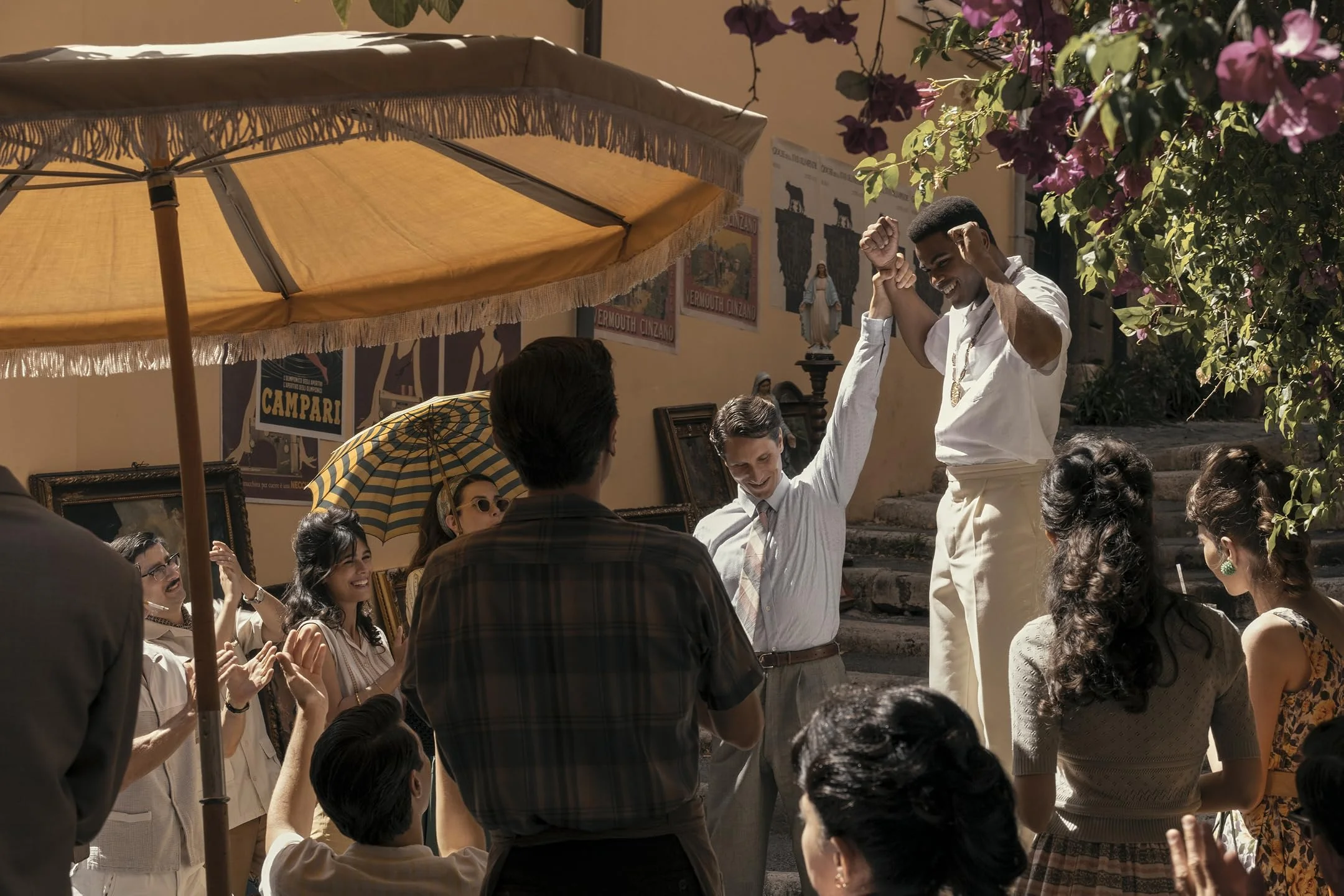
Creator Ben Watkins gives that development eight episodes, covering the stretch from the 1960 Rome Olympics to the 1964 Sonny Liston fight and Clay’s emergence as Muhammad Ali. It is a sensible use of television’s breathing room. The professional ascent supplies direction while disagreements over training, management, and readiness keep interrupting its apparent inevitability. Cassius wants to get on with becoming champion. His family has questions about the timetable. The series gets substantial dramatic mileage from letting people who love the same teenager disagree about what his gifts entitle him to attempt.
Dana Gourrier’s Odessa gives those arguments their strongest emotional foundation. Her easy affection with Best makes the household feel inhabited before its conflicts demand attention. Her fear of boxing also has a specific source: she has seen Sam Baroudi killed in the ring. Cassius hears caution while she remembers a body. Omari Hardwick’s Cash brings a different pressure, mixing pride in his son with frustrated artistic ambition and a determination to influence his career. His drinking and abusive behavior make that involvement volatile. Hardwick preserves the wound behind the controlling father without asking the wound to excuse him.
The family material becomes thinner around Rudy, Cassius’s brother and fellow boxer. Kai Parham gives him a sturdy presence, but his loyalty receives considerably greater dramatic attention than his own sporting ambitions. Within a season that makes time for competing ideas about success, that omission registers. Rudy is often available to help Cassius become himself; the writing is less curious about what Rudy might become. This is a limitation of the role, especially beside the specificity given to Odessa’s fear.
The most productive use of that expanded running time belongs to Sonny Liston. Amin Joseph plays a formidable fighter who cannot command public affection with anything resembling Cassius’s ease. A television appearance in which he struggles to tell a joke makes the distinction painfully clear. Cassius is learning to turn hostility into attention. Liston wants to seem approachable and discovers that being given airtime offers no guarantee of being understood. The scene makes publicity another contest, conducted under rules his future opponent is learning much faster.
Joseph’s work also changes the purpose of the scenes away from boxing. When Geraldine, played by Erica Tazel, reads him a hostile newspaper profile and quietly improves its account, her protection exposes how much punishment can arrive disguised as description. The season gives Liston an interior life before asking us to anticipate his defeat. That choice becomes especially valuable when Cassius adopts the dehumanizing imagery used against him. An authorized biography could comfortably assign cruelty to its hero’s enemies. Here, the hero knows how effectively that cruelty can work and uses it himself.
Watkins is sometimes blunt about the forces surrounding Cassius, but the luncheonette encounter earns its bluntness through the practical business of ordering food. The establishment sells a burger honoring its Olympic champion while refusing him a seat at the counter. Celebration has produced a menu item without producing equal treatment.
Cassius’s growing religious commitment develops within that gap between public recognition and personal freedom. Michael Ealy’s Malcolm X gives the decision weight by warning him about the costs of joining the Nation of Islam. The series distinguishes his mentorship from Elijah Muhammad’s interest in Cassius’s visibility, while Odessa’s hurt prevents conversion from functioning as a frictionless milestone on the way to greatness.
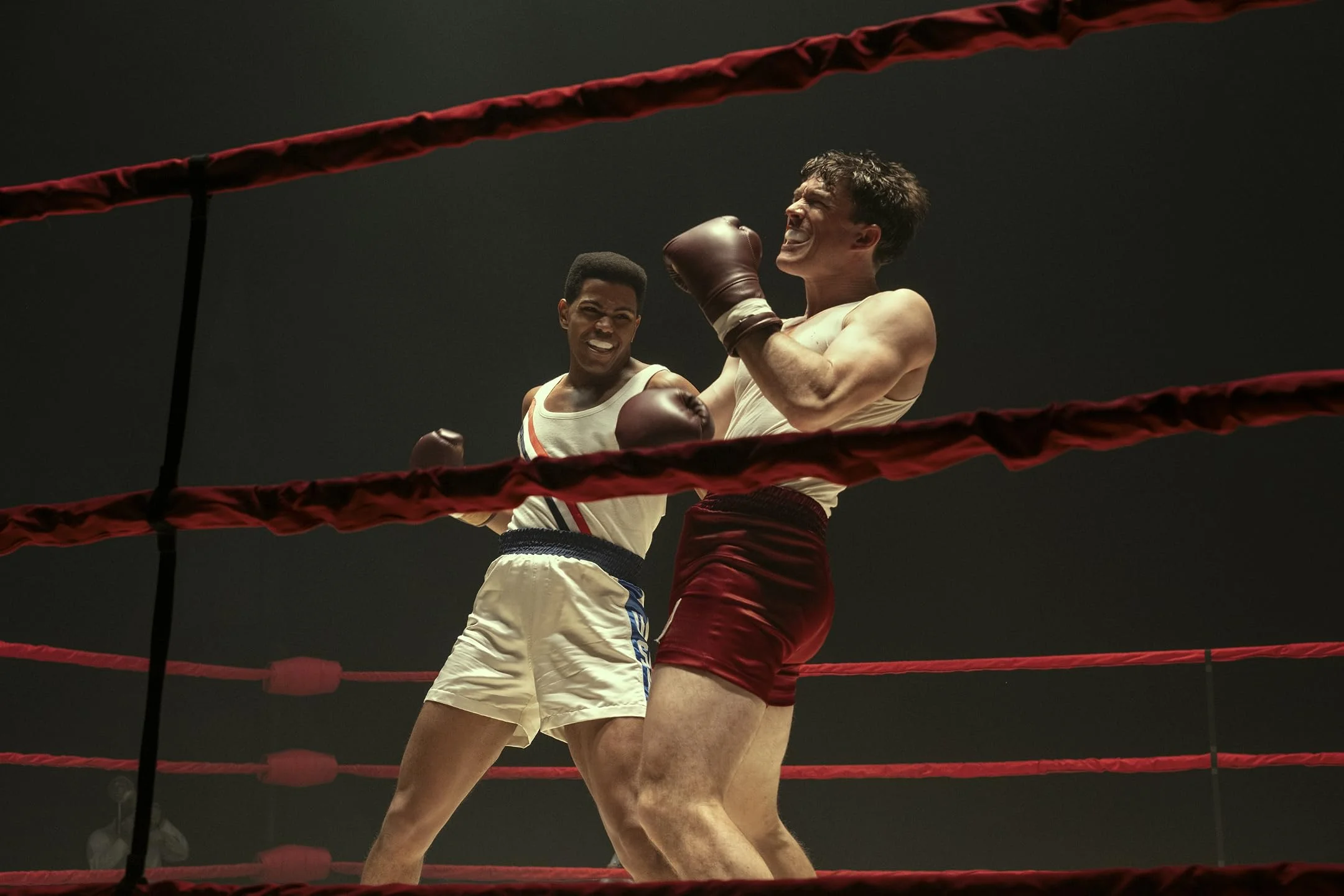
In the ring, Best’s footwork and probing jab make the self-confidence physically intelligible. He gives Cassius a style that can justify the talk. The Henry Cooper bout then makes that assurance vulnerable: a knockdown near the end of the fourth round interrupts the expected exhibition of superiority before Cassius returns to win in the fifth. The dramatic value lies in the interruption. For a moment, all the promises made by this fast, articulate young man depend on a body that has stopped doing what he expects.
The show’s formal experiments are less consistently assured. During a midseason fight, a badly hurt Cassius enters a black-and-white, apparition-filled subjective space as his corner tries to restore his awareness. Leaving the immediate action communicates his distance from the people attempting to reach him, though it also competes with the urgent drama already present in their efforts.
The interlude is strongest as an experience of disorientation; its freight of significance can feel imposed. Hip-hop-backed boxing montages have a related problem. Their promotional energy advertises the athlete’s exceptionalism so insistently that the uncertainty Best supplies elsewhere briefly disappears. The man gets replaced by his campaign.
A.V. Rockwell’s finale has a better source of excitement available in the Liston fight. Its result is familiar, yet familiarity does little to diminish Best’s exhilaration as Cassius enters the ring. The season has made reaching this contest an achievement with personal costs, and the bout gives those accumulated decisions an immediate physical test.
Liston’s presence complicates the pleasure without extinguishing it. We can want Cassius to win while remembering Joseph’s difficult television joke and Geraldine’s protective reading. Victory will give one man the power to announce who he is; the other has already shown us how hard it can be to get anyone to listen.
The Greatest premieres exclusively on Amazon Prime Video on November 4, 2026. Created by Ben Watkins, the biographical drama series chronicles the iconic life, athletic career, and personal struggles of legendary boxer Muhammad Ali.
Where to Watch The Greatest Online




Full Credits
Title: The Greatest
Distributor: Amazon Prime Video
Release date: November 4, 2026
Rating: TV-MA
Running time: 60 minutes per episode
Director: Ben Watkins
Writers: Ben Watkins, Maria Warith-Wade, Jeff Augustin, Blaize Ali-Watkins, Aiyana White
Producers and Executive Producers: Ben Watkins, Lonnie Ali, Michael B. Jordan, Elizabeth Raposo, Josh Wakely, Corey Salter, Marc Rosen, Matthew Gross, Michele Anthony, Boyd Muir
Cast: Jaalen Best, Omari Hardwick, Dana Gourrier, Kai Parham, Amin Joseph, Michael Ealy, Giovanni Ribisi, Erica Tazel
The Review
The Greatest
Jaalen Best gives The Greatest the confidence to take its time. Across eight episodes, Cassius Clay learns to command a crowd while family, faith, and ambition complicate his path to the championship. Amin Joseph’s vulnerable Liston makes the anticipated victory emotionally expensive. Rudy deserves fuller treatment, and the promotional montages occasionally seem impatient with the drama happening between them. The fights deliver, but giving the future opponent a life is what makes the final bout hurt.
PROS
- Best captures both youthful uncertainty and growing showmanship.
- Best captures both youthful uncertainty and growing showmanship.
- Family conflicts give the sporting ascent personal stakes.
- Physical performances make familiar fights tense.
CONS
- Rudy’s own ambitions receive little development.
- Dream imagery sometimes interrupts immediate tension.
- Promotional montages flatten the quieter uncertainty.