











When Sam points, the camera follows his claw. Larry Fessenden gives the vampire in Trauma or, Monsters All a brief power over the image: his gesture determines where we look. The movement belongs to the expressionist vocabulary of Nosferatu, reinforced by Sam’s occasional bald, bat-eared appearance. It makes predation theatrical, almost companionable. We are invited to enjoy the flourish of a creature whose capacity to kill the film has already established. Fessenden, playing Sam himself, understands the uncomfortable intimacy of letting a murderer conduct the tour.
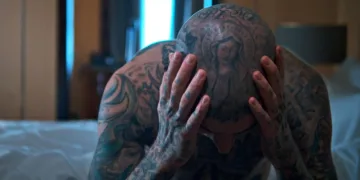
Clips from Habit, where Sam first appeared, give that grotesque face a visible past. The younger man survives inside the older vampire, and the distance between their appearances turns franchise continuity into an encounter with aging. Looking backward supplies reasons for sympathy without changing the nature of his appetite. This is an unusually productive use of returning-character footage: memory complicates what the present body signifies. The film becomes less assured when it asks its many conversations to perform the same work.
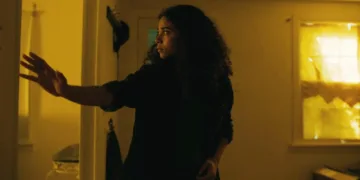
Cassandra’s view of the house next door establishes a different problem of interpretation. A writer and library worker newly arrived in Talbot Falls, she hears growling and notices a chained basement door. Laëtitia Hollard gives the film its human point of entry, but Cassandra’s perspective comes with the partial knowledge of a neighbor looking in. These are credible signs of danger. They also leave the arrangement inside the house unexplained, allowing the familiar grammar of concealed horror to prepare a judgment before the domestic facts are available.
Inside, Adam, the reanimated man from Depraved, cares for Charley, the werewolf from Blackout. Alex Breaux’s Adam retrieves discarded restaurant food; Alex Hurt’s Charley paints murals and submits to confinement around the full moon. Scavenging, painting, restraining: the activities give these bodies routines beyond their expected functions as attractions in a monster picture. The chain protects other people from Charley while making a shared life possible for the pair. Its meaning changes without its threat disappearing. Fessenden locates tenderness inside an arrangement that remains dangerous.
Cassandra’s newspaper article, circulated online too, exposes that arrangement. Charley’s confrontation with her brings the cost into focus: publicity may force him to leave Adam and begin hiding elsewhere. The truth of his condition settles very little about the wisdom of publishing it. Cassandra wants to understand her surroundings, yet her investigation converts a fragile household into public information. Her unfinished book about George Washington Carver adds a pointed inconsistency. She can pursue the complexity of a historical life while allowing the exceptional nature of her neighbors to dominate her account of them.
The film’s treatment of Cassandra becomes sharper when responsibility and persecution occupy the same space. She is Black and queer, and the racist and homophobic hostility she receives cannot be explained away as an understandable response to intrusive reporting. Her developing relationship with Agnes, played by Aitana Doyle, gives her an attachment to Talbot Falls beyond its mysteries. It also leaves her exposed within a place she is trying to make habitable. Her capacity to harm other people and her vulnerability to harm remain separate facts.

Publication brings several kinds of attention into the town, and the distinctions matter. Polidori wants to exploit Adam. Charley’s former partner Sharon and his friends want contact with someone they have lost. The police officers pursuing revenge approach the same information with another purpose entirely. Fessenden’s ensemble is strongest when these motives disturb one another. Sympathy becomes difficult to distribute because exposure can permit reunion and exploitation at once. A single article has supplied everyone with directions, without giving them any reason to want the same destination.
The larger allegory sometimes blunts these distinctions. A trans barista identifies herself through the language of monstrosity, while Cassandra explicitly considers the overlap between her queer story and a monster movie. Such moments make the politics unmistakable, but the metaphor has a strain built into it. Social prejudice invents danger around marginalized identities; Sam actually kills people. Gathering both experiences under one designation can obscure the difference between being feared and giving someone cause for fear. Adam’s care for Charley handles that difficulty with greater precision than the dialogue explaining the film’s inclusiveness.
Physical effects help preserve the creatures’ stubborn particularity. Charley’s fur and makeup keep the werewolf attached to a recognizable human body, while the claw wounds give violence a material consequence. The less convincing digital flies and blurred bursts of superspeed work against that presence. Movement briefly looks detached from weight, and attention shifts from a vulnerable or dangerous body to the device being used to animate it. Limited resources explain the unevenness, but they cannot make every visible compromise expressive.
The same unevenness governs the film’s accumulation of talk. Flashbacks and exposition make the earlier stories intelligible, allowing newcomers to follow the principal relationships. Yet repeated encounters about Cassandra’s article keep returning the drama to information already established.
Charley’s objection changes what publication means; other conversations chiefly confirm that somebody else has read the piece. The eventual convergence takes too long to acquire force. The drag comes from repetitions of explanation, rather than from any shortage of attacks, and the early attention to Cassandra’s Carver writing stretches a connection the film has already made legible.
Sam’s discussion of empathy supplies a more troubling use of speech. He describes morality as something that requires practice, a capacity that deteriorates through neglect. Coming from Fessenden’s vampire, the observation carries the authority of experience and the suspicion of self-excuse.
His exchanges with Sharon, played by Addison Timlin, permit sympathy to emerge without removing the predator established earlier. He possesses the language needed to recognize another person’s suffering. The encounter remains unsettled because his understanding has to coexist with the killing we have already watched.
Trauma or, Monsters All released in theaters via Dark Sky Films on November 4, 2026. Directed by Larry Fessenden, the horror film follows an aspiring writer investigating her small town’s dark history who stirs up public fears about what hidden creatures might lurk within.
Where to Watch Trauma or, Monsters All (2026) Online
Full Credits
Title: Trauma or, Monsters All
Distributor: Dark Sky Films
Release date: November 4, 2026
Running time: 1 hour 59 minutes
Director: Larry Fessenden
Writers: Larry Fessenden
Producers and Executive Producers: Larry Fessenden, Gaby Leyner, James Felix McKenney, J. Christian Ingvordsen, Tilson Allen-Merry, Edwin Linker
Cast: Laëtitia Hollard, Aitana Doyle, Addison Timlin, Alex Hurt, Alex Breaux, Larry Fessenden, John Speredakos, Cody Kostro
Director of Photography (Cinematographer): Sharif El Neklawy
Editors: Larry Fessenden
The Review
Trauma or, Monsters All
Fessenden’s monsters become persuasive through the lives their bodies contain: Adam’s care, Charley’s confinement, Sam’s visibly accumulated years. The camera’s flirtation with the vampire gives sympathy a dangerous accomplice. Repeated exposition slows the gathering storm, and the inclusive monster metaphor sometimes blurs distinctions the characters make sharper. Yet the film’s best encounters preserve an uncomfortable distance between recognizing suffering and behaving decently.
PROS
- Expressive vampire imagery complicates audience sympathy.
- Adam and Charley’s domestic routines give the moral questions substance.
- Archival footage makes Sam’s aging emotionally meaningful.
CONS
- Repeated explanations delay the ensemble’s convergence.
- Broad allegory blurs different kinds of exclusion and danger.
- Uneven digital effects weaken physical presence.