






















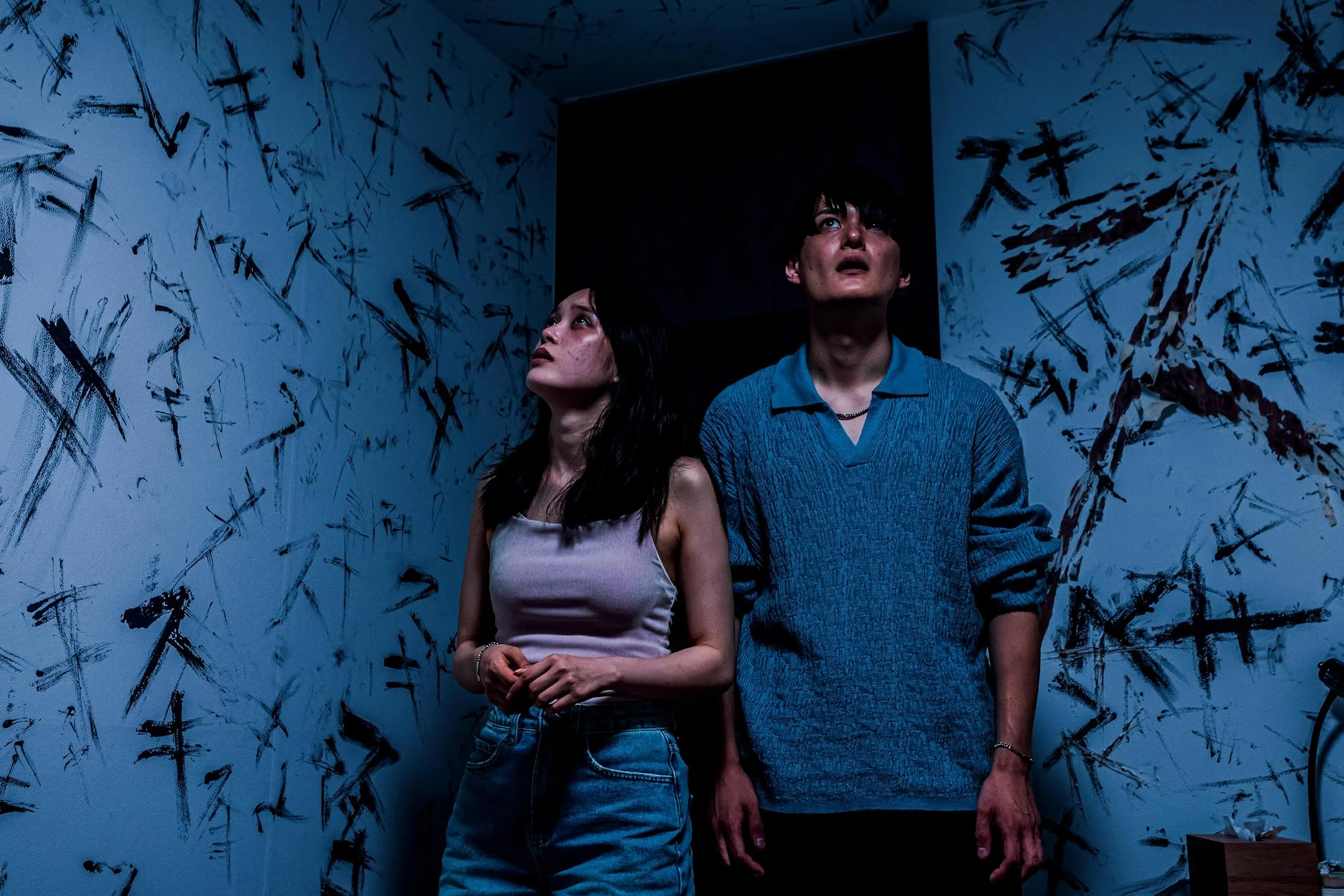

The schoolboy checking his hair in the mirror still has some authority over his appearance. That small privilege disappears quickly. A warning about a female ghost becomes a pursuit, rejection fails to protect him, and he dies while urinating, his eyes sucked from their sockets.
Yuriyan Retriever then uses the liquid spreading across the restroom tiles to spell out Mag Mag. The body that horror has rendered helpless becomes material for a graphic joke. It is a startlingly indecent way to introduce a film, particularly because the boy’s terror has hardly had time to subside.
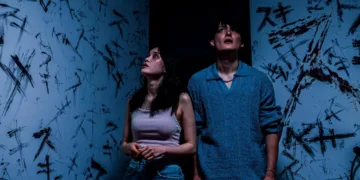
The joke leaves an uncomfortable residue. Retriever’s horror sequences favor static compositions, shadowed spaces, and slight disturbances of the frame, with threatening music and sudden sounds encouraging us to anticipate an attack. These choices place the spectator in a condition resembling the victims’ paralysis: looking becomes an anxious activity with little practical value.
The restroom death then converts that helplessness into spectacle. Our attention moves from a person’s fear to the ingenuity of his humiliation. Retriever, making her feature-directing debut from Eisuke Naito’s screenplay, is willing to compromise the sympathy her horror grammar has just recruited.
Her towering, long-haired phantom belongs recognizably to the female-ghost tradition of Ringu and Ju-On, though affection supplies the immediate threat. Mag Mag pursues the men she desires until they die. Refusal offers no reliable escape, making romantic attention a sentence imposed without consent.
That premise acquires an awkward human reflection through Sanae, an art student and amateur ghost investigator played by Sara Minami. When the ghost kills Hiroshi, the sculptor Sanae has been pursuing, she commits herself to vengeance. His lack of interest in her does little to interrupt her sense of attachment.
Hiroshi’s own romantic expression is hardly innocent of presumption. He presents his model, Rumi, with a nude sculpture intended as a declaration of love. She initially recoils from an exposure she did not want. The sculpture gives this disagreement a visible form: he sees a tribute, while she encounters her body made available to someone else’s interpretation.
His artistic intention cannot determine her response, however sincerely he offers it. In a film crowded with spectacular violations of flesh, this quieter act of representation deserves attention. A person can become material for somebody’s desire before anything supernatural enters the room.
Rumi later understands Hiroshi’s intention and reconciles with him, which prevents the encounter from serving as a simple exhibit for the prosecution. Her response changes; the initial discomfort remains part of what happened. Elsewhere, Akihito’s sexual opportunism within a shared house, pursuing Hina and Haruka while involved with Yui, makes exploitation less ambiguous.
These episodes give the ghost’s victims different kinds of culpability, but culpability and a death sentence remain separate questions. The recurring danger is that grotesque punishment will provide the audience with such a satisfying release that distinctions between carelessness, cruelty, and entitlement cease to matter.
Minami makes Sanae an especially effective obstruction to that satisfaction. Her intrusive devotion denies us the security of a sensible investigator sorting through other people’s disorders. In the prolonged declaration of love, comic persistence becomes disturbing because the feeling continues to demand recognition.
Minami commits to the excess without giving Sanae a comfortable distance from it. The physical extremity reaches its fullest expression when she covers herself in lubricant and forces her body through a sphincter-like opening where the mouth should be in a giant portrait of her beloved. Romantic idealization has acquired some distinctly inhospitable anatomy.
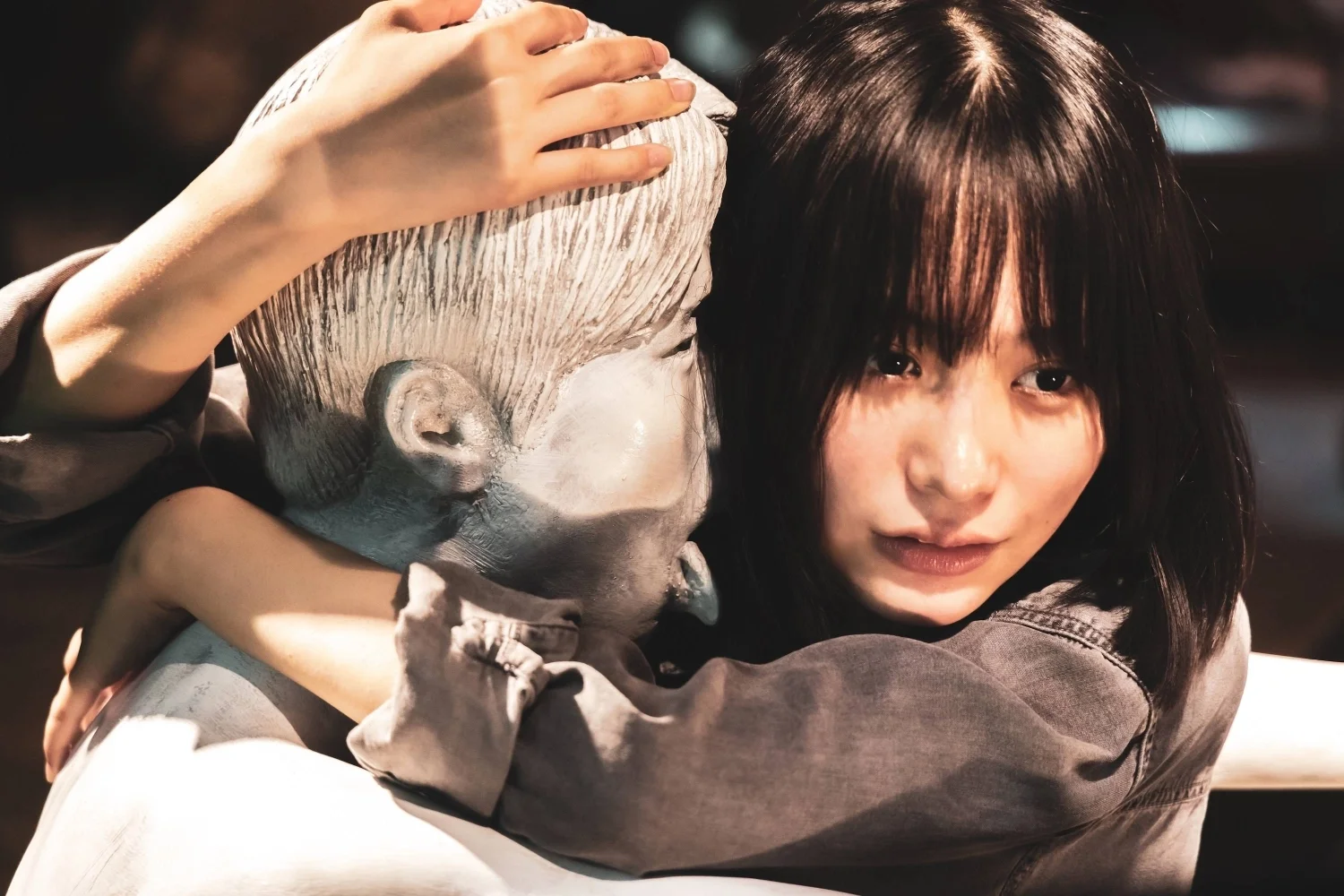
The portrait sequence earns its absurdity through its connection to Sanae’s attachment. She tries to enter an image, giving bodily form to a desire for intimacy organized around her own conception of the man. Beside Hiroshi’s sculpture, it creates a troubling exchange between making an image of another person and surrendering oneself to that image.
The situations are different, and the film need not assign them equal harm for the resemblance to register. Retriever’s grotesquerie becomes revealing here: the impossible object exposes a recognizable refusal to let another person remain separate. The sequence’s sheer extravagance can overwhelm its emotional pressure, but its visual logic holds.
Sanae’s inquiry initially offers a familiar explanation for the haunting. Yurika, an overweight schoolgirl, submits a written confession of love and suffers rejection and bullying before dying by suicide. That apparent history invites us to read the ghost as an injured woman returning to punish her tormentors.
Mag Mag’s imposing size, set against the cruelty directed at Yurika’s appearance, makes the relationship between desirability and fear visible. Yet the later complications resist a stable division between innocent victim and guilty aggressor. The film’s strongest moral uncertainty comes from revising the account that made its violence appear intelligible, rather than simply increasing the violence.
Its chapters are less consistently successful at sustaining that uncertainty. Following several men through pursuit and death establishes a recognizable pattern well before the larger mystery has finished developing. Different relationships supply different offenses, but the spectator increasingly knows the destination.
Across a running time close to two hours, fresh grotesque incidents can restart attention without deepening suspense. Sanae’s investigation and the development of her attachment lose continuity as the film moves among these encounters. The problem is intermittent dramatic accumulation: individual episodes make their points, then the emotional pressure has to be rebuilt elsewhere.
The late convergence gives the fractured narrative a purpose, allowing Sanae’s fuller story to alter our understanding of the pursuit. There is pleasure in discovering that an apparent explanation was provisional, although the revelations cannot restore all the tension spent on repeated deaths. They also return attention to the investigator’s investment in the case. Sanae’s wish to avenge Hiroshi carries the unresolved fact of his rejection. The dead man can no longer answer her devotion, correct her account of their relationship, or object to the image she is defending.
Mag Mag made its world premiere at Beyond Fest on September 30, 2025, before making its theatrical debut in Japan on February 6, 2026, distributed by K2 Pictures internationally. Marking the directorial debut of Japanese comedian Yuriyan Retriever, this subversive horror-comedy centers on a vengeful ghost whose possessive love leads to absurdly grotesque consequences for any man who catches her eye.
Where to Watch Mag Mag (2026) Online
Full Credits
Title: Mag Mag
Distributor: K2 Pictures, Third Window Films
Release date: September 30, 2025 (Beyond Fest), February 6, 2026 (Japan)
Running time: 1 hour 52 minutes (112 minutes)
Director: Yuriyan Retriever
Writers: Eisuke Naito
Producers and Executive Producers: Daisuke Takahashi, Muneyuki Kii
Cast: Sara Minami, Oshiro Maeda, Aoi Yamada, Akari Takaishi, Joe Kujo, Fuku Suzuki, Mizuki Maehara, Atsuko Hirata, Tetsu Hirahara, Takumi Saitoh, Rena Tanaka
Director of Photography (Cinematographer): Hideki Shima
Editors: Taki Yasuda
Composer: Yonkey
The Review
Mag Mag
Mag Mag makes desire visible in uncomfortable forms: an unwanted nude sculpture, a portrait Sanae physically enters, a ghost whose affection permits no refusal. Retriever’s grotesque images complicate sympathy, and Sara Minami gives obsession an unnerving comic force. Repeated deaths weaken suspense, while the chapters interrupt Sanae’s emotional development. The late revelations restore some dramatic purpose, leaving a troubling question about the relationship she believes she is defending.
PROS
- Grotesque imagery gives romantic entitlement a physical form.
- Sara Minami’s committed, disturbing comic performance.
- Framing and sound turn helplessness into uneasy spectatorship.
- Late revelations complicate assumptions about guilt.
CONS
- Repeated death patterns drain suspense.
- Chapter shifts interrupt Sanae’s emotional development.
- Extravagant spectacle sometimes overwhelms emotional pressure.







