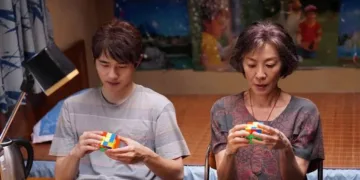


























The cubing instructor is asleep while his elderly student demonstrates what she can do. Wu Youwei has accepted a teaching assignment at an assisted-living home, where the organizer hopes Rubik’s Cubes might help residents stave off dementia. Zhao Yanhong solves one in ten moves and calls out his laziness. Bai Xue’s It’s My Time finds a useful comic imbalance here: the activity offered to preserve an older person’s faculties exposes the younger professional’s failure to use his own. Zhao has been given something to occupy her time. She treats it as something worth mastering.
Once that ability attracts attention, other people begin deciding what it might be worth. Her friend Shuzhen records her achievement; an agent promises income through endorsements. For Zhao, a 70-year-old former mathematics teacher played by Michelle Yeoh, the financial appeal has a painful foundation.
She lost her apartment to a scam, suffered a stroke, and moved into senior housing. Money represents some recovery of control over a life abruptly reorganized by loss. Her eagerness to earn complicates the comforting image of a retiree discovering a pleasant hobby. She wants something the hobby might buy.
The publicity surrounding her talent offers a less demanding kind of recognition than competitive cubing. A late-night game show makes her age the attraction, while online admirers adopt the affectionate name “Grandma Zhao.” Affection is welcome, though the nickname fits her temperament rather poorly.
Younger competitors underestimate her skill and stamina; admirers imagine a cuddly elder. Both responses arrive with a ready-made idea of the person before them. The film’s comedy draws energy from Zhao refusing to cooperate with either expectation, particularly when admiration carries the assumption that she will be gracious about receiving it.
Yeoh gives that refusal an entertainingly abrasive texture. Zhao attacks her robot care companion, slips out to buy alcohol, and directs her temper at people trying to deal with her. These behaviors allow an older female protagonist a degree of bad manners often reserved for younger rebels.
Yeoh makes the mischief inviting without turning every outburst into harmless eccentricity. Zhao can be funny and exhausting within the same encounter. Her intelligence remains evident in the cubing classroom, where her impatience has a proper target: a supposedly qualified instructor who cannot be bothered to teach.
Wu’s own circumstances prevent this from becoming a simple contest between elderly vitality and youthful complacency. Played by Liu Haoran, the 24-year-old former prodigy is introduced being attacked by creditors. Debt, alcohol, and homelessness have diminished the promise attached to his talent.
Zhao recruits him as her coach and gives him somewhere to stay at the senior home. Their arrangement begins with needs that neither can satisfy alone. He possesses expertise she wants; she offers stability he lacks. Haoran’s contribution works through that changing relationship, as a paid opportunity becomes a commitment to someone whose demands require him to engage again.
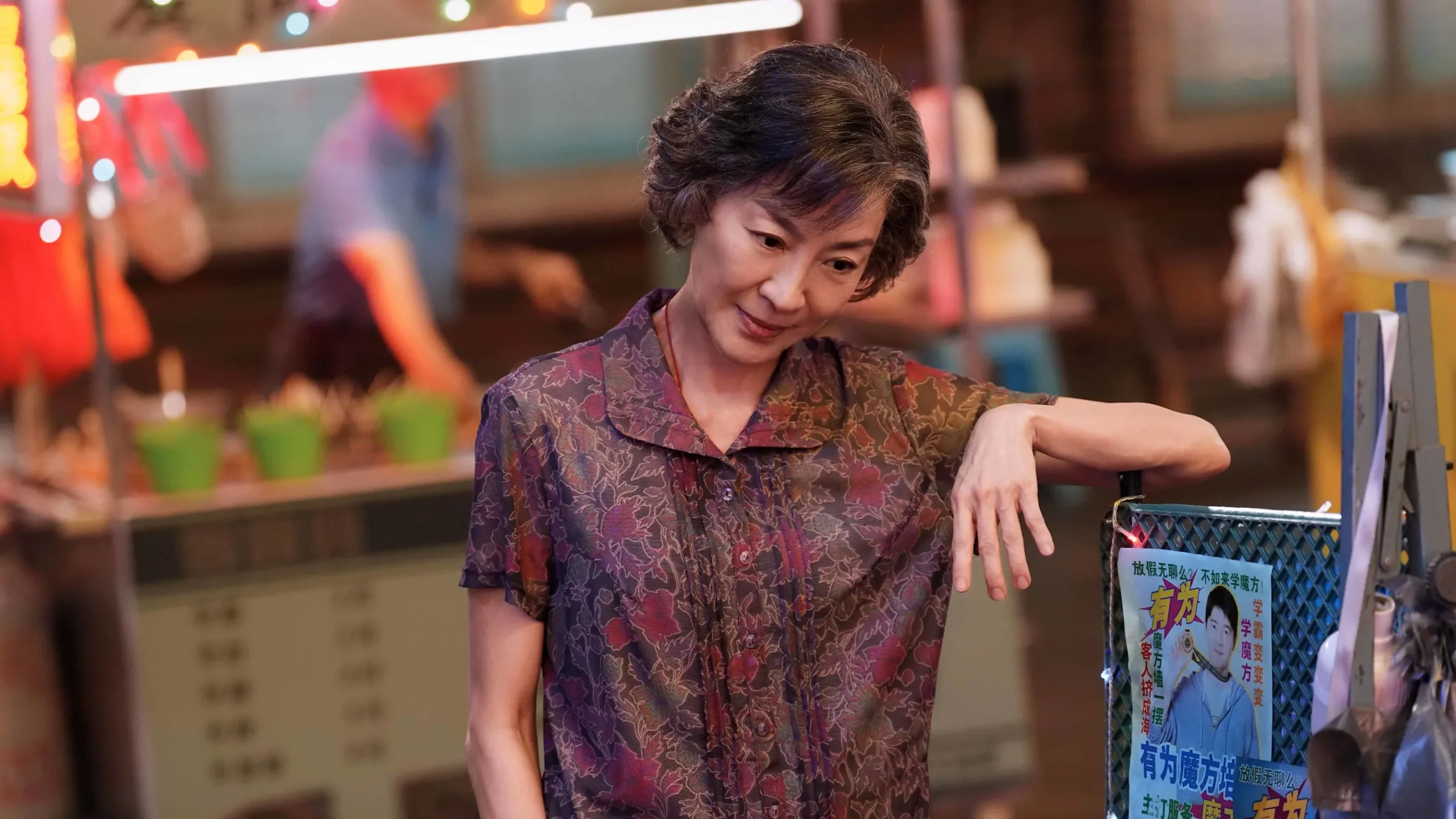
His recent bereavement brings another pressure into the partnership. Having lost his mother, Wu finds a maternal presence in Zhao, and their developing affection gives the coaching scenes emotional weight. It also draws her toward a familiar identity. The woman seeking a new pursuit becomes someone who helps a younger man rebuild his life. That development is tender, though the practical exchange keeps it from swallowing her ambition. She continues to need him as a coach. Her care comes with expectations of work, and his recovery takes place through taking her goal seriously.
Zhao’s relationship with her son, Dong Dawei, places a different limit on her freedom. She feels guilt about the past and wants to provide for his family, despite their comfortable circumstances and encouragement of her new interest. The obstruction here cannot simply be assigned to ungrateful relatives.
Zhao carries a sense of obligation that their support does not immediately dissolve. Wu’s advice to enjoy competing introduces a possibility that earning money and repairing old failures have obscured. Pleasure can be a sufficient reason to continue, even for someone accustomed to measuring her choices through what they give other people.
The competitions make that pleasure accessible. Rapid editing, energetic graphics, and broadcast-style presentation give the cube’s small movements an urgency that a stationary observer might miss. Bai directs attention toward speed, dexterity, and the pressure of performance, allowing Zhao’s expertise to command the screen.
The qualifying rounds grant her the seriousness that the game-show appearance withholds. Her age remains relevant to the obstacles she faces, but the timed contest supplies another measure. Watching her compete becomes exciting because the film makes the task feel demanding, rather than relying entirely on the surprise of an elderly participant.
Its sports construction is also stubbornly familiar. Wu identifies stamina as a weakness, and Zhao runs, lifts weights, and practices toward higher-level competition. The physical training has a stated purpose, yet its presentation slots comfortably into the established machinery of the underdog film. The succession of preparation and qualifying tests makes the dramatic route easy to anticipate. Bai generates lively individual passages without finding an equally distinctive shape for the story carrying them.
The later account of Zhao’s past narrows that distinction further. Successive montages disclose her hardships as a single mother, giving history to the anger Yeoh has already made legible. The feeling is sincere, and the disclosures deepen her anxiety about failing her son.
Their accumulation, however, repeatedly interrupts the present to solicit sympathy for the past. A character initially permitted to be difficult acquires an expanding dossier of suffering that explains her difficulties. Yeoh sustains the connection between the impatient competitor and the wounded parent, but the film keeps supplying emotional assurances after the performance has established enough.
Closing footage of Yeoh meeting Zhao Wenying, the retired teacher and cubing champion who inspired the film, introduces a person beyond the adaptation’s arranged reversals and disclosures. Her achievement deserves attention without requiring every fictional episode to authenticate it. The encounter also shifts the scale of the story’s promise. Exceptional skill has given this older woman a public platform; the freedom she seeks is an ordinary one. Enjoying time that belongs to oneself should remain possible for the residents who will never have a championship to pursue.
It’s My Time premiered in theaters across China on June 30, 2026, and expanded to streaming platforms such as iQIYI. The Chinese sports comedy-drama follows a fiercely independent 70-year-old grandmother who teams up with a debt-ridden, former speedcubing prodigy to enter competitive Rubik’s Cube tournaments, defying ageism and family expectations.
Full Credits
Title: It’s My Time
Distributor: Media Asia Film, iQIYI
Release date: June 30, 2026 (China), September 17, 2026 (Hong Kong)
Running time: 1 hour 47 minutes (107 minutes)
Director: Bai Xue
Writers: Bai Xue, Sun Yan, Xu Yizhou
Producers and Executive Producers: Wen Muye, Ning Hao
Cast: Michelle Yeoh, Liu Haoran, Sa Rina, Bai Ke, Han Tongsheng, Qi Xi, Tian Yu, Huang Yao, Chen Halin, Jiang Qiming, Jin Jing
Director of Photography (Cinematographer): Piao Songri
Editors: Zhou Xinxia
Composer: Gao Xiaoyang
The Review
It's My Time
Michelle Yeoh gives Zhao the intelligence, temper, and appetite for independence that sentimental portraits of aging often smooth away. Her reciprocal partnership with Wu and the lively cubing sequences make that independence worth cheering. Familiar sports plotting and accumulated hardship montages soften the film’s sharper observations, repeatedly asking for sympathy where Yeoh has already earned understanding. Its most persuasive promise is that an older woman can pursue something for her own pleasure.
PROS
- Yeoh’s funny, abrasive, emotionally precise performance.
- A coaching partnership built on reciprocal needs.
- Energetic, engaging cubing competitions.
- Thoughtful treatment of aging, ambition, and family obligation.
CONS
- Predictable underdog plotting.
- Accumulated hardship montages overexplain Zhao and interrupt the present.







