


























Freya has been hired to supply lived experience, and the director keeps correcting what it looks like. Filming a Department for Work and Pensions advert in a supermarket, she sits beneath a shelf of nappies with a prop baby over her shoulder, trying to produce the required expression. One attempt is rejected as too helpless.
“That’s Unicef,” he explains, as though human vulnerability came with an agreed classification system. The shelf presents a practical difficulty; the production wants an expression suitable for its message about government assistance. Freya’s experience qualifies her for the job without giving her authority over how it is represented.
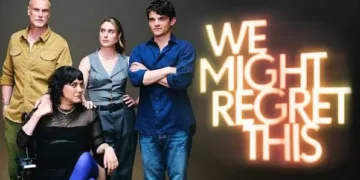
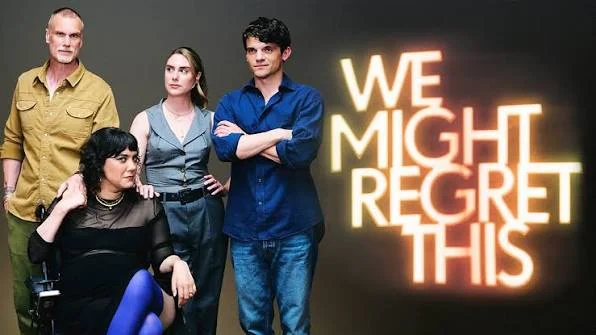
Kyla Harris, the co-creator who plays Freya, gives the exchange its comic balance by resisting the director’s level of absurdity. Her relatively straight performance lets his instructions accumulate their own ridiculousness. The second season of We Might Regret This finds considerable humor in people who believe they understand disability because they have a professional use for it.
Freya is a tetraplegic Canadian artist working in London, yet the advertising assignment narrows that identity to a particular look of need. The demand for authenticity becomes especially funny once the employer starts issuing corrections to the authentic person.
Her engagement offers another assignment. Freya and Abe, played by Darren Boyd, are preparing to marry, and her agents, the Olivias, immediately recognize the commercial possibilities. Emma Sidi and Hanako Footman make their enthusiasm feel professionally rehearsed: a disabled bride could attract a designer, a campaign, an audience.
Their pitches place disability inclusion beside sponsorship so comfortably that the couple’s wishes seem like details to be collected later. Where the advert requires carefully measured helplessness, the wedding campaign requires an attractive celebration. Freya can be paid to embody either, provided someone else gets to decide what her life means.
The agents’ excitement makes a persuasive challenge to the comforting equation between visibility and power. Their interest is real, as are the opportunities they offer. Freya has work to find and reasons to consider a sponsored wedding, which gives her discomfort substance beyond a simple rejection of commercial life. Agreeing could be useful and still feel invasive.
Sophie Thompson’s alternative bridal designer, Beanie McElroy, brings the strain into the fitting itself, proposing half a dress for someone half certain about marrying. The joke makes room for a bride whose hesitation would be inconvenient campaign material. A public celebration is being assembled around a private decision that remains unsettled.
That uncertainty acquires emotional weight through Jo’s absence. Elena Saurel’s Jo became Freya’s live-in personal assistant in the first season, combining friendship, employment, and proximity within an arrangement that could never keep those roles neatly separated. Freya then discovered Jo had been sleeping with Abe’s son, Levi. Jo fled during a care shift, leaving Freya in the hallway.
The betrayal therefore has consequences that a conventional friendship quarrel would not carry. Someone essential to Freya’s daily assistance disappeared at the same moment that she became difficult to trust. Freya’s continuing desire to see her refuses the easy moral tidiness of replacing a bad employee.
The household has acquired its own spokesperson for moving on. Ty, Freya’s reinstated PA, insists they are thriving without Jo while squeezing herself between Freya and Abe. Aasiya Shah delivers the assurance with a speed and conviction that make it sound like a decision already taken on everyone’s behalf.
Ty benefits from the new arrangement, and her account of its stability leaves little room for Freya’s attachment. The joke unsettles the assumption that assistance flows from a competent person toward an incompetent one. Practical dependence gives the assistant a role; it does not make her the most perceptive person in the room.
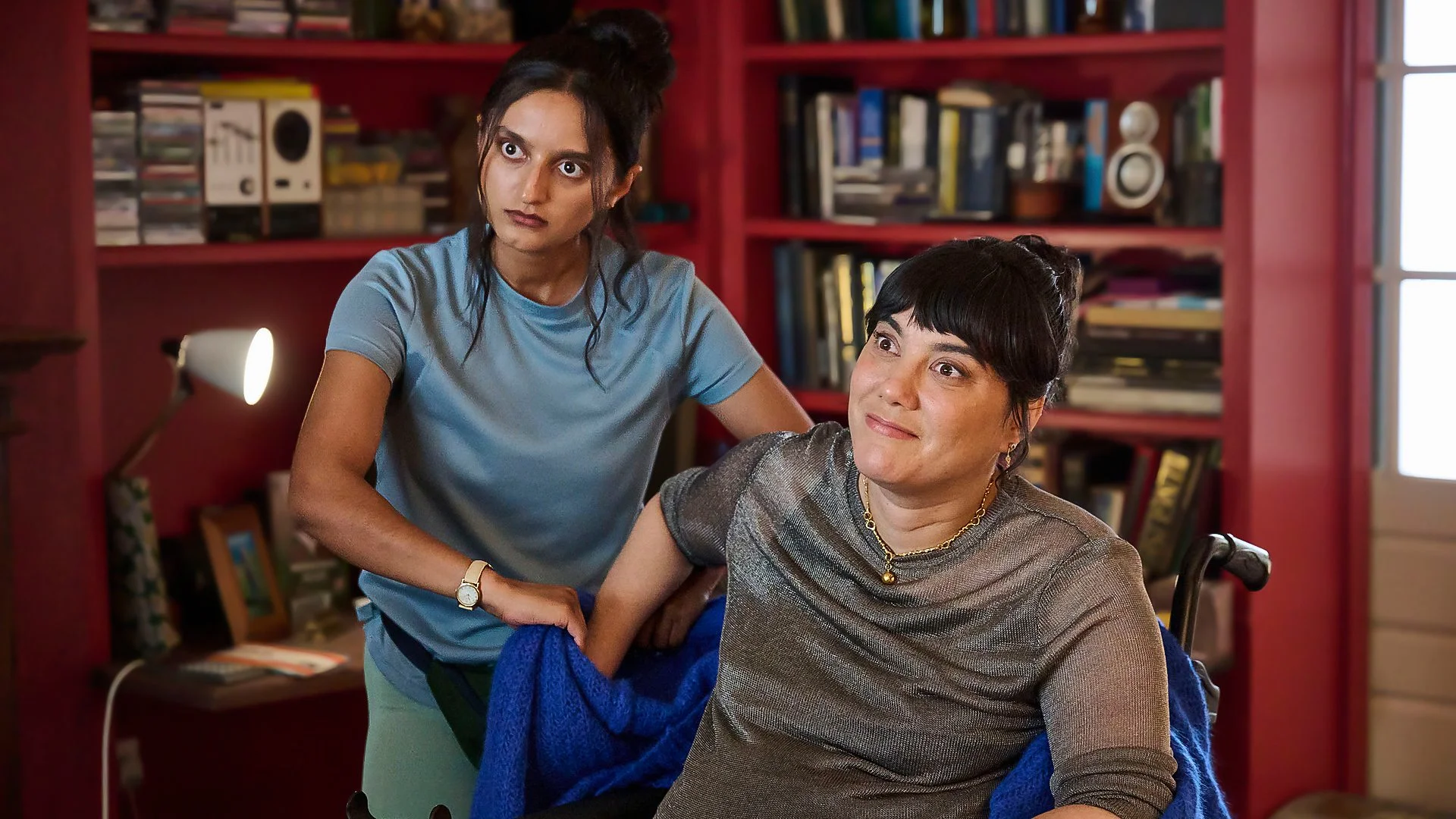
The season’s domestic comedy is strongest when it allows these needs to remain awkwardly simultaneous. Levi, played by Edward Bluemel, fears that Jo’s disappearance has some terrible explanation. Ty would prefer her absence to become permanent. Freya misses her.
At a table where agents and family members discuss weddings and content creation, Freya decides to look for Jo, shifting attention toward the person who is missing from the proposed celebration. Her wish carries affection and injury together. It also gives the series something the publicity campaign cannot supply: a relationship whose value survives its failure to look reassuring.
The comedy occasionally makes its targets too obliging. The Olivias’ declaration that their work combines art, commerce, inclusion, and exploitation practically performs the analysis for the audience. Their bridal pitches are sharper because they let an apparently helpful offer expose its own assumptions. Stating the exploitation outright reduces that uncomfortable process of recognition.
Ty’s emphatic announcement of household harmony has a related limitation: its selfishness is immediately readable, leaving little uncertainty about the gap between her confidence and Freya’s feelings. These are funny performances, but the writing sometimes pushes the eccentricity past the point where a character’s behavior needs to be interpreted.
The comfortable London creative setting also shapes the reach of the satire. Advertising work, publicity meetings, bridal collaborations, and a spacious domestic world make professional condescension unusually available for inspection. Financial hardship receives less concrete dramatic attention.
Freya’s difficulty establishing herself as an artist complicates any description of this environment as simply secure, yet the clearest pressures here concern the terms on which she becomes commercially useful. Affluent disabled people have every claim to stories about romance and bad decisions. Their setting still matters when the comedy moves from these particular indignities toward an account of social power.
The sponsorship offer leaves a material question beneath Freya’s distaste. Refusing would protect an occasion she wants to experience privately; accepting could help her obtain things she has reason to want. The series gives that choice a persuasive emotional texture through the agents’ eagerness and Freya’s hesitation, while leaving the cost of refusal less developed.
We Might Regret This Season 2 premiered on BBC Two and BBC iPlayer on February 25, 2026, with international streaming distribution handled by Village Roadshow Television. Inspired by creator Kyla Harris’s lived experiences, the British comedy-drama series follows a disabled Canadian artist living in London alongside her older partner and her impulsive best friend, who acts as her personal care assistant, navigating the chaotic overlap of romantic ties, independence, and caregiving boundaries.
Full Credits
Title: We Might Regret This Season 2
Distributor: BBC Two, BBC iPlayer, Village Roadshow Television
Release date: February 25, 2026
Rating: TV-MA
Running time: 28–30 minutes per episode
Director: Nick Collett
Writers: Kyla Harris, Lee Getty
Producers and Executive Producers: Ash Atalla, Alex Smith, Rebecca Murrell, Gregor Sharp, Kyla Harris, Lee Getty, Inez Gordon
Cast: Kyla Harris, Darren Boyd, Elena Saurel, Edward Bluemel, Sally Phillips, Aasiya Shah, Emma Sidi, Hanako Footman, Jessie Mei Li
Director of Photography (Cinematographer): Will Hanke
Editors: Hettie Griffiths
Composer: Andrew Yee
The Review
We Might Regret This Season 2
We Might Regret This finds sharp comedy in the people who mistake professional interest in disability for understanding it. Harris’s restrained performance anchors a season that turns advertising, wedding sponsorship, and personal assistance into competing claims on Freya’s life. Her attachment to Jo gives that argument emotional difficulty without tidying away betrayal. Some jokes announce their targets too plainly, and the financial cost of rejecting commercial opportunities remains lightly explored. The season is funniest when an apparently helpful offer exposes how little room it leaves for Freya’s wishes.
PROS
- Sharp satire of advertising and commercial inclusion.
- Harris’s restraint grounds the ensemble’s comic excess.
- Friendship and care remain emotionally complicated.
CONS
- Some exaggerated dialogue makes the satire too explicit.
- The financial stakes of refusing sponsorship receive limited development.







