



























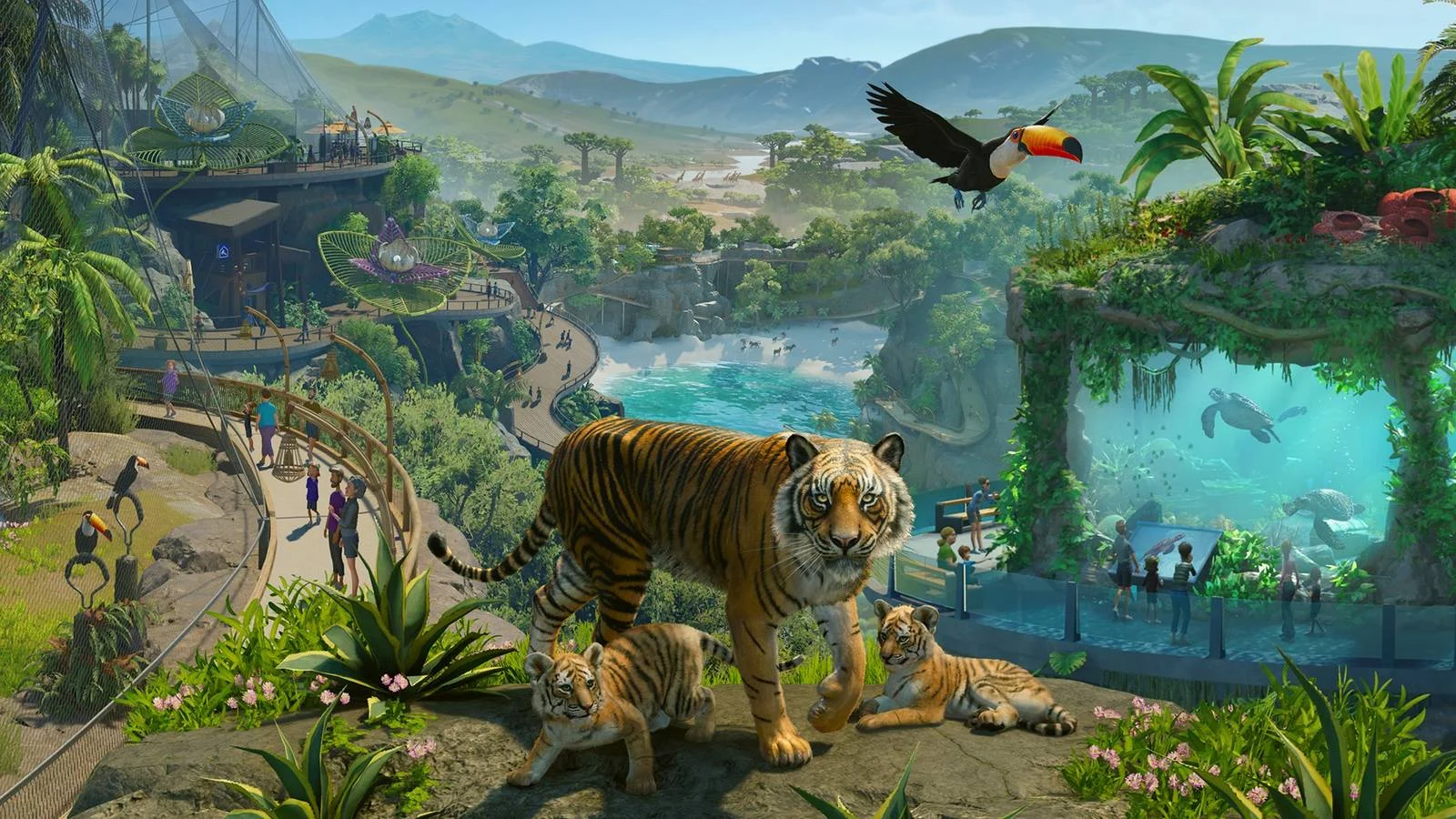

Breeding animals for release into a Wildlife Reserve asks for a different kind of planning from filling an attractive enclosure. Planet Zoo 2 requires suitable age and fertility, attention to relatedness within the breeding pair, and sometimes further research before a release group is ready.
Then there is the destination: enough water, appropriate vegetation, and an ecosystem that can use the species being introduced. The breeding program reaches beyond the zoo’s fences, giving decisions about the next generation a purpose that survives the departure of the animals themselves.
That purpose becomes interesting because a reserve needs animals for different reasons. Grazers, seed dispersers, and prey contribute to its Biodiversity Rating, so choosing a release group involves considering what the ecosystem lacks. A deer entering the Polish reserve can become food for wolves.
The system allows the success of a restoration project to diverge from the survival of an individual animal, which gives conservation some welcome complexity. Exploring on foot or by vehicle and photographing wildlife lets the player observe the place those decisions have helped establish, including outcomes that affection alone would prefer to prevent.
Career supports this connection through the Fauna and Ecosystems Network, linking zoos and reserves into an organization with shared research and animal storage. Some objectives require action at another facility, and earlier zoos remain part of the work. Revisiting them changes the value of a well-established breeding program: it can serve a later need elsewhere. This structure makes continued investment in a location feel sensible, while partially built zoos provide a starting point for learning the systems. The campaign earns its organizational fiction through the practical usefulness of its separate facilities.
Construction benefits from equally concrete improvements, though their importance is measured in saved effort. Scenery resizing allows a rock to become a broad formation or a small ledge, and recoloring extends to its moss. A custom foliage brush can distribute selected plants and rocks across an area, leaving individual placement available for the corners that need particular attention. These tools reduce the repeated assembly involved in realizing a design. The decisions about shape, density, and appearance remain with the player; placing a stretch of undergrowth no longer requires treating every bush as a separate project.
The path draw tool applies that principle to visitor space, turning a sketched shape into a plaza. Prefabs and reusable blueprints help establish functioning facilities without requiring architectural ambition from everyone who wants to manage animals. Aquariums represent a larger change in what can be built directly.
Underwater viewing in the original demanded awkward terrain and water-level adjustments. Here, glass panels, aquarium blueprints, and tunnels make a route beneath the animals a practical construction option. Freshwater, saltwater, and brackish environments, together with underwater terrain, give those installations different requirements and shapes.
Aquarium care also works at two scales. Individual “hero” animals receive individual management, while shoals are handled as groups, allowing a tank to combine a prominent animal with a population of smaller fish without assigning identical administrative weight to each resident.
Aviaries use another useful construction shortcut: barriers and support poles generate the net roof, after which perches and nesting platforms provide places for birds to fly between. Those additions expand the kinds of spaces a zoo can contain. They still leave a separate limitation in the animal list. Missing cheetahs, okapis, and American bison restrict particular regional collections, regardless of how flexible their potential enclosures have become.

Inside the habitats, decoration has acquired useful behavioral consequences. Animals scratch against trees and rub against rocks, making ordinary scenery something they can use. This is a satisfying connection between the editor and its inhabitants: a placed object participates in their activity.
It should not be mistaken for exhaustive social simulation, since interactions between social animals can remain infrequent. Welfare rewards specific habitat work. A giant panda’s need for a surrounding cluster of bamboo gives a concrete demand to satisfy, while the Thriving state, above basic welfare, connects research, reserve releases, and habitat conditions to improved fertility and attractiveness.
Guest management provides clearer diagnostic tools. Heatmaps identify unmet thirst, energy, and education needs, and guest thoughts help explain complaints. That information gives a manager something useful to act upon, rather than simply announcing dissatisfaction.
Staff buildings no longer offend visitors through visibility alone, removing the old incentive to spend time hiding necessary infrastructure. Education retains some less productive labor: boards need their topics assigned manually, and repeating topics does not expand educational coverage. The task has a reason, but maintaining the assignments can occupy attention that the animal systems put to better use.
The economy does not always apply pressure equal to that workload. Cash can accumulate comfortably during extended enclosure work, leaving meticulous maintenance and high ratings as stronger demands than constant financial sacrifice.
Expensive species still require saving, and Conservation Credits retain value, so purchases have weight without making every session a fight against insolvency. Sandbox’s adjustable conditions let players emphasize construction or retain management constraints. Franchise adds online animal trading and community goals. Those options offer different settings for the work, but the appeal of detailed care remains distinct from the difficulty of balancing a budget.

Learning to perform that care is uneven. Career’s objectives, highlighted controls, and hints give a newcomer considerably better footing than an empty map would. Yet some important details remain poorly exposed. Cohabitation guidance can leave the practical specifics to be found elsewhere, and the panel for managing educational topics is easy to miss.
The interface then adds inconsistencies of its own: one search filters as text is entered, another requires Enter; right-click can leave a tool or undo an action. Mastering animal requirements is rewarding. Memorizing different responses to the same input offers a thinner return.
Technical faults deserve the same distinction between their appearance and their consequences. A shark’s tail clipping through aquarium glass interrupts the pleasure of observing a carefully built tank. Camera pop-in does something similar when moving between close inspection and the wider zoo.
Performance also depends on hardware and visual settings, with demanding configurations potentially requiring upscaling; console construction has a complexity meter that places its own limit on building. None of these qualifications erases the practical gains in the editor, but they prevent its freedom from being treated as unlimited or uniformly smooth.
A collision that puts an animal into a crate causes a different problem. Welfare protesters can arrive, and the animal requires manual release, even though the interruption came from the simulation’s handling of an object. This draws the player into correcting a state they did not deliberately create.
During normal care, low welfare is useful information: it points toward a habitat requirement or management decision. After an erroneous collision, the same warning becomes work generated by a faulty response. The manager has to leave the enclosure they were improving, locate the stranded animal, and release it before returning to the animals whose needs they were actually trying to meet.
The Review
Planet Zoo 2
Planet Zoo 2 gives breeding a destination and habitat design visible consequences. Wildlife Reserves let players follow their conservation work beyond the enclosure, while improved construction tools reduce the labor of realizing ambitious plans. Its strongest management decisions concern animal care; financial pressure is less consistent. Missing species restrict some designs, and uneven guidance complicates learning. Simulation faults are the sharper frustration, turning welfare feedback into a demand to repair errors the player never caused.
PROS
- Wildlife Reserves connect breeding to ecological consequences.
- Linked facilities give earlier management work continuing value.
- Improved building tools reduce repetitive placement.
- Aquariums and aviaries expand habitat design.
CONS
- Missing land species restrict planned collections.
- Uneven guidance and inconsistent interface controls.
- Cash flow can soften financial tradeoffs.
- Animal collision faults demand manual intervention.







