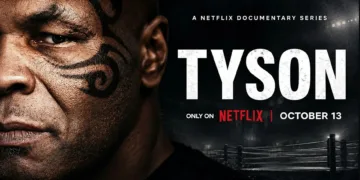




























Mike Tyson tells Floyd Russ to find another subject when an interview reaches territory he dislikes. Russ keeps those exchanges in his four-part Netflix documentary, Tyson, allowing us to see the negotiation that a polished interview often removes. That is a useful decision. We can recognize when the subject limits the conversation rather than mistake a change of topic for the filmmaker’s choice. The harder task is deciding what to do after the refusal, and Russ often lets the interruption stand in for further inquiry.
The close-ups make staying with Tyson unusually absorbing. His eyes command attention while his soft, high voice unsettles the intimidating impression his face creates. Tears, laughter, pride, and resistance can arrive within the same conversation, giving the interviews a suspense that the familiar biography cannot supply. I kept finding myself attentive to his next response even when the documentary’s next historical destination was obvious. The camera records someone whose feelings are immediately available and whose account of his behavior can remain stubbornly inaccessible.
A return to Brownsville makes that instability visible outside the interview setting. Fans surround Tyson, children press close, and his sudden demand that they stop sends them scattering. The scene complicates the warm reception without requiring us to treat a brief encounter as a diagnosis. It also establishes a productive distinction: public affection tells us how people respond to Tyson now; his response to that affection tells us something else. Russ is good at preserving these uncomfortable changes in temperature. He is less consistent at following their implications.
The life story proceeds along a largely chronological route, connecting childhood poverty and juvenile offending to detention, Bobby Stewart’s recognition of Tyson’s ability, and the mentorship of Cus D’Amato. This arrangement gives newcomers a clear path through a crowded history.
D’Amato’s death in 1985 places loss beside the approaching championship success, and the archival fights restore the physical excitement behind the celebrity. The emphasis on Tyson’s need for care makes his attachment to the trainer understandable, though the same explanation grows less adequate as the series moves into the harm Tyson inflicted on others.
Chronology can quietly suggest causation: place deprivation before destructive behavior, and viewers may begin to experience the second as the inevitable continuation of the first. Russ rarely disrupts that progression enough to examine the connections.
Brief rewinds revisit events from hours or days earlier without substantially changing what we know. Pigeon footage, stock material, and familiar inserts keep the biography moving, but movement becomes a substitute for discovery. Across roughly four hours, repeated fight coverage and conventional transitions give the series a size its analysis struggles to justify.
The supporting interviews are strongest when they temporarily reorganize that history around someone else. Buster Douglas describes defeating Tyson weeks after losing his own mother. Suddenly, a milestone in Tyson’s career becomes an achievement with a separate emotional history.
Former manager Rory Holloway’s anger over Tyson dismissing his team introduces the lingering consequences of a decision that a career timeline could simply register and pass. These are valuable changes of perspective. They give familiar events stakes that Tyson’s recollections alone cannot provide.

His children bring a similar pressure to the account of family life. Their testimony includes affection and damage, with Miguel describing his father as a deadbeat. The mixture matters because it prevents improved circumstances from erasing earlier absences. Here, the documentary allows another person’s experience to complicate Tyson’s self-assessment. That capacity makes its treatment of Robin Givens especially frustrating. The difficulty lies in how the material is arranged and which accounts receive the freedom to explain it.
Documentary editing creates relationships between statements, even when those statements were recorded decades apart. In the Barbara Walters footage, Givens describes a tormenting marriage; Tyson says he grabbed her but did not hit her. His present-day account characterizes their relationship as fighting, and he insults her.
A displayed headline casts him as a man seeking love who received marital misery. That framing encourages us to read the marriage through his disappointed hopes while the archival testimony raises questions about abuse. Givens declined a new interview, but her absence does not require the film to organize these competing accounts around his grievance.
The treatment of Desiree Washington is still more troubling. Tyson was convicted of rape and served three years in prison. His continued denial belongs in a documentary about him, but the conviction needs to remain distinct from the opinions offered by his defenders.
Donald Trump’s assurance that Tyson is truthful supplies a character endorsement, not an examination of the case. Other interviewees express doubt about his guilt, while Tom Patti presents his endurance through criticism and imprisonment as evidence of resilience. The accumulated effect moves attention from what Tyson did to what Tyson survived.
That shift reveals a weakness in the celebrity recovery story the series repeatedly approaches. Continued public affection and continued visibility can begin to function as evidence that the difficult reckoning has already happened. The Brownsville homecoming establishes affection; it cannot establish accountability.
Likewise, survivor-resource notices at the ends of the relevant episodes provide useful information without correcting the weight given to denial and sympathetic testimony beforehand. Russ has included the controversy, but inclusion alone does not tell us how carefully a documentary has examined its subject’s claims.
The final episode offers an opportunity to change the filmmaking itself. Tyson takes a hallucinogenic substance associated with toad venom, cries, and invites Russ to join him. Russ participates. A director entering the action changes the relationship we have been watching: the person receiving testimony is now sharing an experience with the person giving it.
Yet the sequence remains within the series’ conventional presentation, offering little formal exploration of that altered position. Tyson’s grief, including the death of his four-year-old daughter Exodus, deserves patient attention without being recruited as proof of redemption. Watching Russ accept the invitation, I wanted the film to stay with his decision too, to examine what joining Tyson might permit him to ask afterward, and what it might make harder to ask.
Tyson premiered globally on Netflix on October 13, 2026. The four-part documentary series chronicles the life and career of legendary boxing champion Mike Tyson, tracing his explosive rise from Brooklyn to becoming the youngest heavyweight champion in history alongside his subsequent legal battles, public controversies, and personal redemption.
Where to Watch Tyson Online
Full Credits
Title: Tyson
Distributor: Netflix
Release date: October 13, 2026
Rating: TV-MA
Running time: 45–55 minutes per episode
Director: Floyd Russ
Writers: Floyd Russ
Producers and Executive Producers: Bill Simmons, Jim Gray, Ian Orefice, Floyd Russ
Cast: Mike Tyson, Trevor Berbick, Evander Holyfield, Robin Givens, Cus D’Amato, Don King
The Review
Tyson
Tyson makes its interviews absorbing through close-ups and unpredictable responses, while Douglas, Holloway, and Tyson’s children give familiar events fresh stakes. Russ’s filmmaking struggles to turn that access into sustained inquiry. Repetitive coverage stretches the biography, and sympathetic testimony weakens scrutiny of abuse and the rape conviction. The director’s eventual participation offers an opportunity the series leaves unexplored.
PROS
- Close-ups capture Tyson’s volatile responses.
- Archival fights convey his athletic impact.
- Supporting interviews complicate his account.
CONS
- One-sided framing of abuse and the rape conviction.
- Repetitive coverage stretches the four-hour length.
- Russ’s shift into participation remains underexamined.







