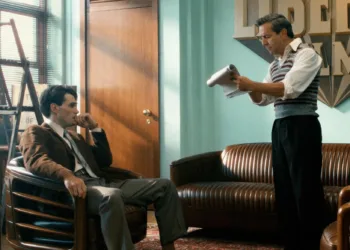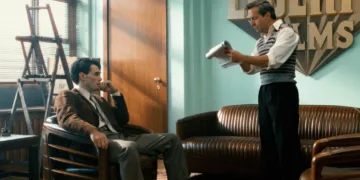




















Colonel Terrill asks James Stewart to give the men a speech. They need heartening, and he has an actor on hand who knows how to get a room to listen. KJ Apa gives Stewart the familiar, slightly uneven cadence and the posture of a man who has never quite settled into his own height. There is something companionable in the way the words come out of him. The men respond. For the duration of the address, Stewart can make the prospect of climbing back into a bomber feel like a thing they can face together.
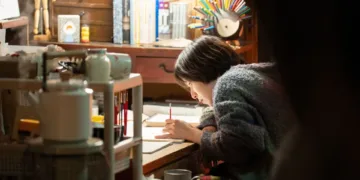
The condolence letters have to reach people Stewart will never see as they read. The men he writes about have died on missions, and their families are left to learn something of their deaths from the officer who spoke to those men about duty. Writing home is part of his duty too. It matters that the speech works as well as it does, that we can hear the warmth in it and feel how welcome that warmth would be before a flight. When Stewart begins to mistrust what he gave those men, his suspicion falls on the part of himself they had good reason to trust.
Aaron Burns and screenwriter Justin Strawhand give Jimmy a narrow span of Stewart’s life in which to make that suspicion felt. He has just won an Oscar for The Philadelphia Story when MGM chief Louis B. Mayer (Jason Alexander) presses him to protect his career. The military sees a use for him in wartime recruitment. An experienced pilot, Stewart pushes to fly and ends up captaining a B-24 Liberator out of England.
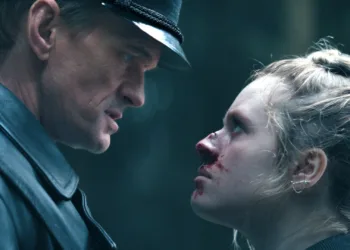
On an early mission, flak tears into the bomber. In the cockpit with his co-pilot Martinez (Julian Works), Stewart is responsible for getting people home in a plane that may no longer be able to take them there. The sequence gives his words to the crew a physical limit. They can make a man willing to go up. They can do very little for him once the metal gives way.
With Lady Julia Tyndall (Kara Killmer), Stewart can say what it feels like to have been good at urging the men on. Burns places the two actors so close as they speak that their conversation has the physical shape of an embrace. The film takes its time getting them there. Killmer lets Julia listen without giving the scene the forward pull of a speech that has to persuade somebody by its end.
Apa’s voice, so readily recognizable when it has a public purpose, can sound uncertain here without losing any of its familiarity. There is a particular loneliness in hearing a man wonder aloud about words other people might remember with gratitude. For a while, Julia can sit close enough to share the thought with him.

Burns is drawn to a warm light that suits the tenderness of those conversations. Its glow is harder to live with elsewhere. The aerial sequences can make a damaged aircraft feel horribly precarious, yet the golden cast of the wartime images and the sweep of Grant Fonda’s orchestra give the suffering a shape that is easier to take in than the one Apa leaves us with.
His Stewart is still trying to decide what his courage was worth to the men who died. The music sometimes seems ready to answer him. In the conversations with Julia, the gentleness comes from the way two people attend to each other. In the wider treatment of the war, it can feel like something the film has laid over him.
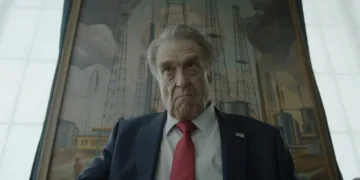
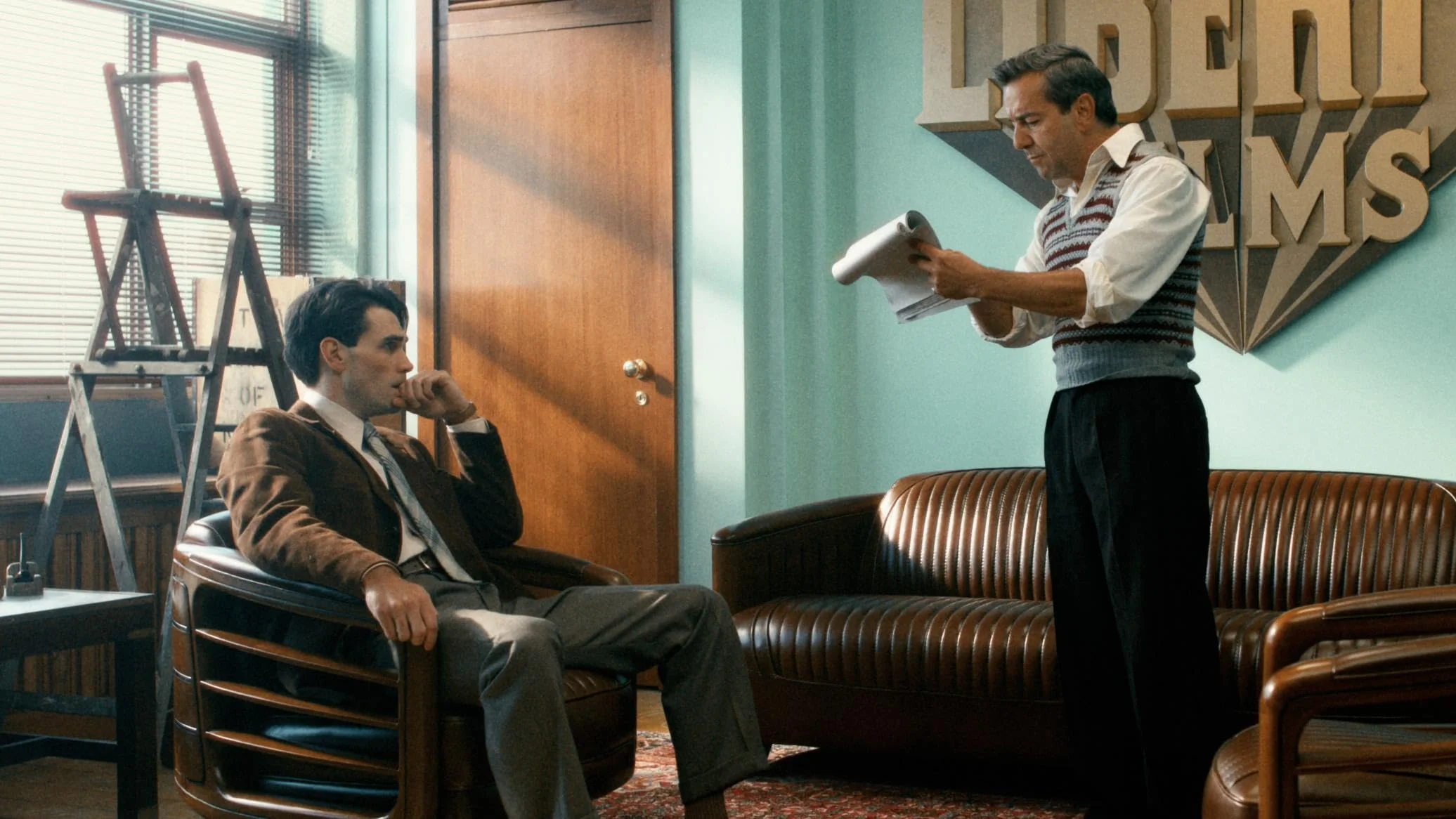
Back in Hollywood, Mayer wants Stewart to play a version of his own military service. It would give an audience a part for him that they already understand. Stewart turns it down. Frank Capra (Max Casella) offers him George Bailey in It’s a Wonderful Life, a man who has spent years being useful to other people and finds himself unable to imagine a reason to stay alive. The offer has an odd tenderness. Capra needs the quality that made people believe Stewart when he spoke to them. He needs it for a man who has ceased to believe that his own presence makes any difference.
Apa lets Stewart hesitate over his return to acting before showing how fiercely he commits to Bailey. It is possible to watch that intensity and feel the relief of a man discovering that he can still do his work. There is something frightening in it too.
The people on Capra’s set have come to make a picture, and Stewart can give them the despair their scene needs with a conviction that makes them uneasy in his company. For the length of the scene, that unease is something everyone can put to work. I keep thinking about what the others are meant to say to him once they have the take.
Jimmy is set for a nationwide theatrical release on November 6, 2026, distributed by Fathom Entertainment following festival screenings earlier in the season. Directed by Aaron Burns, the biographical drama chronicles the life of Hollywood icon Jimmy Stewart—focusing on his rise to fame, his Oscar win, and his subsequent decision to put his acting career on hold to serve as a combat bomber pilot during World War II.
Where to Watch Jimmy (2026) Online
Full Credits
Title: Jimmy
Distributor: Fathom Entertainment
Release date: November 6, 2026 (Theaters)
Rating: PG-13
Running time: 2 hours (120 minutes)
Director: Aaron Burns
Writers: Justin Strawhand
Producers and Executive Producers: Aaron Burns, David C. Cook, Angela Galgani Sullivan, Jack McClintock, John Norton, Justin Strawhand
Cast: KJ Apa, Jason Alexander, Max Casella, Sarah Drew, Julian Works, Neal McDonough, Christopher McDonald, Rob Riggle
Director of Photography (Cinematographer): James Mather
Editors: Stephen O’Connell
Composer: Grant Fonda
The Review
Jimmy
The warmth in KJ Apa’s voice makes it easy to hear why Stewart’s men listen, and painful to hear him wonder what he asked of them. Jimmy gives that doubt room in the quiet with Lady Julia and lets it unsettle the people watching Stewart play George Bailey. The golden light and swelling score are sometimes too ready to console. Apa leaves us with the harder feeling that a man can find his voice again and still be afraid of what comes out.
PROS
- Apa’s vocal cadence makes Stewart’s shift from reassurance to self-doubt audible.
- The troop address and condolence letters give his guilt a concrete shape.
- The close framing with Lady Julia makes room for a rare moment of candor.
- The George Bailey scenes make Stewart’s return to acting feel uncertain.
CONS
- Golden lighting softens the wartime scenes.
- The orchestral score offers reassurance while Stewart’s doubts are still raw.