


























Before Evil Empire took on a full Castlevania game, the series’ Gothic imagery had already entered the French studio’s work through Dead Cells: Return to Castlevania. Belmont’s Curse reverses the direction of that exchange. A Japanese franchise built around European monsters now absorbs some of the visual energy associated with the developers who previously borrowed its creatures and castle. Calling this a homecoming would mistake geography for artistic ownership. The interesting question is what happens to familiar forms when the people interpreting them change.
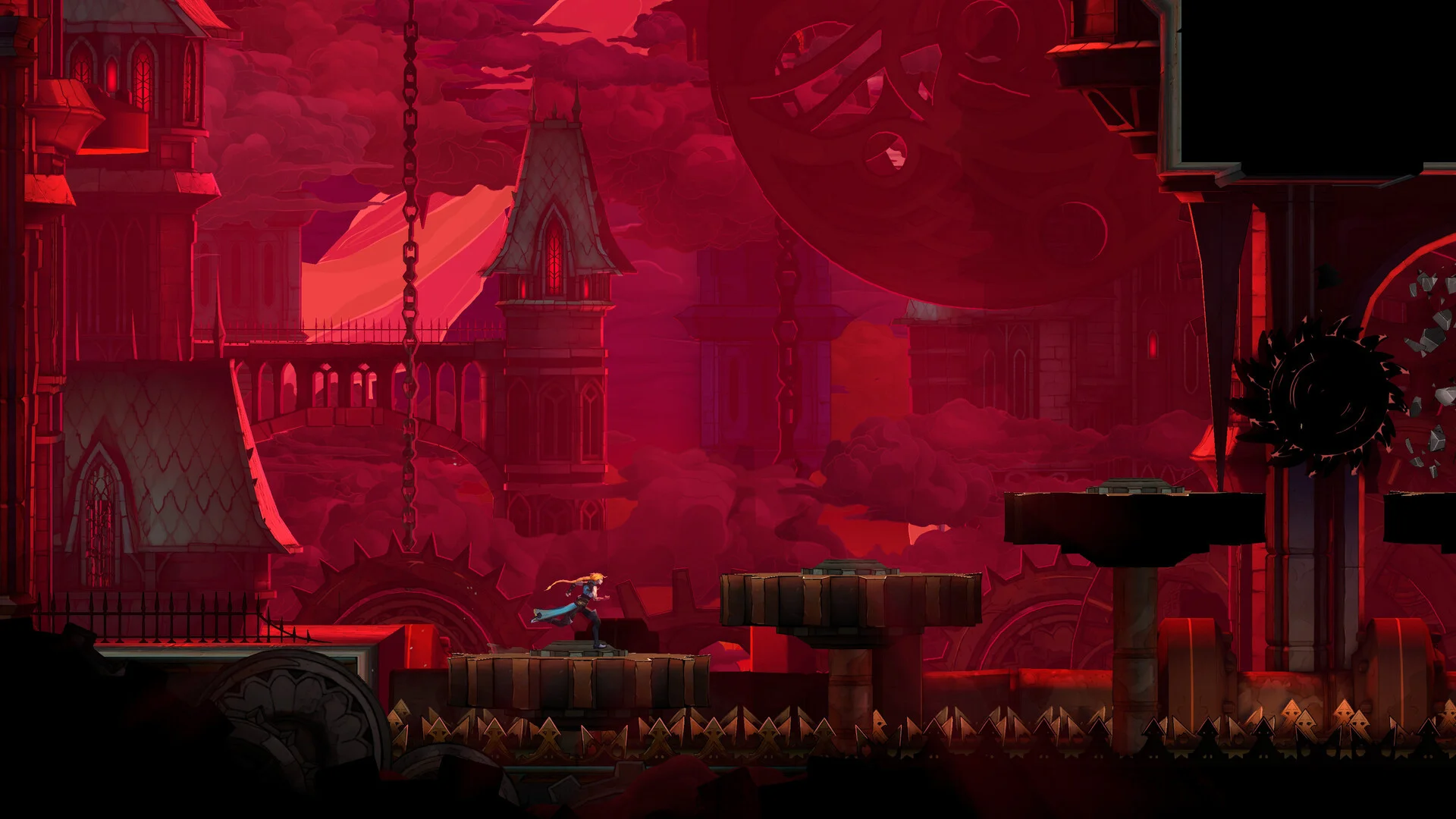
The exaggerated colors offer an immediate answer. Neon accents share space with Gothic architecture and eerie interiors, giving the old vocabulary a different temperature. Axe-throwing armor and a flying sword surrounded by smaller blades remain recognizable threats within this brighter presentation.
The music follows a related approach: “Bloody Tears” returns amid electronic and symphonic arrangements, preserving a melody while changing the textures surrounding it. Recognition involves hearing the difference. The effect is affectionate without treating the series’ previous appearance and sound as objects too fragile to handle.
Paris in 1499 gives this reinterpretation room beyond Dracula’s household. Streets, sewers, a cemetery, and catacombs precede the castle, extending the familiar supernatural infestation into an inhabited city. Twenty-three years after Dracula’s Curse, a bishop summons Trevor Belmont to confront the invasion.
Trevor investigates the summons while his daughter Rose pursues its source. Her parentage supplies two inheritances that the game makes playable: the Belmont whip and the magic associated with her mother, Sypha Belnades. Family continuity becomes an arrangement of abilities, each establishing a different relationship with the world.
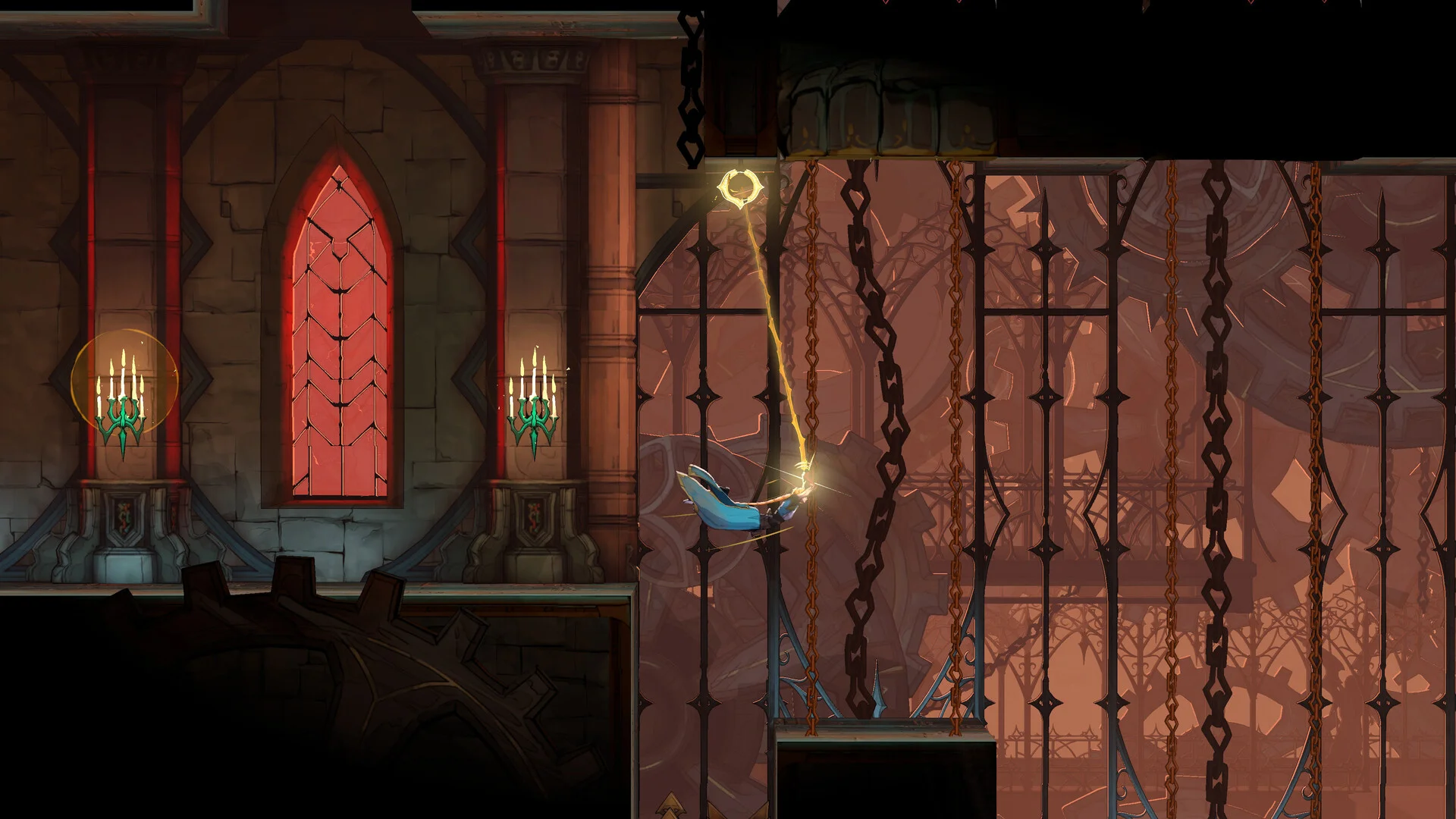
The Vampire Killer is especially persuasive in this respect. It hooks onto environmental points, swings Rose across gaps, and pulls her toward enemies. An approaching monster can become a route through a crowded space; the attack Rose delivers on arrival changes with her equipped weapon.
A greatsword brings a heavy strike, while gauntlets turn the approach into an uppercut. The family’s signature instrument now organizes distances as well as damage. Its importance survives a change in function, giving Rose a recognizable Belmont identity without requiring her to reproduce her father’s movements.
That expanded function lets combat and platforming occupy the same physical language. Swinging through spikes and thorns develops into sequences combining the whip with acquired powers, while light can make platforms solid or insubstantial. In the main hall, portraits provide grapple points leading toward other areas.
These environments ask players to read the Gothic furnishings for possibilities of movement. There is still a whip weapon for those who favor the traditional attack, with its strongest damage at the furthest reach. The distinction between that weapon and the traversal whip gives familiarity a place within a wider repertoire.
The other weapons earn their inclusion through particular uses. Sword and shield provide protection against frontal attacks; the lance reaches airborne targets or enemies across gaps; gauntlets launch foes into aerial combinations. These differences make changing equipment a response to an encounter rather than a purely numerical decision.
The grapple does introduce a timing reservation: its wind-up can complicate an attempt to escape an attack or negotiate a hazard. The issue is localized rather than a reason to dismiss Rose’s movement wholesale. A beautifully articulated action still has to begin soon enough for the player’s intention to survive it.
Sypha’s cards offer a richer revision of the monster-hunting inheritance. Defeated bosses enter Rose’s tarot deck and remain capable of speaking to her. Some have been cursed into committing atrocities, and defeating them can release that curse.
The enemy therefore survives the encounter as a source of knowledge and assistance. This shifts the significance of victory. The monster’s history can continue after its attack pattern has been mastered, bringing an individual presence into a game whose familiar creatures might otherwise function chiefly as obstacles.
There is an uneasy relationship between rescue and possession here. A creature released from one curse remains contained in a card that Rose can use. Assistance, captivity, and cooperation sit close together, and the system invites that reading without establishing a fully developed ethical argument.
Its strongest achievement is simpler: the defeated creature has something left to contribute besides a reward. Challenges that send Rose to a place important to the resident spirit make that contribution tangible. An upgrade can require attention to a former adversary’s attachments, giving exploration a connection to the person inside the card.
The spells keep that relationship active during combat. A blood-and-spike attack causes bleeding and can work around shielded enemies, while a descending giant fist stuns targets and breaks guards. Only one Arcana is equipped at a time, making its role in a chosen fighting style matter.
Melee hits replenish mana, so casting sends Rose back toward the creatures supplying her next spell’s fuel. Kill-count challenges reward repeated use, but the location-based tasks carry greater narrative interest. They make growth depend on seeking something particular, rather than simply performing the same successful action until a counter is satisfied.

The world gives that search considerable scope. Shortcuts connect areas, conspicuous barriers await new abilities, and spirits supply clues to hidden bosses and the puzzles protecting them. Optional encounters contribute to the route toward the fuller ending, so completing an initial run can leave substantial parts of Rose’s inheritance undiscovered.
The difficulty is separating fruitful uncertainty from repeated effort. Fast travel arrives late and connects major regions rather than individual save rooms. A return to an old obstacle can therefore involve a lengthy walk, followed by the discovery that the new ability needs a second power before the route will open.
Repeated fights add weight to those walks, particularly when ordinary enemies take several hits and return after saving. Some hazard sequences can also send Rose back far enough to require minutes of retracing, although checkpoint spacing is not uniformly punishing.
Damage adjustments, invincibility, and an XP slider provide useful control over the combat demands. They leave the distances intact. Following a spirit’s clue can still require crossing familiar rooms, and the map’s unclear symbols can make it difficult to tell which unfinished route deserves attention. Rose may arrive with a newly acquired power and still have to leave the passage unopened.
The Review
Castlevania Belmont's Curse
Belmont’s Curse gives Castlevania’s Gothic inheritance a thoughtful reinterpretation through brighter imagery, rearranged music, and Rose’s two family legacies. The whip connects fighting to movement, while Sypha’s cards let defeated monsters remain characters within Rose’s growing repertoire. Discovery has substance, though limited fast travel, unclear map symbols, and occasional grapple delays make pursuing it unnecessarily laborious. This is an engaging continuation with a persuasive identity of its own.
PROS
- Whip mechanics connect traversal and combat.
- Tarot spirits link characterization to progression.
- Distinct weapons reward situational choices.
- Colorful Gothic environments and inventive musical arrangements.
- Hidden encounters give exploration narrative significance.
CONS
- Late, regional fast travel makes backtracking tedious.
- Grapple wind-up can complicate precise timing.
- Unclear map symbols hinder exploration.







