

























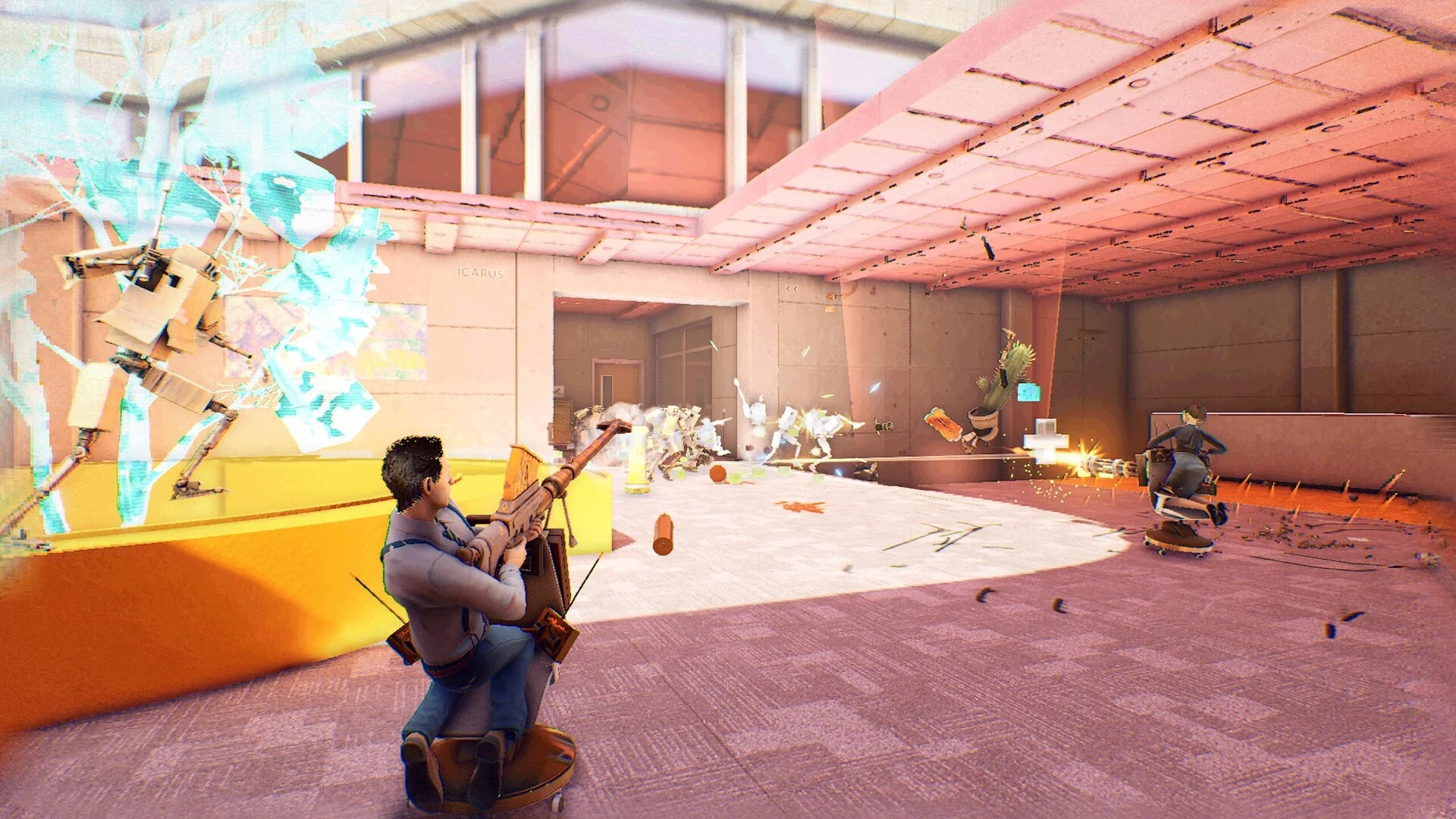

Keeping a minigun trained on pursuing enemies while rolling backward in an office chair gives Last Man Sitting a different rhythm from Vampire Survivors. The waves, experience pickups, and upgrade choices establish a familiar survivor framework, but firing and aiming remain the player’s responsibility. DoubleMoose Games puts the work of a third-person shooter inside that escalating loop. A chair-spin attack helps clear crowds, and a dash offers an escape, leaving several things to manage before the next level-up interrupts the fighting.
Those upgrade interruptions become welcome opportunities to reconsider how the fighting should work. Extra damage might support the weapon already carrying a run; spikes released during a spin or floating turrets can expand the ways a crowd takes damage. The distinction matters because shooting remains enjoyable while a build is still incomplete. Hostile chairs, overflowing bins, and aggressive office plants supply suitably ridiculous targets, yet the attraction survives the joke: aiming into a pursuing pack while keeping enough room to escape is satisfying on its own.
The opening selection makes that promise unnecessarily slow to develop. One employee, one gun, and one chair leave little room to adjust an approach after an early defeat. New weapons, chair styles, and workers arrive through progression, but the first attempts lean heavily on the starting minigun and spin. Survivor games can make weakness productive by encouraging another combination. Here, the initial restriction means learning the combat comes before having much freedom to experiment with it.
Once the options expand, chair upgrades provide some of the clearest examples of meaningful growth. The rocket chair launches forward and explodes on landing. Add the upgrade that leaves fire behind, develop it fully, and that landing produces a wave of flame that travels outward before returning. The ability gains a larger role in clearing enemies through successive choices. That progression captures the pleasure inherited from the survivor formula: an initially manageable effect becomes an event capable of transforming a crowded fight.
Persistent perks give those choices a foundation before a stage begins. Regeneration, increased pickup range, and attack or defense bonuses can ease familiar problems, while a burn-damage perk creates a reason to favor fire during the next attempt. Additional perk slots widen the combinations available. Legendary effects push further, including repeated chair-ability use or increased health traded against healing drops. Receiving perks after failed attempts keeps a loss useful, though discovering a powerful option still depends partly on the reward draw.
The weapon selection offers a less consistent kind of variety. A katana changes the distance at which enemies must be engaged, while a shotgun supplies a different alternative to sustained minigun fire. Those choices can alter the habits developed with the starting loadout.
Several weapons, however, feel close enough to existing options that unlocking them changes effectiveness without substantially changing the approach. The arsenal has real alternatives, but its breadth overstates how many distinct ways of fighting it supplies. Chair abilities and their upgrades often make the stronger case for starting another build.
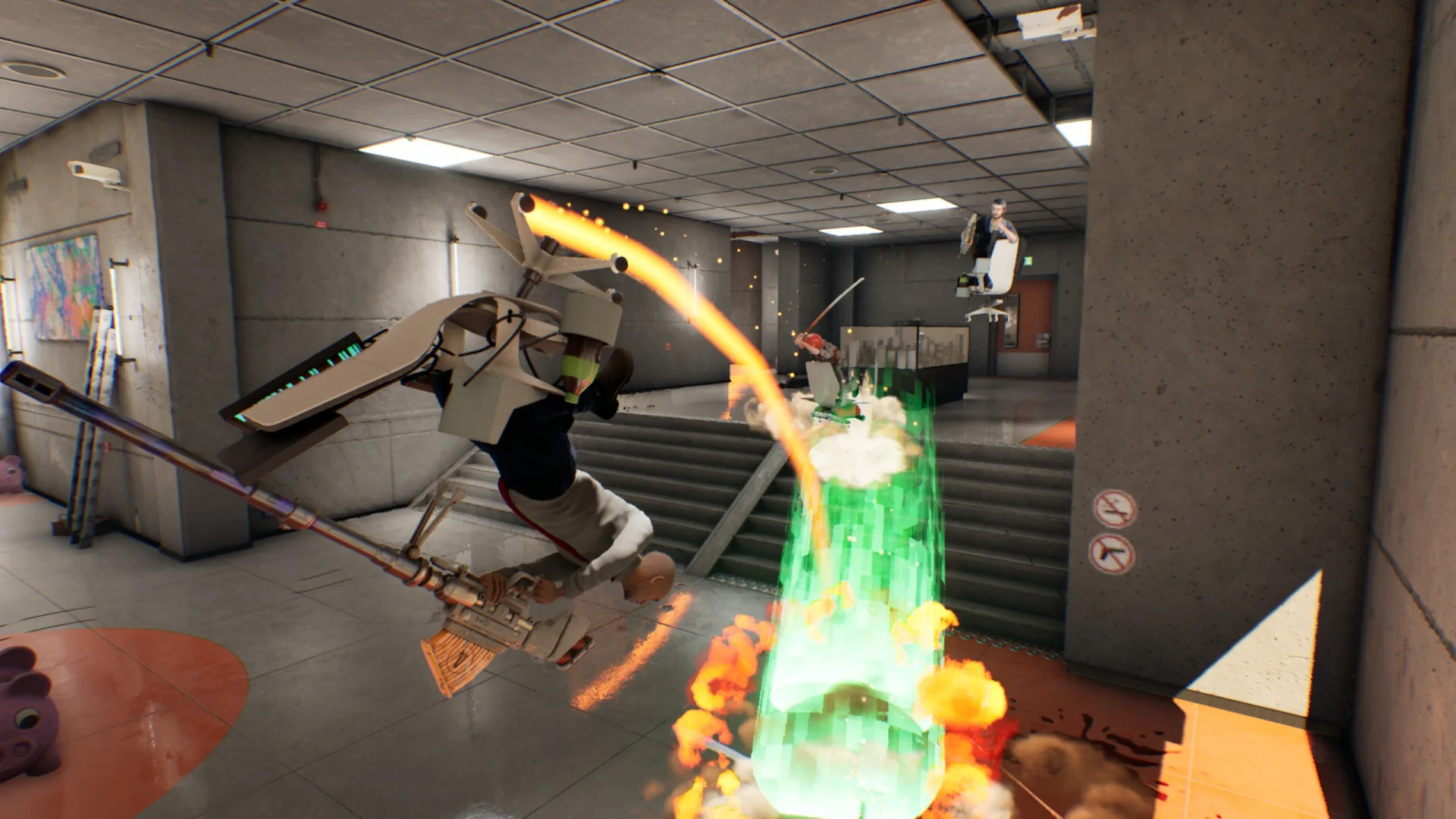
The stages also need to give those builds something different to handle. Telephone objectives interrupt survival with tasks such as popping balloons, gathering litter, breaking boxes, or protecting executives. Their rewards can strengthen an attempt considerably, which makes them worth pursuing even when the activity itself is simple. The small objective pool becomes conspicuous as several tasks recur within rounds. Answering another call can provide a desirable upgrade while asking for an errand that has already lost its surprise.
Termination Time changes the pressure much more effectively. Its hazardous ring contracts until the player has a small area to defend, restricting the retreat-and-fire routine that normally creates breathing room. Ability timing becomes harder to separate from positioning because there is less space available to recover from a poor choice. Compared with collecting another batch of office litter, this event gives an established build a fresh problem. The same equipment must work under a different constraint.
Chair grinding could have supplied another recurring source of variation. Sliding along edges introduces an extreme-sports association that invites a brief Tony Hawk comparison, and fast movement suits the absurd office warfare. Cubicles, cafeterias, and reception areas give the floors different layouts, yet their cramped spaces can leave grinding peripheral to ordinary combat. It is useful as an escape without becoming something that consistently shapes an approach to the arena. The movement system suggests a freer, faster style of play than the stages regularly encourage.
Bosses expose a related mismatch between the strength of the tools and the situations built to resist them. Their timed arrivals should punctuate the waves, but developed builds can erase them before they establish much presence. Quickly destroying a large enemy is a legitimate reward for assembling effective upgrades. Repeatedly doing so reduces the distinction between a boss encounter and another stretch of crowd clearing, however. Even the final boss can fall rapidly enough that reaching it produces little need to reconsider a successful combination.
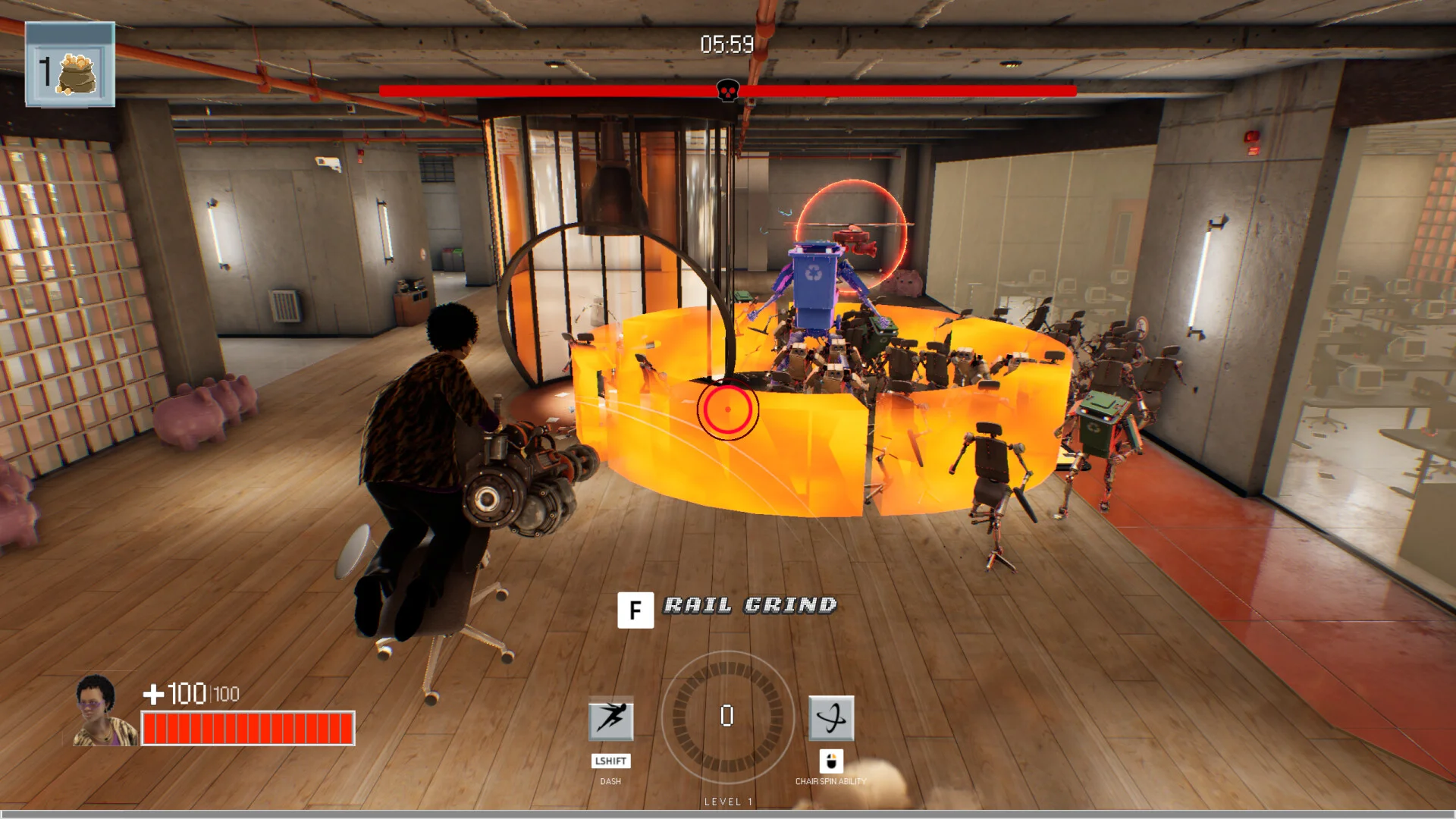
Crowded combat brings less welcome interruptions too. Late-stage carnage can cause slowdown, weakening the responsiveness that manual shooting needs. Enemy reach can also feel difficult to judge amid the accumulated effects and machine parts. These faults matter particularly here because the comparison with Vampire Survivors rests on the extra responsibility placed on aiming and evasion. When the screen becomes hard to read, performing that additional work feels less dependable.
Across eight floors, the solo progression delivers enough unlocks to keep its early hours busy. Higher difficulties and improved perk rewards provide reasons to revisit completed stages; co-op Swarm and PvP offer further ways to play, though they sit outside this assessment of solo staying power.
Returning to a floor exposes the limits of what equipment can refresh. A new chair combination may change how efficiently the player handles a familiar telephone task, a crowded room, or a quickly defeated boss. Eventually, improving that efficiency becomes the main thing left to pursue, and the office supplies fewer occasions to use the growing arsenal differently.
The Review
Last Man Sitting
Last Man Sitting gives the Vampire Survivors formula an enjoyable third-person shooting rhythm, with chair abilities and evolving upgrades that reward experimentation. Its strongest builds are satisfying to assemble, but repetitive objectives, overlapping weapons, and easily overwhelmed bosses give them too few fresh tests. The restricted opening selection delays the fun, while crowded combat can lose responsiveness. There is an entertaining solo campaign here, though returning to its floors increasingly means improving efficiency rather than discovering a different approach.
PROS
- Satisfying manual shooting and evasion
- Chair upgrades that meaningfully transform abilities
- Persistent perks support varied build combinations
- Termination Time changes the tactical demands
CONS
- Restricted starting loadout delays experimentation
- Several weapons offer overlapping play styles
- Repeated objectives weaken solo replay value
- Powerful builds can trivialize bosses
- Slowdown and unclear enemy reach disrupt crowded combat