


























![Kingdom Hearts Collection [I-III] Review](https://gazettely.com/wp-content/uploads/2026/10/Kingdom-Hearts-Collection-I-III-1-360x180.webp "Kingdom Hearts Collection [I-III] Review: KHII Holds Steady as Newer Entries Fluctuate 40")


Five seconds hardly sounds like enough time to reach a door on the far side of a sprawling map. Echo Weaver lets that deadline sit there, apparently ridiculous, until discoveries make the trip possible in two small steps. The pleasure is in how differently the distance feels afterward. A destination that once belonged to some remote future becomes somewhere you can reach almost immediately. The next reset carries a little anticipation: this time, you know where you are going.
That confidence spreads through the game’s returning glaive, too. Its usefulness keeps growing as you learn what to do with it. A throw beyond the visible screen can activate something hidden, encouraging you to question the limits of both the tool and the space around it. Most advanced techniques work this way, waiting to be understood rather than handed over as upgrades. Some tutorial restrictions and permanent improvements qualify that promise, but discovery still feels unusually personal. You have changed what you believe is possible.
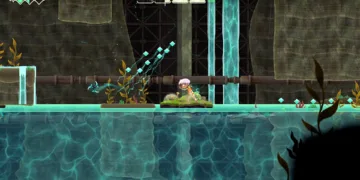
Moonlight Kids builds its 2D adventure around a Weaver, apparently the last of their kind, exploring a ruined science-fiction world caught in a recurring calamity. Each reset brings you back to the starting chamber. Map progress and discoveries survive; opened doors and many other interventions do not. The companion Intermind helps keep track of what you uncover. Echo Weaver belongs to the knowledge-driven branch of exploration games sometimes called “metroidbrainia,” though the label matters less than the eagerness with which a new idea can send you back into familiar corridors.
There is an affinity with Outer Wilds in learning a world that changes according to a schedule. Doors seal, buildings collapse, and reservoirs flood at particular moments. Echo Weaver gives that understanding a demanding physical outlet through movement.
Knowing a connection exists starts the process; reaching it efficiently gives the discovery its satisfying finish. Dashes, slides, jumps, and teleportation gradually turn lengthy approaches into quick passages. Optional time-trial plinths invite you to test that fluency, giving an already familiar destination a fresh reason to attract your attention.
The clock makes those improvements matter. Crystals extend a loop’s small initial allowance up to a thirteen-minute maximum, so a route’s value includes the opportunities it offers to replenish time. Healing consumes a minute, and maps and certain environmental interactions demand time as payment. Taking care of yourself can leave less room to pursue whatever brought you out there. That trade has an immediate emotional weight: accepting a reset is easy when an experiment has answered your question, harder when you are still trying to find the answer.

At its most exciting, the platforming turns that dwindling allowance into concentration. A cliff ascent packs moving platforms, circling worms, thorn hazards, and dangerous drops into a sustained challenge, without a fast-travel return partway up. Learning the route promises relief, but executing it remains a separate demand. Every mistake threatens time already invested. The same structure that makes completing such a climb satisfying can make another attempt feel exhausting, particularly when a reset arrives close to a checkpoint. Progress in your understanding does little to soften having to perform the whole approach again.
The game is better at encouraging inventive movement than at consistently supporting the knowledge that movement generates. Leads gathered from people and puzzles often suggest useful experiments, but some leave the connection between clue and destination obscure. As shortcuts, transport links, timings, and techniques accumulate, consulting records can become a recurring interruption. Curiosity remains active while forward motion stalls. There is a distinct difference between wanting to test an idea and spending another loop trying to remember where the relevant place was.
The map offers custom icons, yet communicates that facility poorly and gives limited automatic help with learned connections. It asks players to preserve a mental account of routes that the map itself only partly expresses. Stronger support for recording those relationships would protect the pleasure of discovery. Nonlinear experimentation produces a related awkwardness when an ability’s introductory acknowledgment arrives after it has already become familiar. Freedom survives these delayed explanations, but the game can feel oddly unaware of what the player has learned.
Its inhabitants provide a reason to keep working through that friction. An elderly woman found beneath fallen rubble can be reached sooner, allowing a conversation about preventing the mistakes that led her there. Finding her earlier elsewhere presents another obstacle: she has little interest in taking advice from a Weaver. The encounter develops concern through successive discoveries. Knowing when to arrive brings you close enough to help; understanding the person becomes the next task. Speed alone cannot resolve her predicament.

That is a richer invitation than the opening mystery always supplies. Questions about the other Weavers, the catastrophe, and the colony’s experiments encourage investigation, but the early uncertainty about your purpose can keep emotional investment at a distance. Echoes and time rifts gradually connect those questions to ambition, friendship, and betrayal. Intermind’s colloquial humor and Z, the giant spider selling maps, make the surviving company approachable. Still, affection for an entertaining character and urgency about their fate develop at different speeds. The game’s cleverest discoveries can arrive before its reasons for making them feel equally strong.
The illustrated characters and strange alien creatures help keep the ruined world inviting, while ethereal, sometimes mournful music leaves room for its losses to register. That warmth matters when everyone else forgets the previous loop. You return carrying knowledge of people who must encounter you afresh, repeating conversations with a growing sense of what could happen to them. Later opportunities to save a scientist or repair a friendship give efficient movement a purpose beyond reaching another unexplored room. Choosing a route can become a decision about whom you still have time to help.
The Review
Echo Weaver
Echo Weaver makes understanding feel personal. An impossible route becomes familiar, and learning to reach someone in time gives that mastery a human purpose. Its discoveries deserve the patience they ask for, though unclear directions and costly platforming retries sometimes drain the excitement from another attempt. The mystery takes longer to earn emotional investment than the movement takes to inspire curiosity, but helping its inhabitants gives those repeated returns meaning.
PROS
- Knowledge-based discoveries create a satisfying sense of capability.
- Movement mastery transforms familiar routes.
- Character interventions give exploration emotional purpose.
- - Illustrated creatures and atmospheric music enrich the ruined world.
CONS
- Timed resets can force lengthy platforming retries.
- Vague Leads and limited map support stall momentum.
- Unclear early purpose delays emotional investment.
- - Ability introductions can arrive after players have learned them.