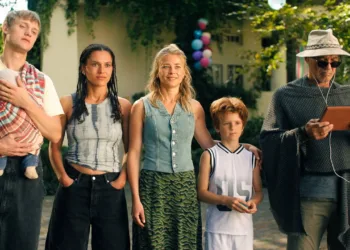




















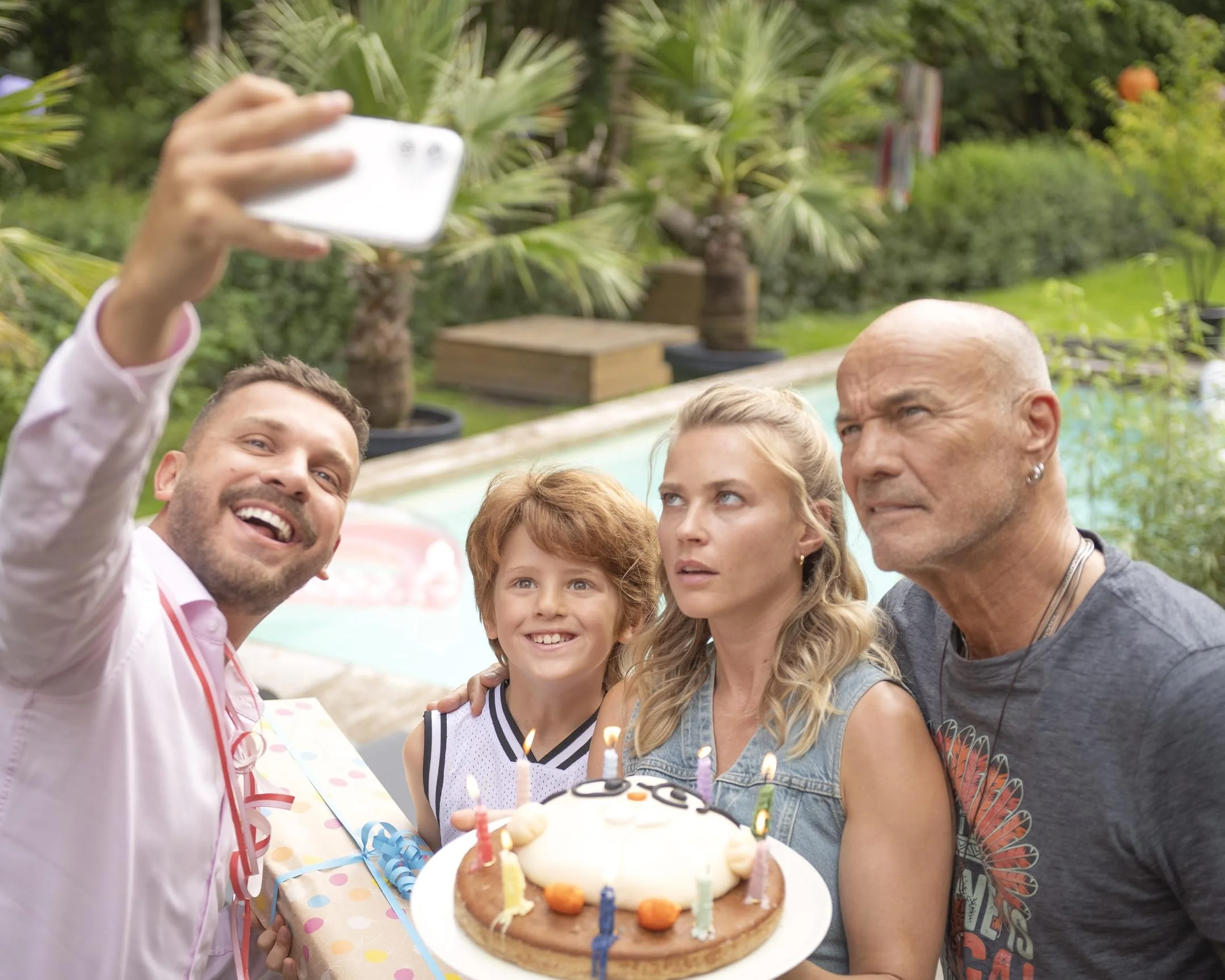
Eighteen hours separate the wrecked house at the start of The Birthday Gift from the carefully arranged celebration that precedes it. Director Vanessa Jopp shows us the damage, then rewinds to let us trace its causes. This is a flash-forward, a glimpse of where the story is heading, and it changes the pleasure of watching: we can stop wondering if the party will go wrong and start watching how people help it along. Marlene’s balloons, gluten-free cake, and hired entertainment become preparations whose survival we have good reason to doubt.
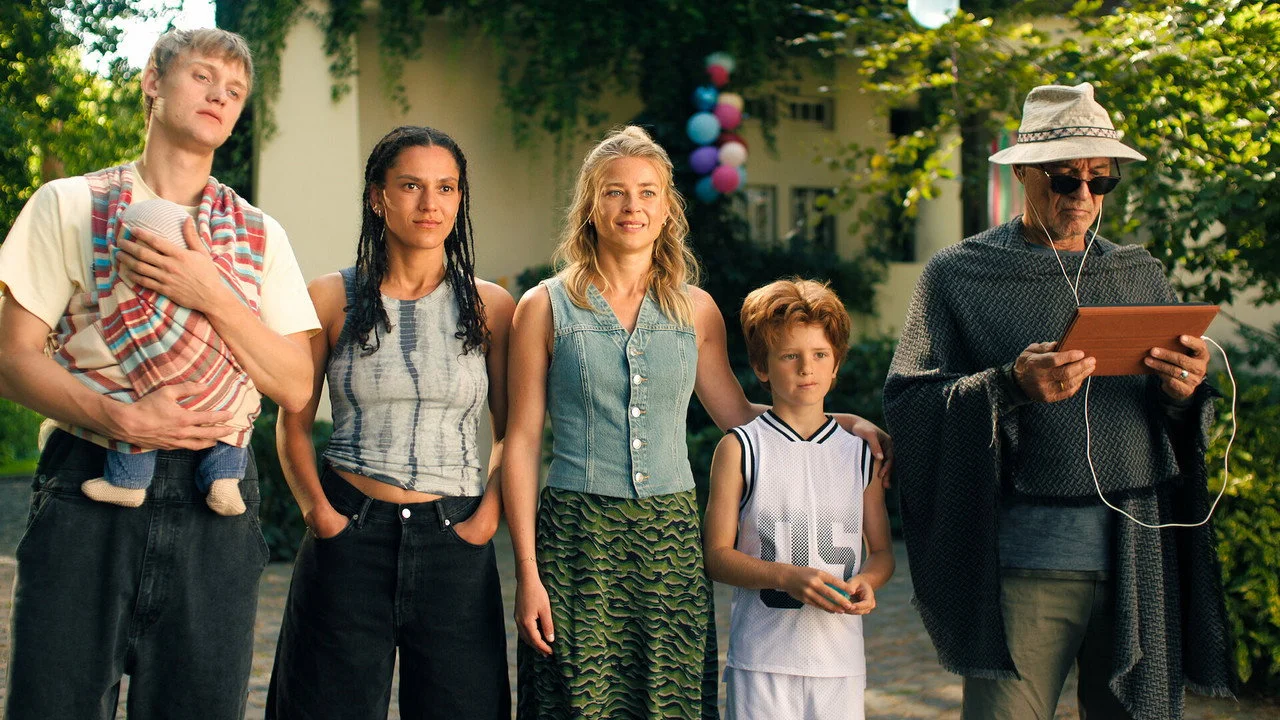
The party already has competing purposes before anyone unwraps a present. Marlene, a single mother played by Jeanne Goursaud, wants her son Theo’s ninth birthday to help him find friends after bullying connected to his childhood health problems. Her brother Timo, played by Edin Hasanović, has lent her his country villa while planning a marriage proposal of his own. His girlfriend Sofia, played by Sogol Faghani, will soon leave for several months in Chile. Marlene needs this gathering to succeed socially; Timo needs it to leave room for something else. Their separate hopes put pressure on the same afternoon.
Then Timo gives Theo a realistic-looking toy gun. The boy is delighted, his mother is horrified, and his uncle sees little reason to apologise. Screenwriter Ben Brooks has found an efficient way to get an ensemble comedy moving. One present produces three incompatible responses without requiring anyone to arrive looking for a fight. Theo sees something to play with. Marlene sees a decision about his upbringing being made without her. Timo regards the objection as an unreasonable response to his generosity. Each reaction makes the next person harder to persuade.
There is enjoyable friction here, especially because Goursaud and Hasanović make the siblings’ familiarity palpable. Their arguments have the confidence of people who know they will remain related after saying something dreadful. Hasanović gives Timo enough charm to keep his assurance entertaining, even as his inability to understand the offence becomes part of it.
Goursaud has a trickier assignment. Her character must keep attempting to restore order while much of the comedy depends on order becoming impossible. The care behind her preparations helps prevent Marlene from becoming merely the woman stopping everyone else from having fun.
I liked the early arguments most when the present remained connected to those personal stakes. Marlene’s fear of another unhappy experience for Theo gives her protectiveness a basis. Timo’s casual attitude carries the privilege of someone who can provoke a parenting dispute and then return to planning his proposal.
The film also catches something uncomfortable about hosting other parents: concern for a child can become tangled with the desire to look competent in front of an audience. Marlene has arranged an occasion for friendship, then finds herself defending her authority while the guests watch.
The difficulty is sustaining that conflict without simply restating it. Comic escalation means that a response creates a fresh problem, which demands another response. Brooks sometimes gets this working, as incompatible personalities and the party’s entertainment contribute to the spreading disorder.
Elsewhere, the exchanges settle into a familiar sequence of objection, indignation, and personal insult. We learn that the adults are entrenched quite quickly. Hearing them defend the same ground again gives the actors activity without always giving the scene a new direction. The film’s brisk 86 minutes cannot entirely disguise that repetition.
Its widening selection of satirical targets makes the problem harder to contain. Arguments about gender, wealth, and emotional openness compete with the original disagreement about children playing with weapons. Any of these subjects could expose something specific about this family, yet their accumulation encourages characters to become representatives of positions.
The toy gun gradually loses its usefulness as a point of contact between Theo’s pleasure and the adults’ principles. It becomes one provocation among several, leaving the question of what this particular child needs increasingly distant from the conversation.
The discovery of their father Hans’s hallucinogenic mushrooms pushes the gathering further toward broad farce. There is room for that silliness in a film that has already hired a snake entertainer for a children’s party. Still, the mushroom material changes the source of the disorder.
The siblings’ dispute grows from their choices and shared history; the drug-related absurdity supplies another way to make events unpredictable. I found the family friction easier to invest in, because an argument between Marlene and Timo can reveal a new hurt even when neither intends to reveal anything.
Hans, played by Heiner Lauterbach, supplies the connection between their parenting arguments and their own upbringing. His eccentricity has comic value, yet his shortcomings as a father give the siblings’ opposing attitudes a personal foundation. Their disagreement acquires weight when it becomes apparent that both are responding to an imperfect childhood.
Goursaud and Hasanović help that recognition feel credible through the affection that survives their combative exchanges. The quieter family material has something to draw upon, and it occasionally allows the characters to seem less certain of the roles they have been performing all afternoon.
The final stretch asks those relationships to carry a substantial emotional turn after so much busy slapstick. The transition feels compressed, even where the actors make the hurt understandable. Returning to Marlene and Timo gives their bond welcome attention, but it also exposes an imbalance established much earlier.
Theo’s delight at the present is an immediate, legible response that the adult debate keeps obscuring. By the time the siblings receive room to address their past, the film has explored their need to be understood much more closely than the boy’s hope of making friends at his own birthday party.
The Birthday Gift premiered globally on Netflix on October 30, 2026. Directed by Vanessa Jopp, the German comedy follows a single mother whose meticulously planned birthday party for her son at a country villa quickly spirals into chaotic family drama.
Where to Watch The Birthday Gift (2026) Online


Full Credits
Title: The Birthday Gift (German: Das Geschenk)
Distributor: Netflix
Release date: October 30, 2026
Rating: TV-MA
Running time: 1 hour 26 minutes (86 minutes)
Director: Vanessa Jopp
Writers: Ben Brooks
Producers and Executive Producers: Eric Bouley, Antonia Matthes
Cast: Jeanne Goursaud, Edin Hasanović, Heiner Lauterbach, Levin Wopp, Sogol Faghani, Berit Künnecke, Enzo Brumm, Amal Keller, Bastian Reiber, Paul Henrich
Director of Photography (Cinematographer): Bernhard Jasper
The Review
The Birthday Gift
The Birthday Gift gets welcome energy from Goursaud and Hasanović, whose sibling chemistry gives the parenting dispute some human stakes. The toy gun is an effective comic trigger, but repeated arguments and competing satirical targets dilute its usefulness. I enjoyed the affection surviving beneath the bickering; the late emotional turn asks that affection to carry too much, while Theo’s hopes for his birthday slip out of focus.
PROS
- Goursaud and Hasanović’s affectionate, combative chemistry.
- Toy-gun dispute establishes clear competing motives.
- Family history gives the quieter moments emotional weight.
CONS
- Arguments repeat without developing.
- Too many satirical targets scatter the focus.
- Compressed transition from slapstick to family drama.
- Theo’s experience receives limited attention.