


















Helena keeps ordering coffee she never drinks, and I kept wanting to know why she came back. At the Bar Amigo Real, a 24-hour café in São Paulo, she takes her usual table, watches the street through the glass doors, then leaves the cup untouched. The routine has a little sadness inside it. Perhaps she wants the company without the conversation, or the reassurance of doing something human. Love Kills leaves enough space around this habit for curiosity to become a tentative kind of affection.
Marcos, the waiter serving her, has his own reasons for watching. He wants to become a chef, spends his working life being humiliated by his boss, and receives little acknowledgment from the woman who has caught his attention. Gabriel Stauffer makes that combination of resentment and fascination easy to understand. Helena offers an escape before she offers him anything resembling a relationship. Their café encounters let us recognize his longing while also noticing how little he knows about its recipient. He has already begun imagining an intimacy she has barely participated in.
Director Luiza Shelling Tubaldini, adapting Danilo Beyruth’s graphic novel, gives that attraction a persuasive setting. Jacob Solitrenick’s red and blue lighting spreads across worn streets and interiors without cleaning away their roughness. The city feels enticing and unsafe in the same glance. That matters for a romance built around approaching danger: you can understand the desire to follow Helena because the film has made her surroundings feel worth entering. São Paulo supplies texture to the fantasy, with ordinary nighttime businesses sitting beside a hidden society that appears to have occupied these streets for ages.
The relationship acquires its best complication when Marcos tries to rescue Helena from an apparent attack. She can handle herself. His intervention instead marks him as a target for the vampires pursuing her, leaving her responsible for protecting the man who assumed she needed protection. It is a promising way to bring them together. His concern has consequences he cannot manage, and her ability to walk away becomes harder to exercise. The reversal also changes the pleasure of watching her: the distant café customer becomes someone whose strength another person must trust.
Marcos’s foolishness is less troublesome than the limited interest the writing sometimes finds in it. His repeated lateness at work complicates his anger at being reprimanded, even while his boss’s cruelty makes leaving understandable. Stauffer sells the eruption of frustration, then gives Marcos an accessible amazement at the vampire world. Those reactions help. Yet his attraction to Helena often remains easier to grasp than the qualities that might make her attachment to him grow. His vulnerability gets them into the same scenes; the romance needs their time together to reveal something that the rescue arrangement alone cannot supply.
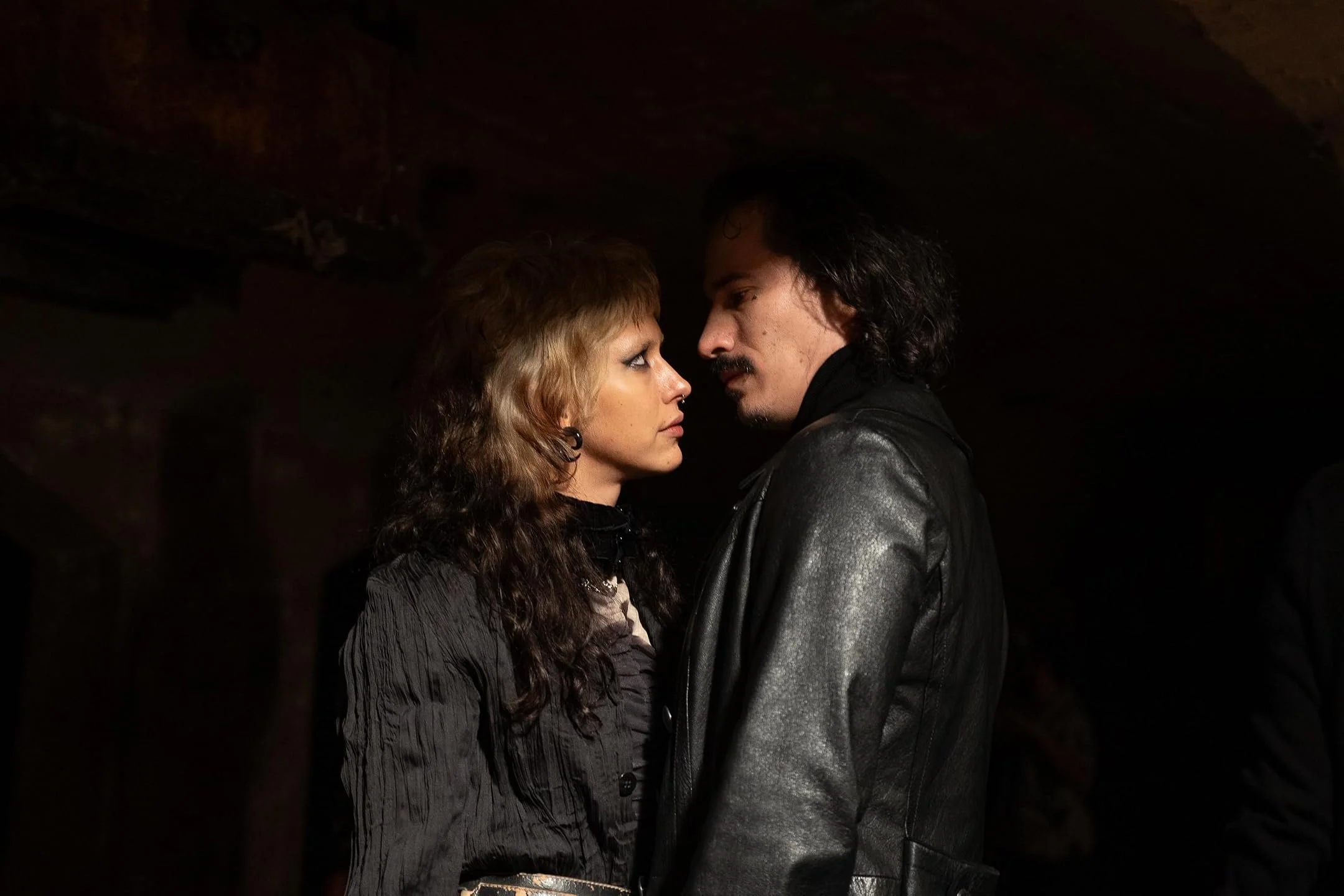
Thaís Lago gives Helena the physical assurance that keeps those scenes watchable. She seems capable of meeting violence without first needing to gather herself, and her heavy outerwear reinforces that guarded presence. During fights, supernatural speed, forceful blows, and punctured flesh offer an immediate pleasure: we get to see the authority her bearing promises. The difficulty comes with repetition. As confrontations accumulate around the pursuit led by her former lover, Leander, their excitement does less to deepen my investment in the couple. Shared danger keeps them occupied without always bringing them emotionally closer.

Dasha’s more exaggerated energy provides a welcome disturbance within that solemn world. Her snarling, demonstrative presence makes vampirism look like something a person might inhabit differently, with appetite and volatility spilling through the formal behavior. She changes the emotional temperature whenever she enters. The other vampires’ cultivated distance has a purpose, but Dasha makes me wish the film allowed a wider range of responses to its own strangeness. A society of ancient predators can accommodate some unruly personalities, especially when its romantic leads already carry so much restraint.
Victor provides another useful variation through the life he has arranged around his hunger. His elegant clothes, ornate cuffs, refrigerated blood, and disturbing domestic dependence make his comfort uneasy to contemplate. There is character in the practical business of how he gets through a night. Helena’s protective clothing and Victor’s aristocratic presentation similarly suggest different relationships with their condition before anyone explains them. These details make the hidden society feel inhabited. They also expose how much harder the dialogue works, repeatedly giving history and feeling a formal verbal presentation.
That formal Portuguese helps separate the vampires from the human world, so its stiffness cannot simply be dismissed as a mistake. It creates distance appropriate to people who have lived outside ordinary time. The cost emerges when conversations strain to become profound before the characters have reached the feeling underneath. Explanations of old attachments and obligations ask for attention that the romance has not always secured. The film’s sluggish passages have less to do with an absence of action than with the sense that another account of the past is postponing a change between the people sharing the present.
On the bridge, Marcos asks Helena if she has ever cared for anyone, and her answer moves toward the burden of memory and the relief mortality might offer. Here the film gives their attraction a painful imbalance. He wants his life to become larger; she carries an existence crowded with things she cannot forget.
That difference could make a simple question about affection difficult for her to answer. Instead, the conversation reaches its polished reflection so quickly that I lose some sense of Marcos waiting to hear something personal. He has asked about someone she might have loved. Her answer gives him a philosophy of dying, leaving the particular person, and Helena’s feelings for them, out of reach.
Love Kills became available on streaming platforms like Film Movement+ on October 30, 2026. Directed by Luiza Shelling Tubaldini, the stylish Brazilian horror-thriller follows a downtrodden café worker in São Paulo who tracks a mysterious customer into a hidden underworld where rival vampire factions wage war.
Where to Watch Love Kills (2025) Online



Full Credits
Title: Love Kills
Distributor: Film Movement+
Release date: October 30, 2026 (Streaming)
Running time: 1 hour 36 minutes (96 minutes)
Director: Luiza Shelling Tubaldini
Writers: Luiza Shelling Tubaldini, Pablo Guelli
Producers and Executive Producers: Luiza Shelling Tubaldini, André Skaf
Cast: Gabriel Stauffer, Thaís Lago, Erom Cordeiro, Iuri Saraiva, Marat Descartes, Almir Guilhermino, Gabriela Flores
The Review
Love Kills
Love Kills made me want to spend time with Helena, then struggled to make her romance feel equally inviting. Thaís Lago’s physical assurance, the café’s quiet rituals, and São Paulo’s nocturnal glow give this vampire world an emotional pull. Marcos’s thin characterization and dialogue that rushes toward profundity keep interrupting the connection. There is pleasure in entering this world, but its lovers remain harder to care about together.
PROS
- Lago’s assured physical presence
- Atmospheric São Paulo locations and lighting
- Helena’s quietly affecting café ritual
- Distinctive supporting-character behavior and design
CONS
- Uneven development of the central romance
- Formal dialogue that strains for profundity
- Repeated confrontations offer limited emotional development