






























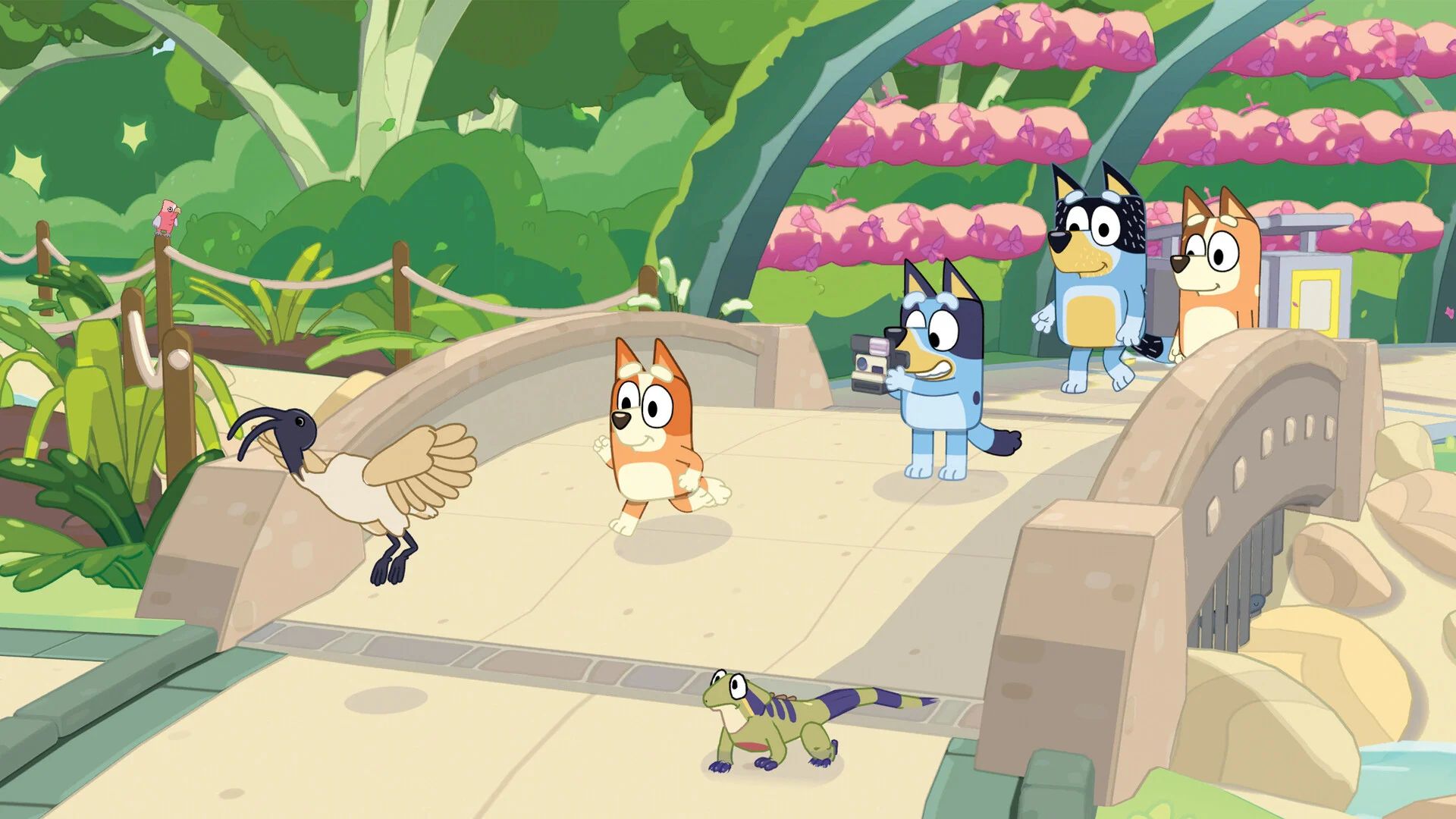
Bluey: The Videogame made familiar television locations explorable, while Bluey’s Quest for the Gold Pen took the family into a more fantastical adventure. Gameloft Brisbane’s Bluey’s Happy Snaps returns to everyday outings with a different activity holding them together. Drawing on “Bob Bilby,” it gives Bluey and Bingo their dad’s old instant camera and sends them looking for things to photograph. Returning fans get another visit to the Heeler home, playgrounds, and beaches, but this time the scenery supplies the objectives.
Each location has a sticker sheet identifying photographic subjects and offering hints. Find the required person, creature, or object, raise the camera, and take a picture to add the corresponding sticker. Collect enough and the next area opens. This gives exploration a readable structure without making every interaction part of the assignment. At the playground, birds and animals provide targets, while swings and familiar friends offer distractions. Children can follow the sheet, stop to play, then resume searching without having to reconstruct a complicated objective.
That relationship between direction and distraction suits the material. Bluey’s television games often grow from ordinary things lying around, and Happy Snaps gives players a reason to inspect those things themselves. The camera can turn through 360 degrees, so looking becomes an action rather than something that happens while travelling to a marker. Finding Turtleboy rewards recognition, but the sticker system also gives a child unfamiliar with that reference a reason to notice him. The game’s franchise detail serves both fans and the scavenger hunt.
Its forgiving rules are equally important. A photograph of the wrong subject carries no punishment, and children can take pictures outside the required list. Experimentation remains available even while progression depends on finding particular targets. Spoken menu options from Bandit and Chilli’s voice actors help children who cannot yet read independently understand what they can select. These are practical accommodations for a first game: instructions can be heard, mistakes cost nothing, and success produces a visible addition to the collection.
Local co-op builds on that accessibility through unequal but useful responsibilities. The primary player handles the camera while the second controls the other sister, moves around, interacts with the environment, and poses. A parent or older sibling can manage the photographic task while a younger child helps create the picture.
The limitation is that shared participation does not necessarily mean equal engagement. The person operating the camera still spends much of the session locating straightforward targets, and the game offers little sustained challenge for an accompanying adult. Its strongest family appeal comes from arranging and enjoying the activity together.
The photography occasionally asks for something livelier. Handing the camera to an adult character lets the playable sister enter the frame, while a timed opportunity sends her racing to a slide before the shutter fires. Moving-vehicle sequences change the demands again, asking players to catch seagulls or fruit bats as they pass.
Here the Pokémon Snap comparison has a clear purpose: a subject that waits patiently during free exploration becomes a temporary opportunity. Missing targets remains forgiving, but the shifting viewpoint requires attention and timing, giving the camera a different use between the larger locations.
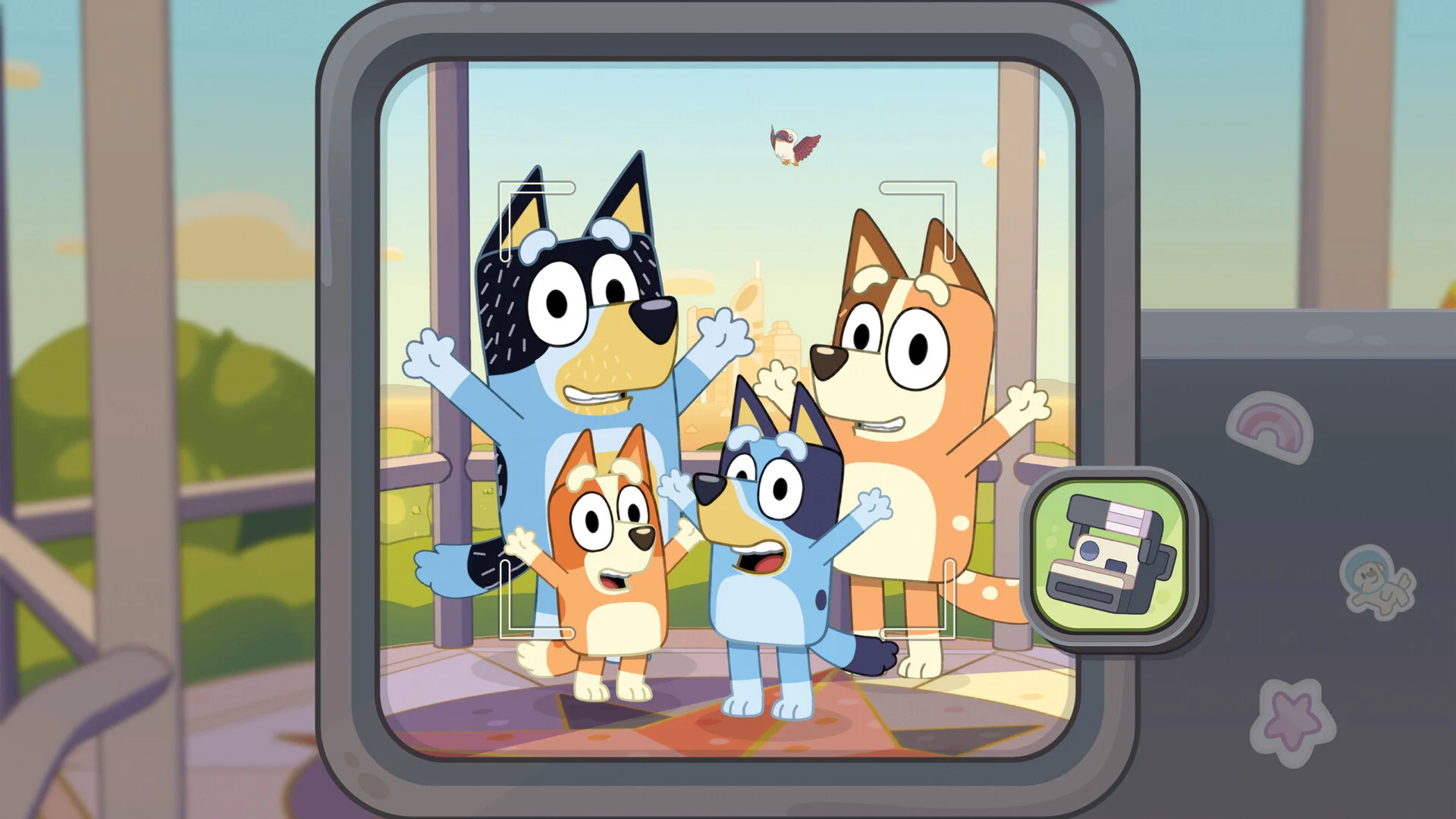
Other diversions draw directly from the show’s habit of turning household objects into games. Bandit finds chairs and sets up Taxi; arranging toys in seats creates a pretend dinner party. These activities translate imaginative play into actions the player can perform, rather than leaving the television reference at the level of decoration. “Pass the Parcel” exposes the difference. Lucky’s Dad asks which rules to use, suggesting an activity is about to develop, then the event finishes off-screen. Recognition establishes an expectation that the game declines to fulfil.
The frequent changes help prevent the photographic search from becoming monotonous, though they also reveal how briefly Happy Snaps develops its ideas. Mini-games finish quickly, the contained locations can be worked through without much difficulty, and the campaign is short.
A young newcomer may appreciate activities that explain themselves and end before becoming frustrating. Players coming from Gold Pen’s adventure emphasis may find fewer reasons to stay involved once they understand the scrapbook routine. The issue is the limited development of the diversions, rather than their simple rules.
Visually, the recognizable locations make searching pleasant. The show’s clean shapes and colours remain easy to read, and appearances by less prominent characters such as Chippie and Cherry give returning viewers details worth spotting.
The familiar voices help preserve the family’s identity, too. Cutscenes are less convincing when characters’ eyes fail to focus naturally on the person or action receiving their attention. In a game built around looking, posing, and interacting, that awkward gaze makes the characters seem less responsive than their surroundings.
Choosing which photographs to keep after a level gives the collection a personal element. The required subject earns a sticker, but the player can still decide which image deserves a place in the album. Colouring pages, decorative stickers, and framing supplies extend that choice, although crafting is less comfortable with a controller than the idea suggests.
Analogue sticks make the tools usable, but positioning and selecting decorations can feel cumbersome. Touch interaction can also fail to activate an item even when finger movement successfully shifts the cursor. Creative options lose some of their appeal when handling the tools becomes the main task.
The “Play in Real Life” menu offers a more direct extension of those activities, providing instructions and materials for recreating games away from the television. Families can revisit these at the Heeler household, giving an outing or mini-game a practical use after its digital version is finished.
Access to the livelier digital diversions is less generous. Grannies, which puts Bluey and Bingo in Rita and Janet costumes to cause havoc in the children’s car, belongs to the Deluxe Edition alongside additional dress-up items. In a brief game that depends on changes of activity, excluding this energetic alternative from the standard package leaves families paying extra for another way to play together.
The Review
Bluey's Happy Snaps
Happy Snaps gives familiar Bluey locations a useful new purpose through forgiving photographic scavenger hunts. Spoken menus and complementary co-op roles make it welcoming for young newcomers, while moving-camera sequences add variety. Compared with Quest for the Gold Pen’s adventure emphasis, its appeal rests on leisurely discovery and shared play. The brief campaign, awkward crafting tools, and Deluxe-exclusive Grannies activity limit an otherwise thoughtful family game.
PROS
- Forgiving photography and spoken menus suit young beginners.
- Co-op gives younger children useful ways to participate.
- Familiar locations and characters reward exploration.
- Real-life activity instructions extend family play.
CONS
- Short campaign and briefly developed mini-games.
- Limited sustained challenge for accompanying adults.
- Cumbersome crafting controls and unreliable touch interaction.
- Grannies activity restricted to the Deluxe Edition.







