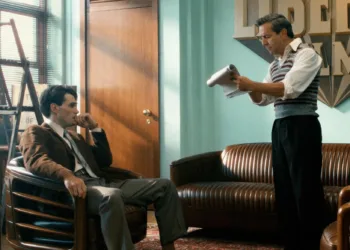
























Martin Beswick suspects that someone in his company is manufacturing a haunting to sabotage his play. It is an accusation with a useful psychological dividend: every unexplained disturbance becomes evidence of another person’s malice, leaving his own competence conveniently outside the investigation. Jonathan Cleaver gives that defensive logic an increasingly irritable custodian.
Martin is rehearsing M. R. James’s A Warning to the Curious at Nottingham’s Hounds Gate theatre, with a documentary crew recording the process. He needs a successful production. Richard Mansfield’s The Hounds Gate Haunting lets that need sour into a conviction that the people around him must be responsible for its difficulties.
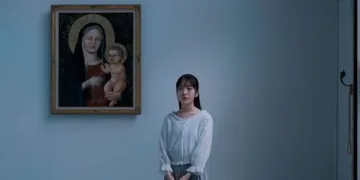
The documentary camera complicates his claim to authority. As cameraman Ben explores the corridors, attention spreads beyond the stage and its director’s instructions; an auditorium seat moving without an occupant can commandeer the production’s interest.
Mansfield finds an economical spatial joke here. The disturbance originates in the place reserved for watching and judging. Coldness felt at the seat and pistachio shells beneath it supply further clues, though neither gives the moving image an explanation. Colin, the company’s self-appointed professional heavyweight, obliges with a story about Cyril Cobb, a director and vicious critic who occupied that seat and died choking on pistachios.
Cobb’s nickname, Stalls, binds his authority to his preferred vantage point. His ridiculous death gives that authority a welcome indignity, but the acoustic haunting restores its force. Knocks and whispers make the building difficult to dismiss as an inert workplace; the recorded complaint, “Not … good … enough!”, gives the disturbance a discriminating hostility.
Cassie’s discovery of notes and tape recorders beneath the stage helps turn theatrical folklore into something the company can investigate. The sound has an especially unpleasant function for Martin. It appears to preserve an adverse judgment beyond the reach of argument, delivered by a speaker who cannot be persuaded to reconsider.
That dependence on recorded sound makes a small early inconsistency unusually distracting. Martin begins speaking before he receives a microphone, yet the handover produces no appreciable change in vocal quality, and Alex remains equally clear behind him.
Plausible recording arrangements could account for this; the awkwardness lies in making the microphone conspicuous without giving its arrival an audible purpose. The film asks us to attend to equipment as a means of discovering what the theatre contains. For a moment, the equipment looks like an accessory to the documentary performance, and listening becomes a slightly less trustworthy activity.

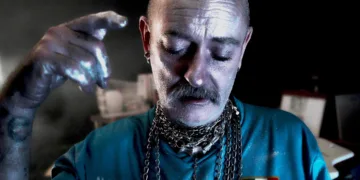
Cleaver provides a stronger basis for belief through Martin’s gathering annoyance. His resistance gives the hauntings a human consequence before they become aggressively supernatural. Each manifestation eats into his ability to maintain rehearsal discipline, and his sabotage theory converts that loss of control into suspicion of his collaborators.
The performance keeps vanity and vulnerability close together. Martin’s need for a hit makes his defensiveness intelligible, while his readiness to assign hostile intentions makes working beside him increasingly unattractive. He can acknowledge a threat to the production readily enough. A threat to his estimate of himself requires a culprit.
Alex, played by Luke Willis, gives that suspicion somewhere credible to settle. His practical jokes and enjoyment of teasing Martin establish a workplace where deception already has a harmless social function. The supernatural can exploit an existing failure of trust. Matthew Hunt’s Colin contributes a different strain of professional insecurity, inflating occasional television extras work into a claim to distinction and keeping his agent within conversational reach.
Hunt’s expansive playing suits a man advertising his own importance, though the recurring bluster becomes predictable. There is a narrow comic distance between an actor playing a tiresome performer and a film allowing the performance itself to become tiresome; Colin occasionally closes it.
Jessica’s repeated attempts to sell Tend & Tonic products offer a cleaner interruption of Martin’s ambitions. Rosanne Priest gives the company another person trying to extract something private from a supposedly collective enterprise. Her sales pitches are funny because the rehearsal must accommodate a second, entirely unrelated campaign for attention.
Alongside Colin’s status-seeking and Alex’s teasing, they establish a group whose priorities fail to align without requiring anyone to be malicious. The limitation is repetition. These habits quickly tell us how the participants obstruct one another, but provide relatively little sense of relationships changing under pressure. Martin accumulates strain while several people around him retain the dimensions of their introductory joke.
The early haunting benefits from that comic environment. A seat shifting or a knock in the building can remain poised between supernatural intrusion and somebody amusing themselves at Martin’s expense. Suspense depends on that explanation becoming harder to sustain.
Mansfield is patient, sometimes excessively so: recurring minor disturbances keep announcing an unsettled atmosphere without always changing our expectations of danger. Martin’s deteriorating composure supplies movement that the haunting itself can lack. The increasing activity does generate unease, but the film’s comic irritations are often sharper than its threats. Its restraint works best when a disturbance alters our reading of somebody’s behavior; the accumulation of eerie signs alone has less purchase.
The final twist places a heavier demand on those lightly sketched relationships. Its connection to the struggle between creative ambition and hostile criticism makes thematic sense, yet its arrival compresses the dramatic work needed to make the reversal convincing.
We have spent time learning the company’s recurring habits and watching Martin become furious with them. The reveal asks that familiarity to support a sudden change in understanding, with too little space for the participants to acquire the weight it needs. Martin’s fear of artistic inadequacy has received sustained attention; the people implicated in his account of that fear have remained much easier to recognize than to know.
The Hounds Gate Haunting released across digital platforms, including Found TV. Directed by Richard Mansfield, the horror film follows an amateur theatrical troupe staging a ghost story at Nottingham’s historic Hounds Gate Theater who accidentally awaken the building’s real-life phantom.
Where to Watch The Hounds Gate Haunting (2025) Online



Full Credits
Title: The Hounds Gate Haunting
Distributor: Found TV / Amazon Video
Release date: 2025 (Festival/Platform release) / August 2026 (Digital platforms)
Rating: CTC
Running time: 1 hour 21 minutes (81 minutes)
Director: Richard Mansfield
Writers: Richard Mansfield
Producers and Executive Producers: Richard Mansfield
Cast: Jonathan Cleaver, Lara Drew, Andrew Fearon, Matthew Hunt, Daniel Mansfield, Rosanne Priest, Emma Rayner, Jake Turner, Luke Willis
Director of Photography (Cinematographer): Richard Mansfield
Editors: Richard Mansfield
The Review
The Hounds Gate Haunting
Mansfield makes an empty auditorium seat an effective source of authority, then lets Jonathan Cleaver's rattled director supply the human damage. The documentary gaze and hostile recordings give this modest horror-comedy a sharp angle on artistic insecurity. Its company is funny in recognizable ways, but too often stays fixed in those habits; the haunting also spends stretches repeating itself. An abrupt final reversal exposes the cost of that thin characterization, leaving the psychological tension better developed than the payoff.
PROS
- Cleaver's increasingly defensive, irritable performance.
- Clever use of audience space as a source of menace.
- Recorded criticism gives the haunting psychological force.
- Dry comedy grounded in competing rehearsal-room priorities.
CONS
- Supporting characters remain confined to recurring habits.
- Minor disturbances sometimes prolong rather than intensify suspense.
- The final twist lacks sufficient dramatic preparation.