




























During the fish’s circus routine, the wait for a laugh becomes part of the entertainment. The scene stretches its quiet interval far enough that you start noticing your own expectation: surely something has to happen now. Then it keeps waiting. For an animated family feature filled with magical gadgets and unruly creatures, The Cat in the Hat shows surprising confidence in that pause. Writers and directors Erica Rivinoja and Alessandro Carloni trust children to enjoy anticipation, including the delicious awkwardness of a joke withholding its reward.
A dynamite gag works through a different kind of delay. The Cat produces an explosive, decides against using it, and returns it to his hat, where it remains until the eventual detonation. This is a delayed payoff: the film gives us information, lets our attention move elsewhere, then brings that information back at an inconvenient moment. Both sequences find laughs by controlling our attention. The expanded crowd of Things has less success sustaining its clapping, tongue-clicking, bodily percussion, and collisions. Once their noisy method becomes familiar, prolonged exposure supplies diminishing surprise.
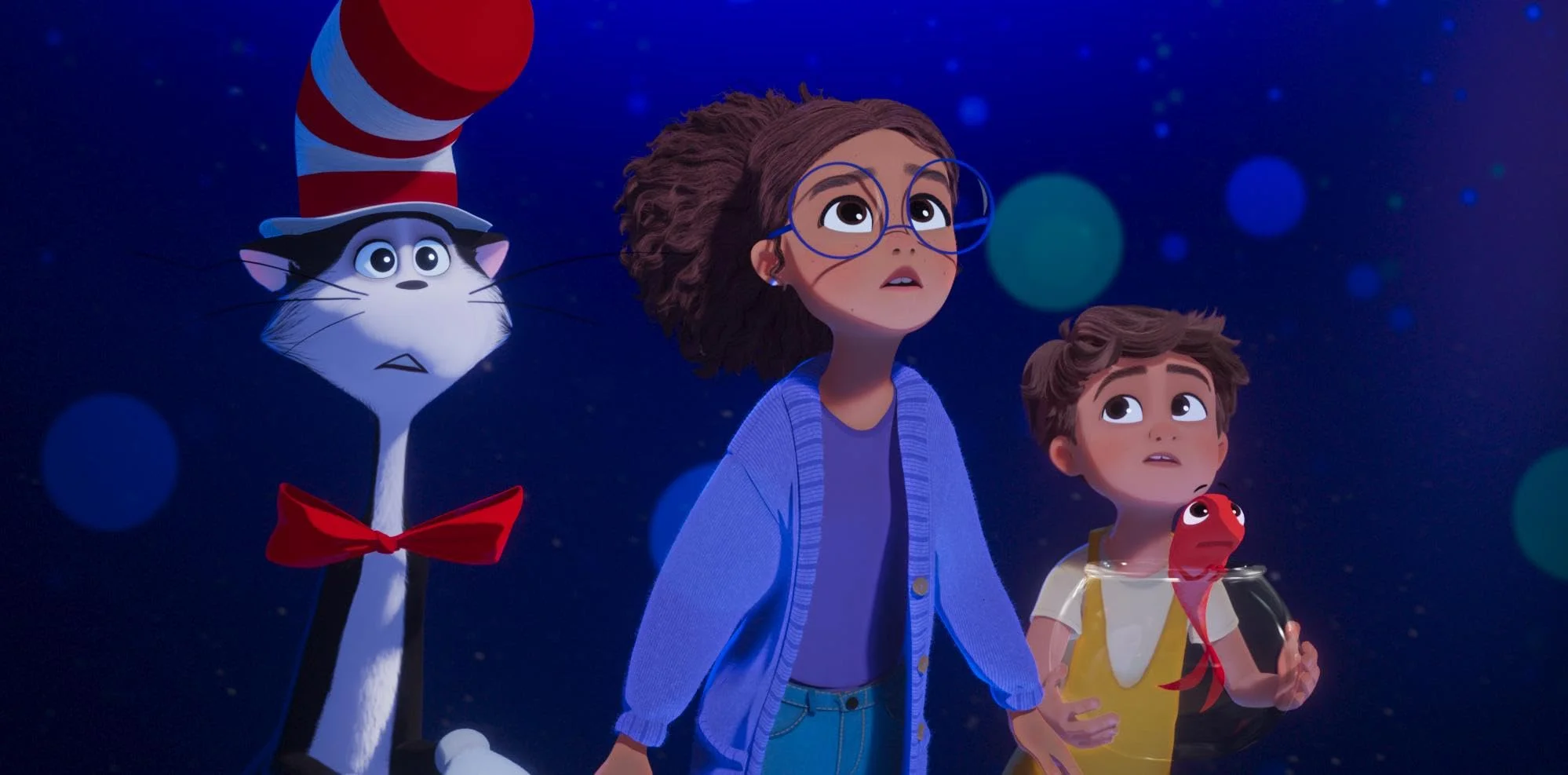
Bill Hader’s vocal performance often understands that distinction. His Cat can raise the volume, yet the quieter, pleased-with-himself muttering gives the character an appealing private rhythm. You hear someone enjoying his own cleverness before anyone else has approved it. There are hints of uncertainty beneath the confidence, though Hader is funniest when he lets a supposedly effortless flourish sound slightly questionable. Matt Berry provides an excellent opposing force as Waffles, the family goldfish whom the Cat grants speech. His grandly offended delivery gives the mayhem someone specific to inconvenience. Every indignity seems to merit a formal objection.
The film places this troublesome visitor inside an organization devoted to cheering up children. At the I.I.I.I., the Institute for the Institution of Imagination and Inspiration, LLC, agents receive assignments and have their work assessed for amusement and mess. The Cat’s Mess-o-Meter readings threaten his employment, and his boss, Mr. Hoogeboom, voiced by Giancarlo Esposito, offers a final assignment. It is an efficient explanation for his arrival, with an amusingly practical question attached: who accounts for the damage after the fun? It also makes the Cat easier to anticipate. His disruption has a job description, a supervisor, and an approved emotional purpose.
His assignment brings him to Gabby and Sebastian, siblings who have moved into a city apartment with their mother, Carmen. Xochitl Gomez gives Gabby’s unhappiness a withdrawn edge, while Tiago Martinez supplies Sebastian’s more readily available energy. Their difficulties overlap without becoming identical. Gabby misses the life she knew and rejects her trumpet instead of embracing a new school band. Sebastian wants access to a sister whose interests are changing. That distinction matters. Returning to the old address would answer one child’s immediate wish without necessarily restoring the relationship the other misses.
The Go-Backer, a layered stopwatch capable of reversing time, makes Gabby’s desire actionable. She sees an opportunity to undo the move. When the device disappears into the family’s moving boxes, recovering it becomes the adventure’s organizing task. Those boxes contain separate collections of toys, mementos, belongings, and paperwork; inside, their contents become enormous imaginative environments. I like how directly the idea connects a practical feature of moving house to the difficulty of leaving one. The family has transported its possessions, while each person remains attached to a different version of home.
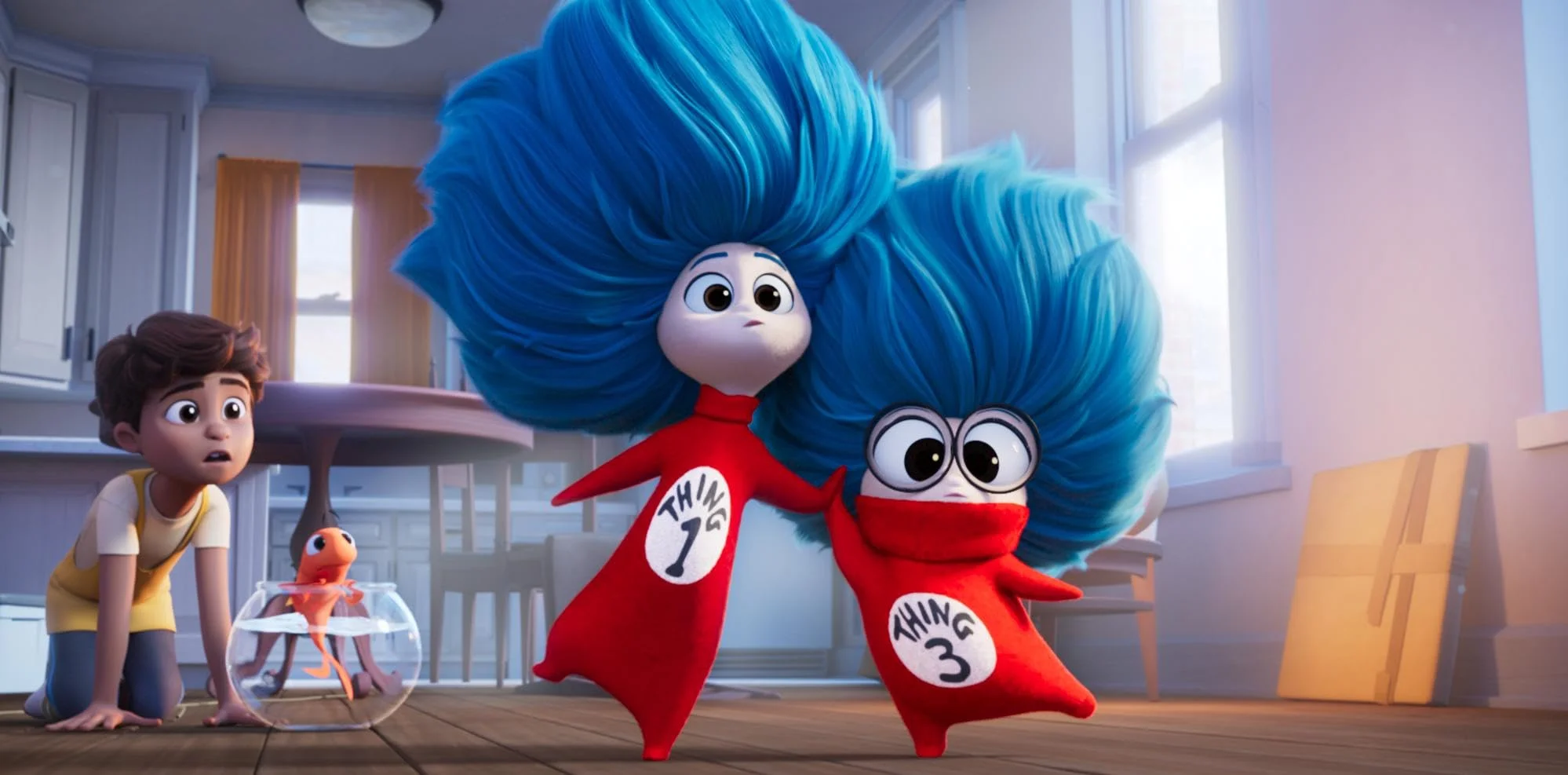
The animation helps us understand these spaces before the dialogue explains them. The apartment has restrained colors, rounded computer-generated forms, and comparatively grounded movement. Imaginative settings introduce brighter colors, exaggerated motion, and surfaces with a flatter, illustrated appearance. That change in rendering, the way forms are shaded and presented, signals a change in what bodies and objects can do. A red couch becomes a transforming vehicle; an underwater excursion includes swimming underwear and an operatic whale with a unicorn horn. Ordinary household material becomes strange through scale, motion, and unexpected combinations. The visual invention has an accessible starting point.
The boxes also create a limitation. Because each collection belongs to a particular family member, discovery begins to resemble an organized tour of individual feelings. Sebastian’s toys explain his desire for play; Gabby’s mementos explain her attachment to the past. The arrangement makes their emotions readable, though it leaves less room for an object to mean something untidy or contradictory. The Go-Backer is especially effective because it gives Gabby a tempting possibility before asking her to reconsider it. Some of the surrounding possessions arrive with their interpretive work already neatly assigned.
Across 107 minutes, that family exploration competes with several additional obligations. The Cat must protect his job, recover the device, and contend with Something, a pursuing monster. Paula Pell’s suspicious landlord introduces the threat of eviction, attaching another set of consequences to the apartment’s disorder. Each conflict can function individually. Together, they repeatedly redirect attention toward another problem requiring resolution. The lengthy setup establishes the agency and its rules before the box adventure gets moving, while the later stretch must service threats operating at domestic, professional, and fantastical scales.
The monster confrontation makes that competition especially visible. Gabby’s wish concerns a painfully recognizable loss of familiarity; the expanding danger asks us to worry about the survival of imaginative worlds. Spectacle changes the question occupying the scene. Can the characters overcome the threat? That question produces activity, yet the quieter business of understanding a sibling or accepting a new home receives less space. The circus routine demonstrates how pleasurable duration can be when the audience has something precise to anticipate. Here, the accumulating emergencies make it harder to stay invested in one developing choice.
Carmen’s belongings provide the most worthwhile reason to remain with the family material. Her children discover creativity and a capacity for fun beneath the paperwork they associate with her working life. The film allows a mother’s responsibilities to exist without treating them as evidence of an impoverished personality. That is a thoughtful correction to the children’s limited view. Placing the discovery late, among so many other demands, gives it a heavy explanatory burden: it must disclose Carmen’s neglected interests and help change her children’s understanding of their situation. I wanted time for their new knowledge to affect how they treated her, beyond the immediate relief of finally recognizing it.
The Cat in the Hat releases in theaters nationwide on November 6, 2026, distributed by Warner Bros. Pictures. Directed by Alessandro Carloni and Erica Rivinoja, this animated family comedy brings Dr. Seuss’s iconic mischief-making feline back to the big screen as he embarks on an adventure to cheer up two siblings struggling with their move to a new town.
Where to Watch The Cat in the Hat (2026) Online
Full Credits
Title: The Cat in the Hat
Distributor: Warner Bros. Pictures
Release date: November 6, 2026 (United States)
Rating: G
Running time: 1 hour 25 minutes
Director: Alessandro Carloni, Erica Rivinoja
Writers: Alessandro Carloni, Erica Rivinoja, Jared Stern
Producers and Executive Producers: Jared Stern, Susan Downey, Daniel Chuba, Mike Bodkin, Dr. Seuss Enterprises
Cast: Bill Hader, Xochitl Gomez, Matt Berry, Quinta Brunson, Paula Pell, Tiago Martinez, Giancarlo Esposito, America Ferrera, Bowen Yang, Tituss Burgess
Editors: Tim Mertens
Composer: Mark Mothersbaugh
The Review
The Cat in the Hat
The Cat in the Hat finds real pleasure in comic timing, expressive animation, and the collision between Hader’s confidence and Berry’s indignation. Turning moving boxes into imaginative worlds gives the family story a clever physical shape. Yet competing threats crowd that discovery, and the monster spectacle takes attention from relationships that need time to develop. I enjoyed the patient gags and the generous view of a working mother; the adventure surrounding them could have used similar restraint.
PROS
- Patient comic timing and effective delayed payoffs.
- Visual styles distinguish everyday life from imaginative spaces.
- Hader and Berry create lively comic opposition.
- Thoughtful recognition of Carmen’s creative life.
CONS
- Competing crises interrupt the family story.
- Box worlds explain emotions too neatly.
- The Things’ physical comedy becomes repetitive.
- Carmen’s late revelation has limited room to develop.