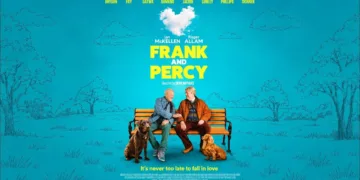


























Frank’s burgundy jackets give way to yellow and blue as his attachment to Percy grows. Inside the charity shop where he volunteers, he moves from a plain corner toward his colleague’s patterned surroundings. These changes in Frank and Percy give renewed desire a visible place in an elderly man’s daily life. Roger Allam supplies the essential behavioural evidence: the withdrawn Frank begins to laugh openly. Colour accompanies that loosening of reserve, allowing the change to register across his clothes, his workplace, and his response to another person.
Cinematographer Ryan Eddleston extends the pattern through vertical composition. During unhappy passages, the men occupy the lower third of the frame; reunion restores them to the middle, and the final passage places them higher still. Their emotional circumstances become a question of screen position.
The device is legible enough to risk being schematic, yet its generosity has a specific purpose. These bodies are permitted to occupy the picture as the romance develops. Desire gives them spatial presence, with the frame accommodating a change that Frank has scarcely found language for.
His life has contracted since his wife’s death from cancer. A retired history teacher, he passes time at the garden centre among memories of their marriage. Walking Toffee on Hampstead Heath brings him into contact with Percy, Ian McKellen’s sociable academic, who has a dog called Bruno and difficulties of his own.
Percy’s colourful clothes and mischievous manner suggest a man with ample resources for enjoying himself. His unsatisfying encounters through the Papa Search dating service reveal the limits of those resources. Allam’s reserve and McKellen’s outward energy give loneliness two distinct forms.
Director Sean Mathias reunites the actors from Ben Weatherill’s stage play, with Martin Sherman expanding the material for the screen. The relationship’s most consequential development remains a small conversational act. Over a drink, Percy asks permission to kiss Frank, and Frank agrees.
The question preserves a space in which Frank can decide. McKellen’s confidence becomes attractive here because it includes attention to another man’s uncertainty. The scene allows discovery to proceed at the pace of an answer, after the men have already established the familiarity of their repeated meetings.
Frank’s response to the kiss is beautifully particular: “I felt like I did when I had a cataract removed.” The comparison draws on his bodily experience to describe an unfamiliar sensation. Age supplies him with a vocabulary for pleasure.
His subsequent consideration of bisexuality keeps the discovery open, with the relationship arriving before a settled account of what it means for his identity. Allam’s laughter has similar precision. It makes Frank’s growing receptiveness audible without suggesting that his previous life was false, or that bereavement can be disposed of once a new partner appears.
The visual treatment sometimes settles that openness too readily. Yellow and blue, patterned surroundings, and the upward progression within the frame make emotional renewal exceptionally easy to read. Ben Pearson’s woodwind score reinforces the film’s gentle atmosphere, but its reassuring presence can become an instruction to find everything touching.
Frank’s uncertainty deserves some room to remain uncertain. When his pleasure registers in Allam’s laughter or in the odd specificity of the cataract remark, the emotion already has a convincing source; the surrounding sweetness occasionally presses harder than the exchange requires.

Sherman’s expanded social world introduces a different pressure. Hugh Skinner’s dating-app match insists that Percy call him “daddy,” converting an encounter into a prescribed verbal performance. It is funny, though the conspicuous routine leaves little space for the mutual attention that makes Percy’s request to kiss Frank so persuasive.
The film’s broad comedy can reduce a person to the terms of a gag. Stephen Fry’s Dennis, Percy’s former partner, has a sharper point of contact with the central romance: his complaints about bodily changes caused by prostate-cancer medication keep sexual life entangled with illness. Even through his self-pity, the body remains an active concern.
Mortality also runs through the men’s conversation with a useful lack of ceremony. Frank turns weather talk toward heart attacks; later, funerals seem to constitute much of their social calendar. Percy’s recognition of a former sexual partner among the churchyard headstones gives mourning an inconveniently intimate footnote.
The joke retrieves a history of appetite from a place organised around its extinction. These exchanges help prevent the warm photography from enclosing the men in a decorative old age. Their talk is morbid, sexual, occasionally ridiculous, and still capable of taking the other person by surprise.
Joanna Lumley’s Belinda, Frank’s sister-in-law, brings the cost of that continuing openness into focus. Living with dementia, she has a lucid moment in which she calls him lucky to have a broken heart at 77. Lumley gives the observation weight through Belinda’s own vulnerability; the reassurance comes from someone whose condition makes reassurance difficult.
Her remark also complicates the film’s upward visual trajectory. Frank’s renewed participation in life includes pain that cannot be resolved by a warmer jacket or a kinder position in the frame. Belinda recognises his hurt as something he still has the capacity to experience, and asks him to value that capacity while he is suffering.
Frank and Percy made its world premiere at the BFI London Film Festival on October 13, 2026, ahead of its UK theatrical release through Icon Film Distribution. Adapted from Ben Weatherill’s stage play, the British comedy-drama follows two elderly dog walkers who forge an unexpected friendship on Hampstead Heath that gradually evolves into a deeper, life-changing romance.
Full Credits
Title: Frank and Percy
Distributor: Kaleidoscope Film Distribution, Icon Film Distribution
Release date: October 13, 2026
Running time: 1 hour 49 minutes (109 minutes)
Director: Sean Mathias
Writers: Martin Sherman, Ben Weatherill
Producers and Executive Producers: John Gore, David Gilbery, Naomi George
Cast: Ian McKellen, Roger Allam, Stephen Fry, Jessica Gunning, Joanna Lumley, Derek Jacobi, Ncuti Gatwa, Siân Phillips, Rob Brydon, Felicity Kendal, Peter Davison, Gary Wilmot
Director of Photography (Cinematographer): Ryan Eddleston
Editors: Tania Goding
The Review
Frank and Percy
Frank and Percy gives late-life desire a persuasive physical presence through colour, composition, and Allam’s growing openness. McKellen makes confidence attentive, while Lumley’s Belinda gives heartbreak an uncomfortable value. The woodwind score sometimes insists on tenderness, and the broader dating comedy sacrifices individual detail. Its strongest exchanges leave room for discovery, embarrassment, and the freedom to risk being hurt.
PROS
- Belinda’s lucid intervention complicates the comforting tone.
- Allam’s convincing shift from reserve to pleasure.
- Colour and composition make emotional renewal visible.
- McKellen’s attentive handling of Percy’s confidence.
CONS
- The score sometimes overstates tenderness.
- Broad dating comedy reduces character detail.







