




























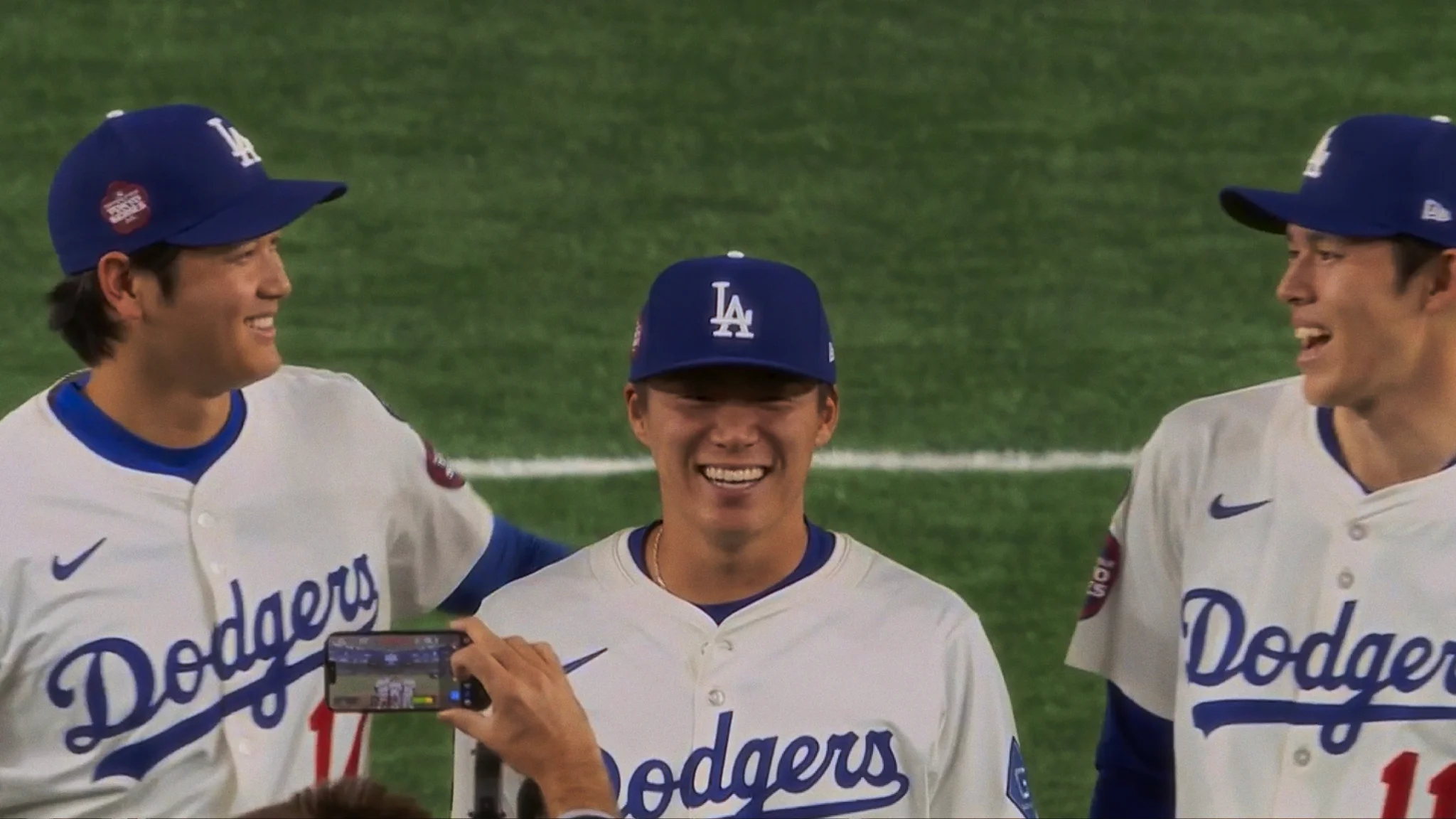

The cut from major-league players at the Tokyo Dome to children playing baseball in Osaka makes the distance between them feel briefly manageable. After Opening Day highlights of Shohei Ohtani, Yoshinobu Yamamoto, Seiya Suzuki, and Shota Imanaga, Homecoming: The Tokyo Series returns to the Yamadanishi Little Wolf youth team. Professional achievement becomes a possibility someone small might imagine for themselves. You can understand that feeling without knowing a pitching rotation or remembering a single score. The edit gives the children a place in the event before any of them could earn one on the field.
Their coach, Yasuko “Obachan” Tanahara, complicates that promise in a welcome way. She teaches kindness and respect alongside baseball, and describes the work as her reason for living. Her investment asks us to care about what happens to these children even if none becomes a professional athlete.
When the film revisits the team through young player Kanato and his father, Shogo, ambition acquires a family relationship rather than remaining an uplifting abstraction. Tanahara’s presence gives those ambitions somewhere to develop, with an adult who considers their behavior away from the game part of her responsibility.
Director Jason Sterman places this small community alongside the Dodgers–Cubs series that opened the 2025 MLB regular season in Tokyo. The returning Japanese players include Dodgers Ohtani, Yamamoto, and Roki Sasaki, and Cubs Suzuki and Imanaga.
Yamamoto recalls visiting the Tokyo Dome as a child and wanting to create similarly lasting memories for others. His recollection makes the film’s shift back to youth baseball especially effective: an admired player remembers occupying the position of an admirer. The homecoming carries an obligation to people watching, which gives the event an emotional stake separate from winning its two games.
That stake becomes tangible in the quieter portraits of people who help baseball remain playable. In Gifu Prefecture, Mizuno craftsman Tamio Nawa hand-shapes wooden bats. In Tokyo, Tomohiro Yonezawaya restores worn gloves and supplies reused equipment to growing children through Re-Birth.
The activities invite different kinds of affection. Nawa’s work directs attention toward the care invested before an object reaches its player; Yonezawaya’s gives an already used object another chance to belong to someone. The pleasure of these passages comes from watching devotion produce something useful. Baseball acquires a practical life beyond the extraordinary bodies capable of playing it professionally.
Sterman gives this work time, using slow, sometimes wordless transitions rather than treating each subject as a quick testimonial. The participants retain their Japanese voices, preserving their presence within accounts that could easily have become explanatory material for visiting viewers. Michael Dean Parsons and Scott Michael Smith’s piano-led score starts sparsely and gathers force as the series approaches.
Its gradual expansion encourages anticipation without making the early portraits feel hurried. Yet the music also carries some connective work that the stories themselves leave unfinished. Bat-making, glove repair, and coaching share an affectionate register; their proximity to the Tokyo games does not consistently develop those relationships.
The film’s strongest transition between professional and youth baseball makes that limitation easier to feel. It demonstrates how a change of scale can deepen our attachment, then leaves us wanting similar development elsewhere. Salon owner and Ohtani admirer Hironobou Kanno watches Game 2 at home, while the other featured community subjects remain outside the stadium story.
There is nothing emotionally inadequate about following an event through a television. For many fans, that is where sporting memories live. Kanno’s viewing could provide a connection between the film’s two scales, but it receives too little development to make the series feel like a consequential episode in the lives we have been learning about.

As the event approaches, journalists Jason Coskrey, Jim Allen, and Meghan Montemurro supply context about Japanese baseball. Montemurro’s access includes a Cubs team dinner and a school visit involving former Cubs Derrek Lee and Kosuke Fukudome. The school visit fits the film’s interest in contact between established players and children.
The difficulty lies in the changing relationship with the viewer. We have spent time alongside people teaching and repairing; now we follow reporting access to a major event. Information increases, while the intimacy established in Osaka and the workshops becomes harder to sustain across the shift.
Ohtani’s role exposes the gap most clearly. The film communicates his importance through admiration, a brief visit to his hometown, and limited press-conference material before the games. His significance is easy to recognize, but there is less opportunity to experience the return from his side.
Near the end, receiving the Player of the Game award, he speaks about his nerves and his gratitude at having played successfully in Japan. That admission gives the occasion a pressure the surrounding celebration can obscure. The person everyone wants to see has something to worry about, and his relief offers a brief point of contact with the children still learning to perform in front of others.
Inside the Tokyo Dome, attention to spectators’ faces and families makes the games accessible as an experience of watching together. Detailed sports analysis would serve a different purpose, and Sterman’s choice allows recognition and anticipation to carry these passages. Its event footage can communicate the pleasure of being present while leaving the local stories suspended.
Returning to the Little Wolf community gives the film a more specific change to reckon with. A dinner marks the end of Tanahara’s coaching era and the continuation of her influence. After seeing how completely she has invested herself in teaching, the occasion carries the unease of something familiar ending. It also changes the children’s place in the film: they are people who have received care that will eventually need another form. Someone will have to keep teaching the habits she considered worth taking beyond the field.
Homecoming: The Tokyo Series debuted in U.S. theaters as a special event before streaming via CNN Films, Prime Video, and Discovery Global Sports. Directed by Jason Sterman, the sports documentary explores Japan’s deep-rooted passion for baseball through the lens of the 2025 MLB season-opening series in Tokyo between the Los Angeles Dodgers and the Chicago Cubs, highlighting major Japanese stars alongside local youth players, coaches, and craftspeople.
Where to Watch Homecoming: The Tokyo Series (2026) Online
Full Credits
Title: Homecoming: The Tokyo Series
Distributor: Fathom Entertainment, CNN Films, Prime Video, Discovery Global Sports
Release date: February 23, 2026 (Theatrical), March 2026 (CNN / Streaming)
Running time: 1 hour 31 minutes (91 minutes)
Director: Jason Sterman
Writers: Jason Sterman
Producers and Executive Producers: Jason Sterman, Brian McGinn, Dan Silver, Nick Trotta, Jamie McBriety
Cast: Shota Imanaga, Shohei Ohtani, Roki Sasaki, Seiya Suzuki, Yoshinobu Yamamoto
The Review
Homecoming The Tokyo Series
Homecoming: The Tokyo Series earns affection through the people who teach baseball, make its equipment, and give children room to dream. Its patient observation makes those relationships worth caring about, even without much interest in the sport. The Tokyo games offer excitement, though their connection to the local stories remains underdeveloped, and Ohtani’s own experience receives limited attention. Tanahara’s coaching and farewell provide the most lasting emotional attachment.
PROS
- Tanahara’s coaching gives childhood ambition a personal stake.
- Thoughtful editing connects professional achievement to youth baseball.
- Patient craft portraits make everyday devotion tangible.
- The piano-led score builds anticipation gently.
CONS
- The Tokyo Series insufficiently develops the local subjects’ stories.
- Journalist-led event coverage weakens the earlier intimacy.
- Limited pregame access to Ohtani restricts his personal perspective.







