






























DCS Carol Shaw deals with the man who impersonated one of her detectives by giving him a consultancy and an NDA. It is an admirably efficient solution to a returning television programme’s employment needs. John “Ludwig” Taylor, David Mitchell’s reclusive puzzle setter, can continue investigating crimes with the Cambridge police, provided he keeps quiet about having passed himself off as his missing twin, James. He is supposed to abandon his private investigation into James’s disappearance, too. Creator and writer Mark Brotherhood secures the familiar attractions of his series through an arrangement whose convenience is difficult to overlook.
That convenience buys some worthwhile freedom. John can now develop relationships under his own name, allowing exchanges previously shaped by deception to acquire a different kind of uncertainty. His growing connection with the recently promoted DCI Russell Carter is particularly rewarding.
Carter, played with restrained distress by Dipo Ola, wants answers about his fiancée’s death; John has information and suspicions he remains reluctant to share. Each recognizes that the other is withholding something. Their professional familiarity develops alongside that mutual caution, giving the police partnership an emotional pressure that John’s new job title cannot resolve.
Brotherhood also understands how little official recognition should change Mitchell’s performance. John’s ability to untangle an elaborate puzzle coexists with difficulty opening a door, while his old Nokia keeps him comfortably removed from contemporary expectations of effortless connectivity.
These details make competence particular rather than universal. During his explanations to assembled suspects, Mitchell allows John a confidence that ordinary conversation rarely grants him. The pleasure comes from seeing someone acquire authority in the precise circumstances that suit him. The consultancy preserves that pleasure without requiring another season of colleagues failing to recognize an impostor.
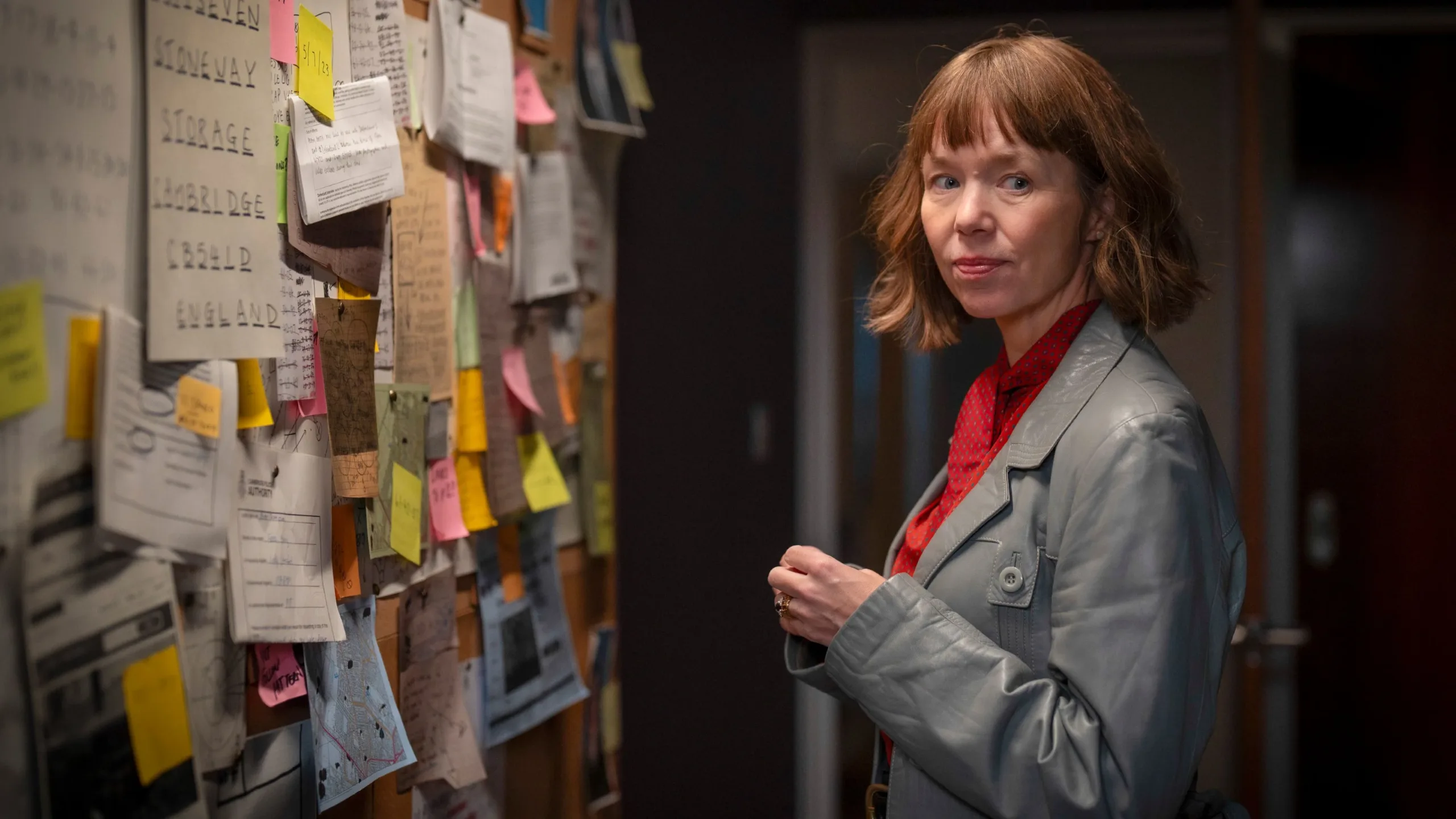
The greater creative gain, though, comes from giving Lucy Betts-Taylor a route into the investigation that John cannot supply. Anna Maxwell Martin’s character obtains work as a photojournalist at the East Anglia Advertiser, using her press credentials to pursue leads and witness accounts, sometimes with help from her son Henry.
Her expanded role has an observable effect on how the story operates: information now enters through reporting as well as police access and puzzle solving. A series organized around an exceptional man becomes more interesting when it gives somebody else a different means of finding things out.
Lucy’s work with editor Gareth Fisher makes that redistribution feel substantial. Mark Bonnar gives Gareth a resistant temperament that gradually yields to respect as he becomes involved in the inquiry. Their developing professional relationship supplies Lucy with an environment beyond her household and its missing husband.
Maxwell Martin retains the anxiety of a woman whose family remains suspended around an absence, even as Lucy approaches her reporting with confidence. Her initiative brings fresh exposure to danger, too. The writing allows capability and fear to occupy the same character without treating either as a temporary interruption of the other.
Her chemistry with Mitchell remains an attraction, carrying an ease that makes their unusual domestic arrangement emotionally suggestive. Yet the season’s useful decision is to give Lucy business elsewhere. John and Lucy are often apart when discoveries occur, which sacrifices some opportunities to enjoy them thinking together. It also lets their partnership depend on separate contributions. Lucy can return with something John did not deduce. For a programme developing its female lead, that is a meaningful change in dramatic responsibility, and Maxwell Martin makes the additional room count.
The weekly mysteries retain their own pleasures. The first presents an elderly woman killed with sewing scissors at a theatre and two daughters, played by Rebecca Front and Doon Mackichan, each insisting she alone committed the murder. The competing confessions reverse the usual resistance to admitting guilt, giving John a problem whose apparent abundance of answers obstructs a solution.
The sisters’ pearls, worn over grey custody tracksuits, provide an equally economical visual joke. Police processing has changed their clothes without entirely disturbing their social presentation. The programme can enjoy its genteel world while noticing how stubbornly its occupants maintain appearances.
These cases offer the satisfaction of watching an awkward person become certain, although the elaborate explanations can leave limited room for viewers to reason alongside him. John’s pleasure in arriving at an answer remains infectious, and the theatre puzzle has enough comic invention to make the eventual gathering of suspects worth anticipating.
The difficulty lies in the cases’ changing place within the season. They once helped sustain John’s impersonation; now they compete with an investigation that carries the characters’ strongest personal investments. Familiar episodic rewards have to justify their space beside a mystery that increasingly commands attention.
Across six hour-long episodes, that competition produces uneven pacing. John pursues James’s disappearance through Sinclair’s files, Lucy follows her reporting leads, and politician Joanne Kemper, played by Sian Clifford, draws the conspiracy into further dangerous territory. The continuing story gathers momentum, while some individual case resolutions feel hurried.
An episode can be leisurely in its movement and still leave insufficient room for its weekly explanation. The finale makes the imbalance clearer by bringing an individual murder investigation into close contact with James’s disappearance. The two forms of suspense strengthen each other there, exposing how separately they can operate elsewhere.
The gathering of an investigative group by the season’s end also changes the significance of John’s position. Police officers, a newspaper editor, Lucy and Henry now have a shared stake in work that began with one man borrowing his brother’s identity.
The series has created several sources of knowledge, each attached to a person with reasons to pursue or protect it. Shared resolve does not automatically make those people transparent to one another. John and Carter’s guarded familiarity gives the group’s promise a useful complication: they have learned to work together while keeping potentially useful information private.
Ludwig Season 2 premiered on BBC One and BBC iPlayer on August 20, 2026, followed by an international release on BritBox starting October 13, 2026. The second installment of the hit comedy-mystery series sees reclusive puzzle setter John “Ludwig” Taylor appointed as an official police crime scene consultant, using his analytical mind to crack baffling murders while digging deeper into his missing brother’s web of secrets.
Where to Watch Ludwig Season 2 Online




Full Credits
Title: Ludwig Season 2
Distributor: BBC One, BBC iPlayer, BritBox
Release date: August 20, 2026 (UK), October 13, 2026 (BritBox / International)
Rating: TV-14 / TV-MA
Running time: 56 minutes per episode
Director: George Kane, Stella Corradi
Writers: Mark Brotherhood
Producers and Executive Producers: Georgie Fallon, Kenton Allen, Chris Sussman, Kathryn O’Connor, Mark Brotherhood, David Mitchell, Saurabh Kakkar, Toby Welch
Cast: David Mitchell, Anna Maxwell Martin, Dipo Ola, Mark Bonnar, Sian Clifford, Ralph Ineson, Dorothy Atkinson, Ben Ashenden, Dylan Hughes, Rumi Sutton, Stephen Merchant
Composer: Finn Keane, Nathan Klein
The Review
Ludwig Season 2
Ludwig’s second season finds a productive way to expand a star vehicle: give other people meaningful investigative work. Lucy’s reporting brings fresh authority to the drama, while Mitchell’s precise comedy and John’s guarded relationship with Carter preserve its pleasures. The consultancy arrangement is suspiciously convenient, and the continuing conspiracy sometimes squeezes the weekly mysteries. Still, the growing ensemble gives this familiar format room to develop without losing its affection for an improbable deduction.
PROS
- Lucy’s reporting gives her independent investigative authority.
- Mitchell balances social discomfort with deductive confidence.
- John and Carter’s guarded trust adds emotional tension.
- Inventive cases retain the pleasure of the weekly mystery.
CONS
- The NDA makes John’s return too convenient.
- Elaborate deductions leave limited room for audience participation.
- The conspiracy sometimes crowds weekly case resolutions.







