





























Sophie has trouble keeping time, but her father helps pay the bills. That gives the auditions in Agnès Jaoui’s Crescendo a second selection process running alongside the singing. The Floral Opera Company needs a cast for The Marriage of Figaro, and artistic judgment must accommodate the people keeping the company solvent.
Jaoui uses this process to introduce an ensemble without stopping to explain everybody’s place in it. We learn the hierarchy by watching a decision: Sophie, played by Tiphaine Daviot, gets Susanne, a demanding role her abilities cannot comfortably support. The compromise already has a place in the cast.
The standards become especially slippery around Cora, whose strong voice earns her the male role of Cherubino. Established singer Piazonni dismisses her as a diversity appointment, making Eye Haïdara’s character defend a legitimacy that money has secured for Sophie.
Meanwhile, Mirabelle, the social media celebrity hired to direct, brings an audience the struggling company needs. Conductor Igor accepts that commercial logic while overruling her casting preferences. These decisions give the film’s generational conflict some useful specificity. Nobody is defending artistic excellence from an equally disinterested position, and the veterans’ authority includes considerable freedom to decide when qualifications matter.
Claire Chust makes Mirabelle’s uncertainty easy to understand. Her hesitant delivery belongs to someone who has been given responsibility without the practical authority to exercise it. Piazonni talks over her; Hannah, the veteran soprano played by Jaoui, mocks the way she speaks; a radio presenter tries to supply her opinions for her.
Chust gives these encounters an awkwardness that the film’s caricature of fashionable activism sometimes threatens to flatten. Mirabelle can be inexperienced and still deserve to finish a sentence. I like how clearly the performance establishes that distinction, even when the writing seems happiest arranging another collision between her vocabulary and the veterans’ impatience.
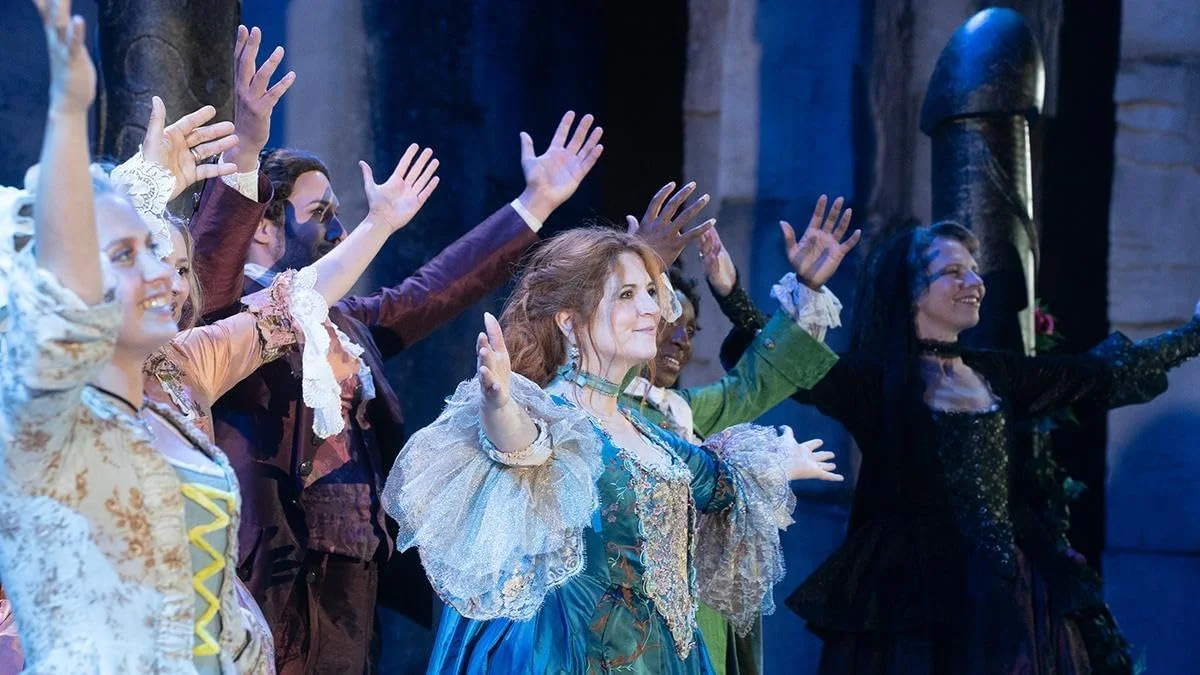
Her staging supplies the film’s largest visual joke: six enormous phallus-shaped columns, intended as an indictment of patriarchy. The symbolism leaves little room for interpretation, which makes Hannah leaning against one while practicing her singing particularly funny.
Production design becomes a prop, and an imposing artistic statement becomes something a working performer can rest against. The joke grows out of the gap between directing an idea and getting people through a rehearsal. It also briefly gives Hannah and Mirabelle a relationship expressed through action, free of the arguments through which they usually explain themselves.
The choice of opera provides a sharper connection. Piazonni plays Count Almaviva, a man accustomed to using his position to pursue women. Dramatic irony lets an audience recognize implications the people inside a story fail to acknowledge, and here it makes the company’s familiarity with its material uncomfortable.
These performers know how to stage sexual entitlement. Recognizing it among colleagues proves harder. Jaoui has found a setting in which the artistic work can press directly against the workers’ behavior, with Mozart supplying a subject they cannot dismiss as some incomprehensible new concern.

That connection becomes fraught when Piazonni is accused of sexually assaulting Sophie during rehearsal. Mirabelle has asked him to make his performance physically assertive, and the company divides over the relationship between that instruction and his conduct. The distinction requires care: a direction to portray domination cannot establish another performer’s consent.
Crescendo understands that a rehearsal brings professional expectation, personal trust, and unequal status into close contact. Yet its attention quickly spreads across the reactions of the group. Sophie’s allegation becomes an occasion for people to declare positions, defend colleagues, and worry about the production’s survival.
An ensemble film can use those competing responses to reveal interests that nobody would volunteer in isolation. Here, the debates too often repeat the characters’ established functions. Mirabelle’s recurrent distress about failing to create a safe working environment keeps returning her to the same comic posture.
Piazonni’s habitual contempt makes him readily legible before the dispute begins. Giving both characters opportunities to speak does limited dramatic work when their responses seldom disturb what we already understand about them. The film needs their encounters to produce discoveries; too many produce another statement of the disagreement.
Igor offers a promising complication because his attempts to keep everyone calm are entangled with fear about his own past. A singer, La Mancini, may name him in a forthcoming disclosure concerning misconduct. Auteuil’s anxious peacemaking gives those scenes two simultaneous purposes: he is managing a troubled company and anticipating a threat to himself.
That personal stake is useful because it changes how his moderation sounds without requiring the audience to settle his history. Hannah’s mediation carries a related tension. Her willingness to listen arrives alongside the condescension she has already shown Mirabelle, so her position between generations remains imperfectly earned.
Jaoui keeps these pressures moving through the practical business of putting on a show. The approaching performance gives the separate storylines a shared deadline, while the Roman amphitheatre in southern France, lavish costumes, and substantial sets make the enterprise attractive enough to understand everyone’s attachment to it.
Mozart’s extensive presence supplies buoyancy that the arguments frequently lack. There is real pleasure in being around people attempting something difficult together. The ensemble construction makes room for rehearsals, rivalries, financial anxiety, and personal panic without making the production itself disappear beneath the discussion.
That pleasure makes the quieter position of assistant Clothilde especially significant. Lucie Gallo’s character feels unable to express an opinion, a response the film’s louder divisions can easily overshadow. She has to keep working among people whose conflict she cannot safely enter. Against her inhibition, the music’s invitation to enjoy the collective effort acquires an uncomfortable pressure.
The company has many reasons to value restored cooperation, including salaries, reputations, and the performance everyone has prepared. For someone in Clothilde’s position, returning to work can leave the conditions that restricted her speech entirely intact.
Crescendo (released in French as L’Objet du délit) premiered at the Cannes Film Festival on May 22, 2026, followed by its theatrical release in France on May 27, 2026 via StudioCanal. Directed by Agnès Jaoui, the French-Belgian comedy-drama follows the behind-the-scenes chaos of an ambitious opera staging of The Marriage of Figaro, where generational and cultural tensions boil over when an allegation disrupts the entire production.
Full Credits
Title: Crescendo
Distributor: StudioCanal, O’Brother Distribution
Release date: May 22, 2026 (Cannes Film Festival), May 27, 2026 (France)
Running time: 2 hours 14 minutes (134 minutes)
Director: Agnès Jaoui
Writers: Agnès Jaoui, Noé Debré, Laurent Jaoui, Emmanuel Salinger, Florence Seyvos
Producers and Executive Producers: François Kraus, Denis Pineau-Valencienne, Jacques-Henri Bronckart, Tatjana Kozar
Cast: Agnès Jaoui, Daniel Auteuil, Eye Haïdara, Claire Chust, Vincenzo Amato, Patrick Mille, Hervé Pierre, Emmanuel Salinger, Jacques Weber
Director of Photography (Cinematographer): David Chizallet
Composer: Fernando Fiszbein
The Review
Crescendo
Crescendo is most engaging when casting decisions and rehearsal mishaps explain how power works inside an opera company. Claire Chust gives Mirabelle’s uncertainty a human scale, and Mozart keeps the production buoyant. Once the assault allegation takes over, repeated arguments and fixed character positions limit the drama’s development. Jaoui makes the company’s desire to keep performing understandable, while leaving its handling of misconduct insufficiently examined.
PROS
- Casting scenes reveal competing standards with clarity.
- Chust brings vulnerability to Mirabelle.
- Stage design produces effective physical comedy.
- - Mozart and the lavish setting sustain enjoyment.
CONS
- Characters remain confined to familiar positions.
- Repeated declarations slow dramatic development.
- - The allegation becomes secondary to the company’s crisis.







