




























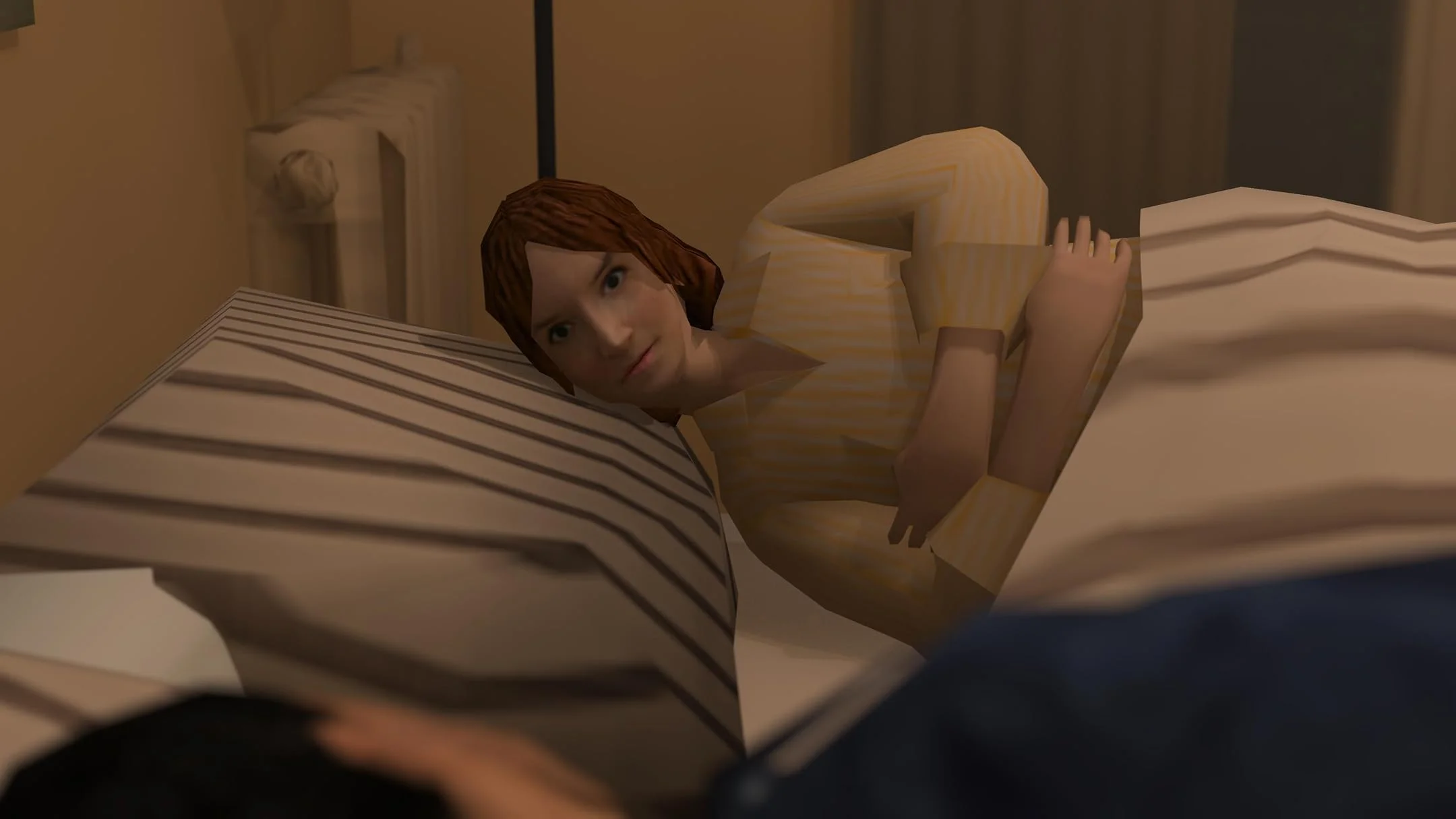

Bruno keeps a scooter engine in his kitchen cupboard because it fits. When his friend Jacky arrives before six in the morning to announce that their entire world is a simulation, however, Bruno finds the proposition difficult to accommodate. He has a pregnant wife who needs her sleep. Jacky has hundreds of observations that apparently require immediate discussion. Quentin Dupieux’s Vertiginous gives their disagreement an awkward practical basis: a discovery about the nature of existence still has to compete with the inconvenience of someone ringing your doorbell.
Then Fabienne gives birth during the encounter, and Jacky notices that the baby has no umbilical cord. For him, this is another item for the list. Bruno scarcely registers the impossibility. Neither response suggests much attention to Fabienne herself. The men have different priorities, certainly, but Jacky’s commitment to seeing what others overlook already looks selective. He notices the missing connection between mother and child while treating the birth chiefly as confirmation of his argument. Being observant can leave an awful lot unseen.
Alain Chabat’s Jacky and Jonathan Cohen’s Bruno make this dispute funny through the friction between insistence and irritation. Chabat needs his discovery acknowledged; Cohen makes the demand for acknowledgment sound exhausting. Their digital likenesses have little facial flexibility, which leaves the vocal performances carrying distinctions the animation barely supplies. The recognizable social rhythm survives: one friend has found something he cannot stop talking about, and the other has been assigned the job of listening.
The image, meanwhile, appears to have settled their dispute already. Dupieux’s first animated feature places its inhabitants among plastic-looking storefronts and unfinished surroundings, their bodies moving with the stiffness of old video-game figures. Jacky’s evidence includes a pigeon flying inside a manhole cover and a hat that remains in one spot in the Seine. The world’s construction is available to us before he begins explaining it.
Yet our advantage over Bruno deserves some suspicion. We know these figures are artificial because we recognize animation. Bruno has no alternative visual standard available. His face presumably looks ordinary to him. Dupieux turns the audience’s immediate recognition into a small epistemological trap: the thing that makes us feel clever about his world is knowledge acquired outside it. Inside, a strangely behaving pigeon might simply be a strangely behaving pigeon.
The crude design works particularly well against the camera’s unhurried tracking movements. Bodies behave awkwardly within compositions that retain a measured assurance. Dupieux lets us inspect the artificiality without making every shot announce a fresh visual stunt. The friends’ argument can occupy this space with the same mundane persistence it might have in a café.
That persistence also becomes a limitation. After the missing cord, trapped pigeon, and conspicuously digital bodies have established the principle, another anomaly has less work to do. Recognizing a defect and hearing it entered into evidence gradually become predictable comic actions. The visual idea remains sound while individual repetitions lose force. At 67 minutes, the film has little padding, but brevity cannot make a familiar joke surprising again.
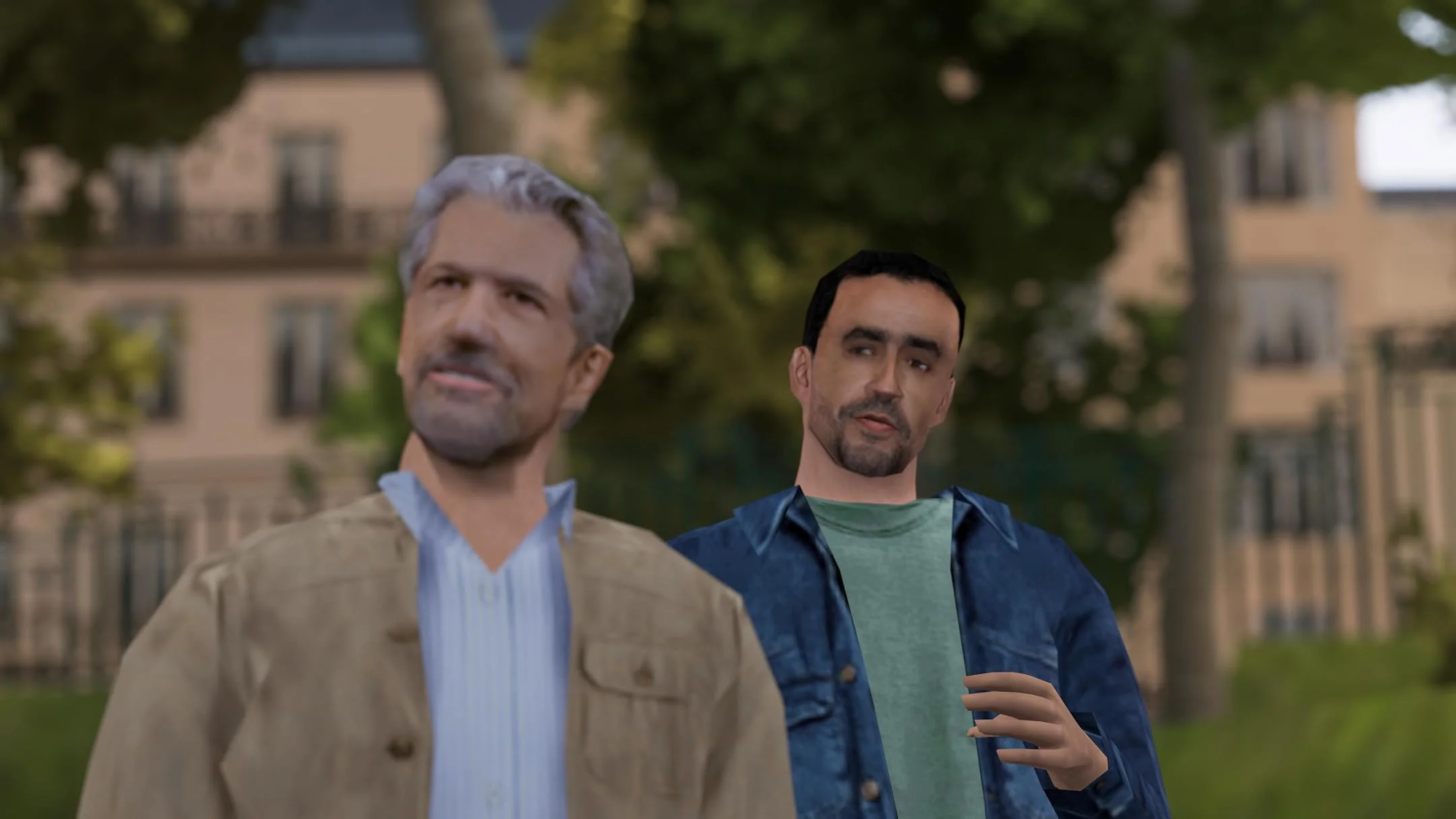
I initially took Bruno’s resistance as intellectual laziness. The kitchen engine encouraged that reading: here was a man who could rationalize anything provided it suited him. Then the friends encounter a researcher, voiced by Jean-Marie Winling, whose explanation Bruno understands with unexpected sophistication. That changes the earlier scenes. He has the capacity to follow an unfamiliar idea. His impatience cannot be dismissed as an inability to think. Comprehension was never the whole problem.
Bruno’s early objections concern the hour, the disturbance, the immediate demands of his household. Once his intelligence becomes apparent, those complaints acquire a different weight. An idea can be intelligible and still feel like an unwelcome obligation. Jacky assumes that establishing the truth should determine his friend’s response. Bruno keeps exposing the gap between accepting an explanation and agreeing to reorganize one’s life around it.
The later jump in time and location makes that gap the basis for a sharper social joke. Bruno’s insights have changed his circumstances, and the film turns toward technology gurus and the commercial possibilities of privileged understanding. Knowledge that first arrives as a nuisance becomes something useful. The satire finds its target in that conversion: insight acquires authority, authority acquires value, and the promise of understanding existence becomes available for exploitation.
This late movement gives the premise a fresh direction, though the compressed treatment offers less room to examine the machinery of influence than the opening gives to ordinary resistance. Dupieux is precise about the experience of being cornered by a friend with a theory. His treatment of the profitable afterlife of such theories is broader. The shift extends the argument, but its targets are less individually observed.
The friendship keeps the abstraction from drifting entirely away. Jacky brings his discovery to Bruno because he needs this particular person to hear it. Their combative exchanges make recognition feel like a personal demand long before it becomes a question of public authority. As the investigation changes their relationship, the original desire remains awkwardly exposed. Proving something about everyone’s existence offers no guarantee that the person beside you will respond as you hoped.
The animated outtakes during the credits introduce another kind of recognition. They invite us to treat these rigid figures as performers who can slip out of character, make mistakes, and briefly exist beyond the scene they were supposed to enact. It is an affectionate convention with a peculiar implication here. Dupieux has spent the film making artificiality visible; now he asks us to enjoy artificial people appearing spontaneous. I found that invitation easy to accept. The outtakes give their figures the suggestion of a life outside the story, and for a moment I wanted to grant them one, despite knowing that every apparent departure had been arranged.
Vertiginous (released in French as Le Vertige) made its world premiere as the closing film of the Directors’ Fortnight at the 79th Cannes Film Festival on May 21, 2026, before its theatrical release across France on June 10, 2026 via Diaphana Distribution. Serving as the first animated feature from director Quentin Dupieux, the surreal comedy follows a man who visits his friend with the alarming news that human existence is merely a simulation, sending them down a bizarre existential rabbit hole.
Full Credits
Title: Vertiginous
Distributor: Diaphana Distribution, O’Brother Distribution
Release date: May 21, 2026 (Cannes Film Festival Premiere), June 10, 2026 (France Theatrical)
Running time: 1 hour 7 minutes (67 minutes)
Director: Quentin Dupieux
Writers: Quentin Dupieux
Producers and Executive Producers: Hugo Sélignac
Cast: Alain Chabat, Jonathan Cohen, Anaïs Demoustier, Jean-Marie Winling, Jean-Christophe Le Guennan, Oscar Vercken de Vreuschmen, Coco Dupieux
Director of Photography (Cinematographer): Quentin Dupieux
Editors: Quentin Dupieux, Léo Pouliquen
Composer: Franck Lascombes
The Review
Vertiginous
Vertiginous makes its visibly artificial world a productive setting for some embarrassingly human behavior. Dupieux’s strongest idea concerns how readily intelligence serves convenience, with Bruno’s changing response giving the comedy an edge its familiar simulation premise might otherwise lack. Repeated glitch jokes lose force, and the technology-guru satire receives sketchier treatment than the friendship. Still, Chabat and Cohen keep the philosophy agreeably difficult to separate from the irritation of having a friend.
PROS
- Crude animation gives the philosophical premise concrete form.
- Chabat and Cohen sustain a dry, recognizable friendship.
- Bruno’s intelligence complicates the early comedy.
- Animated outtakes playfully reopen the question of control.
CONS
- Repeated anomaly jokes deliver diminishing returns.
- Later commercial satire lacks the opening’s precise observation.







