




























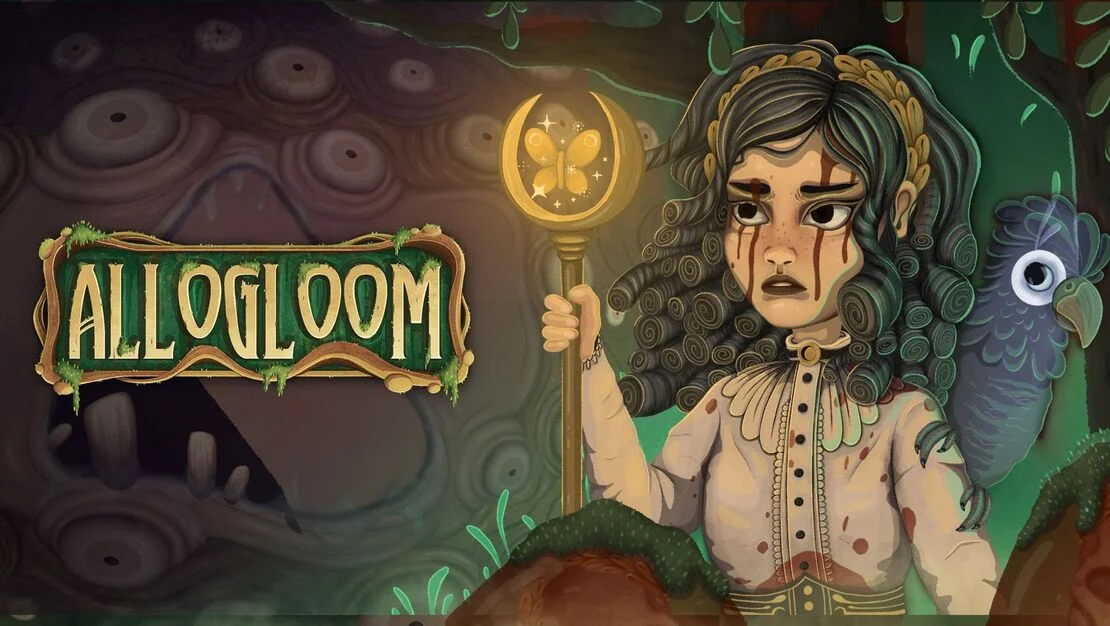

Preparing for the Blessed Festivities means helping the family get ready to feed the moths. Nora’s grandmother takes the occasion seriously, and the Moth Minder’s delivery of fruit belongs to the household routine. The moths eat people, including anyone who tries to leave Gruesome Grove. Nora already has something else to worry about: her mother is missing. Allogloom lets these concerns occupy the same domestic space, where an alarming ceremony still involves the familiar business of doing things for your relatives.
When monsters abduct Nora’s family and the other villagers, that small amount of time spent among them matters. The rescue grows out of a home the player has helped prepare. Galactic Ghosty’s point-and-click adventure also leaves room to complicate those first impressions.
Nora’s brother Tommy can initially seem like someone whose defining characteristic is being difficult, yet inspecting objects associated with him suggests a person beyond that immediate irritation. Taking an interest in the surroundings changes how his absence feels. It gives the search a personal weight that the kidnapping alone could only announce.
This is where the optional interactions earn their place. Conversations and inspections can be passed over in pursuit of the next required item, but doing so makes the world less inhabited. Hopper, the family parrot who accompanies Nora at points, extends that sense of attachment across the adventure’s stranger locations. Elsewhere, a son seeks his father and a child looks for the comfort of a pet. These connections give the shifting settings an emotional continuity. People and animals keep reaching for someone familiar, even as the bodies and places around them become increasingly difficult to recognize.
The illustrations make that reaching feel surprisingly comfortable. Warm autumnal colors soften Gruesome Grove without concealing its nastiness, and the hand-drawn surfaces encourage the eye to linger on creatures with elongated tongues and clusters of bloody eyes.
Their grotesqueness rewards inspection. There is pleasure in seeing how each body has been imagined, even when its anatomy gives you good reason to recoil. The game’s appeal depends on that willingness to look closely. Blood and bodily distortion are present, but sustained terror is rarely the main attraction. Curiosity keeps getting the better of disgust.
That relationship becomes especially enjoyable when looking turns into doing. The sixth chapter’s deserted hospital contains a melting nurse, a hungry squid-like baby, and a talking wizard door with an organ problem. Finding replacement organs for a door is an absurd task, yet it gives the player a practical relationship with something that might otherwise serve as unsettling scenery. You have to consider what this creature needs. A body becomes an obstacle, then a problem you can understand, and helping it produces the familiar satisfaction of making progress through a place that initially seems incomprehensible.

Another hospital puzzle connects a monster in a receptionist’s room with a telephone’s volume and a call from a payphone. The interest lies in recognizing how separate objects might affect one another across the location. Allogloom mostly works through finding items, identifying their uses, and talking to characters, with occasional inventory combinations.
It gets considerable mileage from placing those readable actions inside such peculiar circumstances. The surroundings can be outrageous while the player’s reasoning remains grounded. Solving something offers a little confidence that this world, for all its deformities, can be understood.
The optional Object Highlights setting helps preserve that confidence. It identifies interactive elements without supplying the steps needed to use them. That distinction matters in a game whose detailed illustrations invite attention everywhere: uncertainty about which part of the picture accepts a click can become a distraction from the actual problem. Highlights leave the connections for the player to make. Some backtracking still becomes irritating when the next action is unclear, and a location that once invited leisurely inspection can start to feel like ground being covered again in search of an overlooked object.
Across eight chapters and roughly three to five hours, the adventure has enough movement to keep that frustration from defining it. The hospital also expands the questions beyond the immediate rescue, bringing the monsters’ origins into the story.
Discoveries about the moths and Gruesome Grove’s dangerous tree sap make earlier details available for reconsideration. This gives the changes of setting a useful pull: there are people to find, and there is also the growing possibility of understanding the conditions they have lived with. The compact runtime leaves room for those connections without requiring every unfamiliar place to become an extended puzzle box.
Sound is less consistent at sustaining the invitation to stay. Music tracks can end abruptly and leave stretches of silence that expose the sparseness of the surrounding effects. Unvoiced dialogue itself feels compatible with the illustrated world. Reading gives the player room to imagine the voices belonging to these faces, while creature and animal sounds provide occasional texture. The thinner environmental sound becomes noticeable when the music disappears, leaving a richly drawn space with relatively little audible life. The loss is a sense of presence rather than a missing performance.
Presentation faults can interrupt continuity in a similarly specific way, though their occurrence varies between builds. Characters have been reported moving without their walking animation, and Nora’s appearance can switch between clean and bloodied during conversations. Her accumulating blood is otherwise an effective visual detail: the girl prepared for a celebration carries evidence of what she has done while searching for her family. It asks for no speech about how the experience has changed her. When that appearance resets incorrectly, a conversation can briefly return her to the condition she was in before those encounters.
The Review
Allogloom
Allogloom makes affection feel plausible in a village that feeds people to moths. Its family connections, inviting illustrations, and approachable puzzles give the grotesque world reasons to matter beyond its appearance. Exploring can change how you feel about someone; solving a creature’s problem can make its strangeness familiar. Backtracking, thin environmental sound, and presentation glitches occasionally interrupt that involvement, but this compact adventure rewards the attention its peculiar inhabitants invite.
PROS
- Optional exploration deepens attachment to Nora’s family.
- Warm illustrations encourage curiosity about grotesque creatures.
- Puzzles turn unsettling encounters into satisfying discoveries.
- Compact pacing sustains the unfolding mystery.
CONS
- Unclear next steps can make backtracking irritating.
- Interrupted music exposes sparse environmental sound.
- Reported animation and appearance glitches disrupt continuity.







