

























Madelyn Yu already had a career when she left the Philippines. She was a head nurse, a wife, and the mother of a young child. American hospitals needed nurses, and recruitment offered her an opportunity that required leaving much of that life behind. Her husband and child eventually joined her in the United States. The separation matters because it prevents her account from becoming a simple progression from deprivation to opportunity. She had something to lose before she had anything to gain.
Retirement in 2019, after forty-six years of nursing, supplies an apparent endpoint. Yu and her husband planned to travel. Then the pandemic arrived, and both contracted COVID-19. Professional achievement cannot organize these events into a reassuring finish. Her account contains the familiar ingredients of a success story, but its later developments resist the idea that years of service purchase security. The life keeps moving after the résumé has reached its final entry.
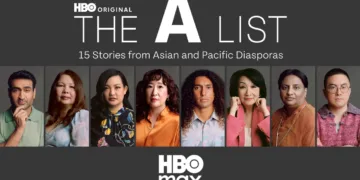
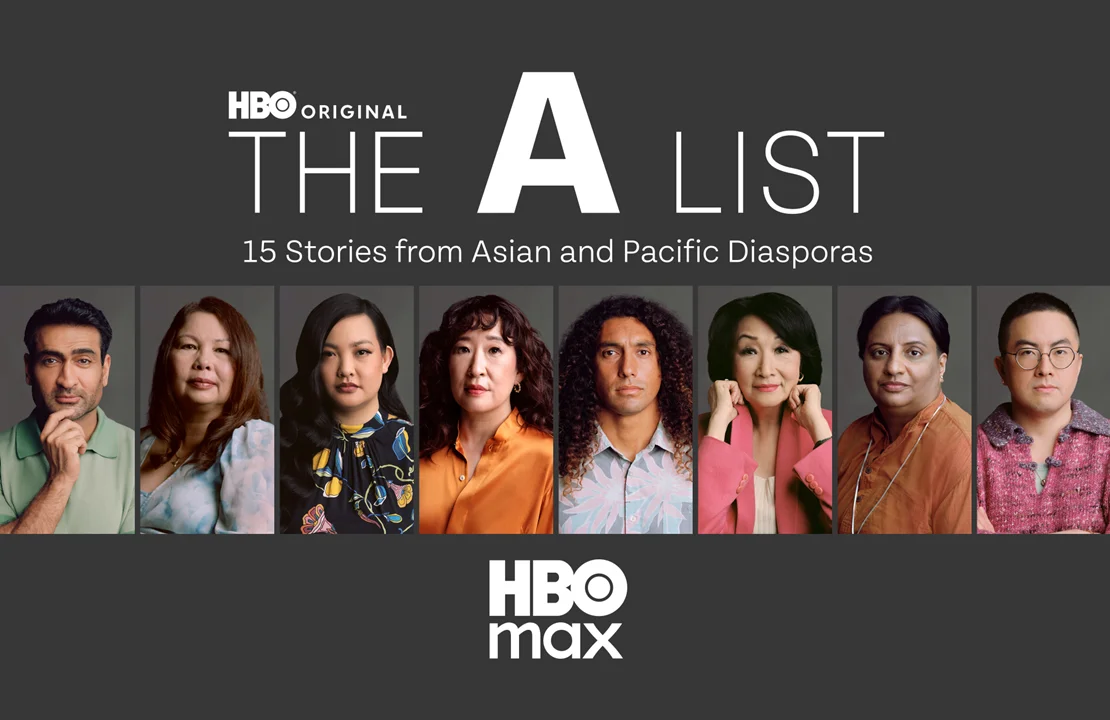
Eugene Yi’s The A List: 15 Stories from Asian and Pacific Diasporas works best when its brief portraits preserve that resistance to neatness. Its fifteen subjects include actors, activists, scientists, an athlete, and a nurse, presented through direct interviews, photographs, and family films. Sandra Oh asks questions about identity and self-perception; Kumail Nanjiani describes the persistence of being regarded as foreign. Those concerns establish a useful tension between how people understand themselves and how others classify them. The film’s task is to give that tension different shapes across individual lives.
Yia Vang’s account does this through food. As a child, he wanted to distance himself from his Hmong identity, dividing life at school from life at home. The rejection of his school lunches gives that division a practical daily cause. His father’s encouragement to assimilate complicates the expected conflict: parental authority is helping him adjust to the outside world rather than simply defending tradition against it.
Vang’s later career as a chef changes the significance of food within his story, though professional recognition cannot retroactively make those childhood experiences harmless. The connection is effective because the same part of his life carries different meanings at different ages.
Schuler Bailar’s story has a clearer decision and response. After coming out as a transgender man, he receives support at Harvard and transfers from the women’s swimming team to the men’s team. Identity here produces a specific institutional change, with a place on a team at stake.
That makes the account dramatically legible without requiring a manufactured crisis. Bailar’s observations about the fetishization of Asian women and the diminished visibility of Asian men then complicate the change: moving between categories also changes the prejudices directed toward him. The transfer resolves a practical question while leaving the surrounding assumptions available for scrutiny.
These portraits give the film substance beyond its selection of accomplished people. That selection still creates a limitation. An anthology built around distinguished careers can make recognition seem like the natural destination of a story about belonging. Yu’s service, Vang’s culinary success, and Bailar’s athletic achievement provide readily understood markers of progress.

Yet Nanjiani’s account of being denied recognition as American suggests that achievement offers no dependable resolution. The documentary accommodates this contradiction, but its collection of separate portraits develops the individual experiences more fully than the relationship between success and acceptance.
DJ Rekha and Manny Crisostomo offer useful departures from that framework. Rekha’s work serving the South Asian community acquires a protective function after 9/11. The relevant outcome becomes the creation of a place where other people can gather. Crisostomo wins a Pulitzer Prize for his photography at the Detroit Free Press, then returns to Guam to document life there.
Mainland recognition is one development in his account; returning gives his work another purpose. Guam’s status as a U.S. territory also unsettles any easy assumption that every subject’s story concerns arrival from outside America. These accounts expand the film’s range through differences in direction, rather than through demographic variety alone.
Yi’s restrained format gives those differences room, although it offers limited connective development. Bailar’s supported place within an established institution and Rekha’s creation of a communal gathering space suggest different ways people secure acceptance. The portrait structure lets each account retain its own stakes, but leaves much of the comparison to the viewer.
This is a real tradeoff. The film is accessible and frequently moving at the level of the individual interview; as a sustained argument, it is less developed. Photographs and family footage give the recollections a visible record, while testimony carries most of the explanatory work. The method suits these compact histories, even when the collection invites questions it does not pursue at length.
Kathy Masaoka’s discussion of Japanese American wartime incarceration gives that reliance on testimony a further purpose. She talks about what she did not know and what had not been communicated to her. Missing information becomes part of the account, rather than a gap the documentary can quietly fill with historical material.
Yi includes footage of Ronald Reagan speaking, bringing presidential speech into a collection dominated by personal recollection. Masaoka’s testimony addresses a different problem: public history can exist without reaching the people whose understanding it should inform. Her account has to include the period before she possessed the information to recognize what had happened to her community.
The A List: 15 Stories from Asian and Pacific Diasporas premiered on Max, offering an intimate look at the Asian American, Native Hawaiian, and Pacific Islander communities. Directed by Eugene Yi, the documentary features fifteen prominent public figures sharing personal vignettes on identity, culture, and systemic challenges.
Where to Watch The A List: 15 Stories from Asian and Pacific Diasporas (2026) Online


Full Credits
Title: The A List: 15 Stories from Asian and Pacific Diasporas
Distributor: HBO Documentary Films, Max
Release date: November 17, 2025 (Film Festival Premiere), May 2026 (Wide Release / CAAMFest)
Rating: TV-MA
Running time: 1 hour 24 minutes (84 minutes)
Director: Eugene Yi
Producers and Executive Producers: Eugene Yi, Jada Yuan, Chad Thompson, Timothy Greenfield-Sanders, Nancy Abraham, Lisa Heller, Tina Nguyen
Cast: Sandra Oh, Tammy Duckworth, Kumail Nanjiani, Amanda Nguyen, Connie Chung, DJ Rekha, Schuyler Bailar, Bowen Yang
Director of Photography (Cinematographer): Nausheen Dadabhoy
Editors: Johanna Giebelhaus
Composer: Gene Back
The Review
The A List: 15 Stories from Asian and Pacific Diasporas
Eugene Yi’s documentary earns its emotional force through lives that resist tidy success stories. Family separation, institutional support, and communal responsibility give its portraits distinct stakes. The direct interview format serves those accounts well, though the anthology develops connections between them less fully. Its accomplished subjects occasionally narrow the frame of belonging toward achievement, but their unresolved experiences keep recognition from becoming an easy answer.
PROS
- Personal accounts built around concrete decisions and consequences.
- Varied meanings of belonging across the portraits.
- Testimony that exposes gaps in inherited historical knowledge.
- Restrained presentation that gives individual experiences room.
CONS
- Limited development of connections between the portraits.
- Achievement-centered selection can narrow its account of belonging.







