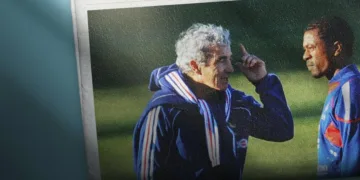


























Raymond Domenech admits he lied, then asks us to take his sense of betrayal seriously. I found myself resisting him almost immediately. A manager who has helped damage his own credibility makes an awkward witness to the disloyalty of others. Yet the admission also puts an uncomfortable question before the viewer: how much truth are we prepared to discard because we dislike the person telling it?
His diaries complicate the answer. Displayed as short passages typed onto a white word-processing screen, they preserve his irritation with the players without the retrospective interview’s opportunities for adjustment. The plain presentation gives those judgments a chilly permanence. It also tempts us to mistake private writing for unfiltered truth. A diary can record contempt accurately while telling us very little about the people receiving it. Domenech’s entries expose the coach’s attitude; they cannot settle the dressing-room dispute.
Christophe Astruc and Jérôme Fritel build The Bus: A French Football Mutiny around that unstable relationship between testimony and authority. Their French-language documentary revisits France’s disastrous 2010 World Cup in South Africa, where Nicolas Anelka’s expulsion prompted his teammates to refuse training and remain on their bus at Knysna. Captain Patrice Evra and Domenech supply opposing accounts of a relationship whose wounds plainly outlasted the tournament.
Domenech is an extraordinarily watchable obstacle to his own defense. His televised proposal to his girlfriend demonstrates a talent for making a public occasion serve a private impulse (an unusual qualification for international management). But the captaincy tensions involving Evra and William Gallas carry greater explanatory weight. Leadership becomes another source of uncertainty inside a squad already struggling to trust its coach. Set beside the diaries’ disparaging descriptions of the players, these disputes reveal an authority that expects allegiance while doing little to sustain the confidence on which allegiance depends.
I initially thought the film had found an adequate explanation in Domenech himself. Evra’s recollection that he once liked him interrupted that reading. Affection had existed; contempt was not the relationship’s inevitable starting condition.
The question changes from how anyone tolerated this man to how that attachment deteriorated so badly. Here the documentary’s limited account of his appointment and continued tenure becomes frustrating. We get plentiful evidence of his conduct, less understanding of the decisions that kept him in charge. Then L’Équipe enters, and my neat allocation of blame becomes harder to maintain.
Anelka’s halftime confrontation with Domenech reaches the public through a damaging front-page report whose wording is disputed by accounts in the film. Anelka is expelled. The distinction between an argument occurring and a published quotation being accurate should matter enormously, yet disciplinary consequences arrive while the account itself remains contested. The film’s reconstruction of the front page in Photoshop makes the newspaper’s assembly visible. Words become a designed public object, ready to circulate and acquire authority. Watching that process gives the scandal a material cause beyond the familiar explanation of oversized egos.
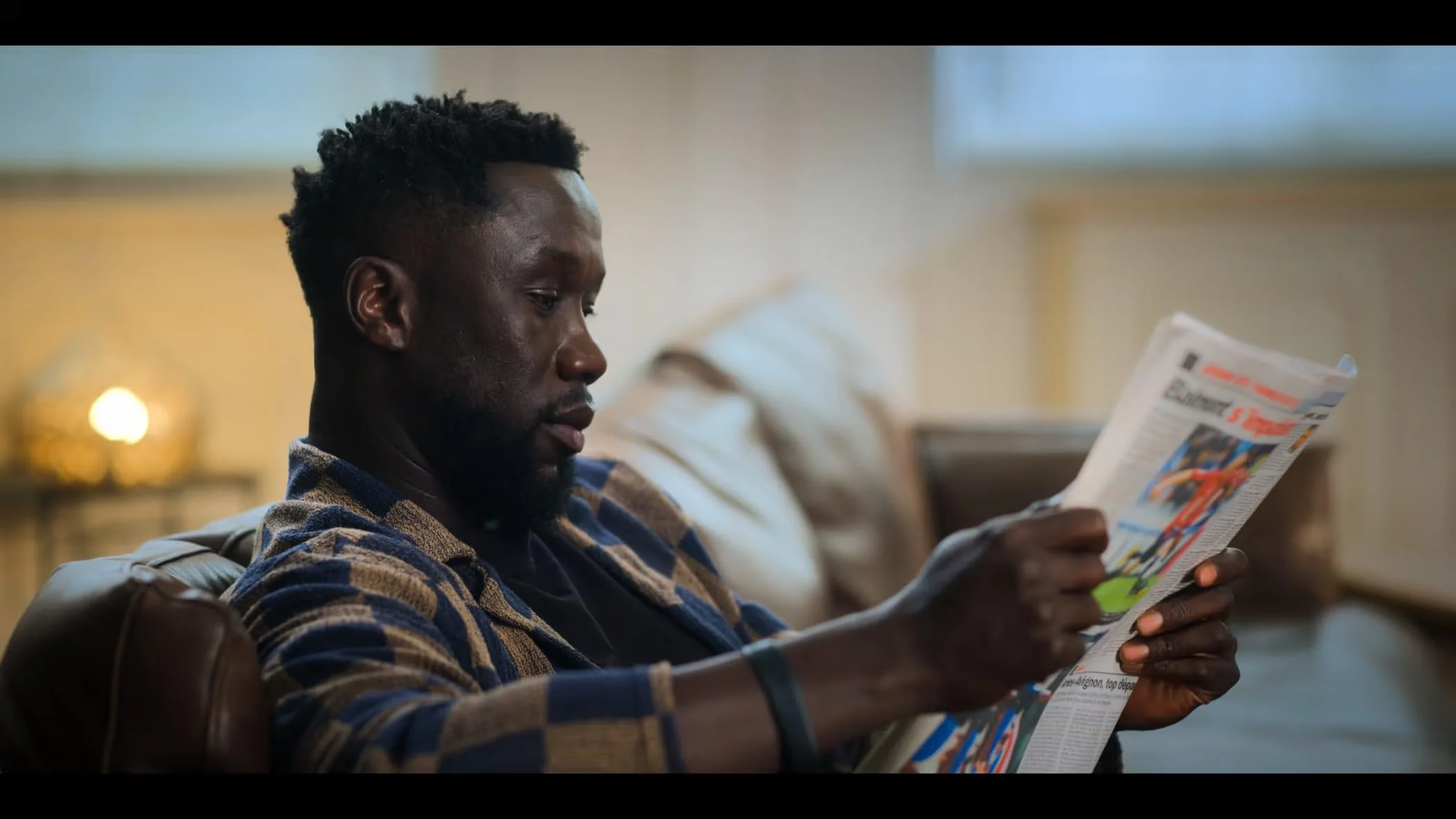
The reconstruction cannot prove that every editorial choice was malicious. Its value lies in making choices perceptible. Evra later crumples the headline and throws it away, a staged gesture that supplies emotional satisfaction without undoing anything the publication set in motion. The paper can be discarded. Its consequences remain available to everyone else.
Interviews with Gallas, Bacary Sagna, the team’s press officer, newspaper journalists, and a government sports minister widen the account beyond the coach-captain confrontation. The participants’ continuing hurt gives familiar events a sharp personal charge, while their competing explanations invite scrutiny. Access provides friction rather than certainty. The hunt for the dressing-room leaker sustains suspicion, but the unresolved identity matters less than the ease with which an uncertain account becomes grounds for punishment. Anelka’s absence from the new interviews leaves a substantial gap: the man whose treatment precipitated the protest has no fresh account of his own here.
The film’s brisk progression from poor performances to accusation, expulsion, and refusal creates the tension of a political thriller through recognizable failures of trust. It occasionally reaches for visual insistence, including a football set on fire, when the testimony already supplies sufficient heat. The typed diaries and reconstructed newspaper are stronger devices because they let us examine how the crisis was recorded and presented. Burning equipment mostly confirms that things went badly.
The players’ arrival at open training without boots makes their refusal concrete before the bus becomes its enduring image. Solidarity with Anelka explains the action, but leaves its wisdom open to argument. They have obligations to their teammate and to the side they represent; those loyalties have become incompatible in practice. I can understand their protest without regarding every consequence as justified. Footage of journalists scrambling around the training ground and the involvement of government show how quickly a workplace dispute becomes a public demand for national obedience.
This is where the documentary’s compactness begins to cost it. Evra’s opening account of football as an escape from the underprivileged France of his childhood establishes a relationship between sporting opportunity and belonging. The closing far-right intervention questioning the squad’s ethnic composition exposes a harsher condition attached to that relationship. Criticism of a training refusal has become an opportunity to question the players’ legitimacy as representatives of France. Their decisions and their ethnicity belong to different arguments; the political intervention collapses them.
The film gives this shift limited development across its roughly 81 minutes. Its detailed attention to the personal dispute makes the bus protest intelligible, but leaves the racialized response insufficiently examined. Evra can explain how football offered him a place within French public life. By the closing material, he and his teammates face a challenge that no account of the leaked insult can answer: their ancestry has been introduced into the case against their conduct.
The Bus: A French Football Mutiny premiered globally on Netflix on May 13, 2026. The sports documentary investigates the catastrophic collapse of the French national football team during the 2010 FIFA World Cup, focusing on the infamous player strike and team mutiny in South Africa.
Where to Watch The Bus: A French Football Mutiny (2026) Online


Full Credits
Title: The Bus: A French Football Mutiny
Distributor: Netflix
Release date: May 13, 2026
Rating: TV-MA / Unrated
Running time: 1 hour 21 minutes (81 minutes)
Director: Jérôme Fritel, Christophe Astruc
Writers: Jérôme Fritel, Christophe Astruc
Producers and Executive Producers: Nicolas Valode
Cast: Raymond Domenech, Patrice Evra, Nicolas Anelka, William Gallas
The Review
The Bus: A French Football Mutiny
The Bus makes France’s collapse gripping through competing accounts of loyalty, punishment, and broken trust. Its interviews, diaries, and reconstructed newspaper expose how credibility fails while authority keeps operating. I found its account of damaged relationships persuasive; its political implications needed tougher scrutiny. Anelka’s absence and the thin treatment of racialized belonging leave significant gaps in an otherwise sharp examination of collective failure.
PROS
- Competing testimony gives familiar events fresh tension.
- Domenech’s diaries expose the deterioration of trust.
- Newspaper reconstruction makes editorial choices visible.
- Brisk escalation connects personal conflict to public scandal.
CONS
- Limited explanation of Domenech’s continued tenure.
- Anelka’s absence leaves a central perspective missing.
- Racialized belonging receives insufficient examination.
- Decorative imagery occasionally substitutes spectacle for insight.







