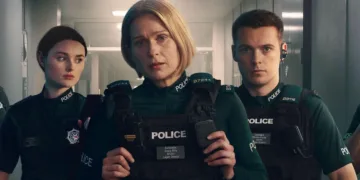


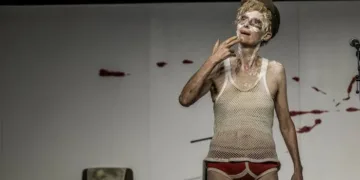









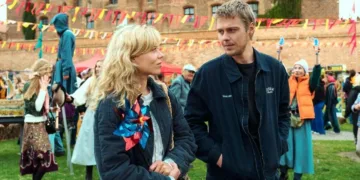






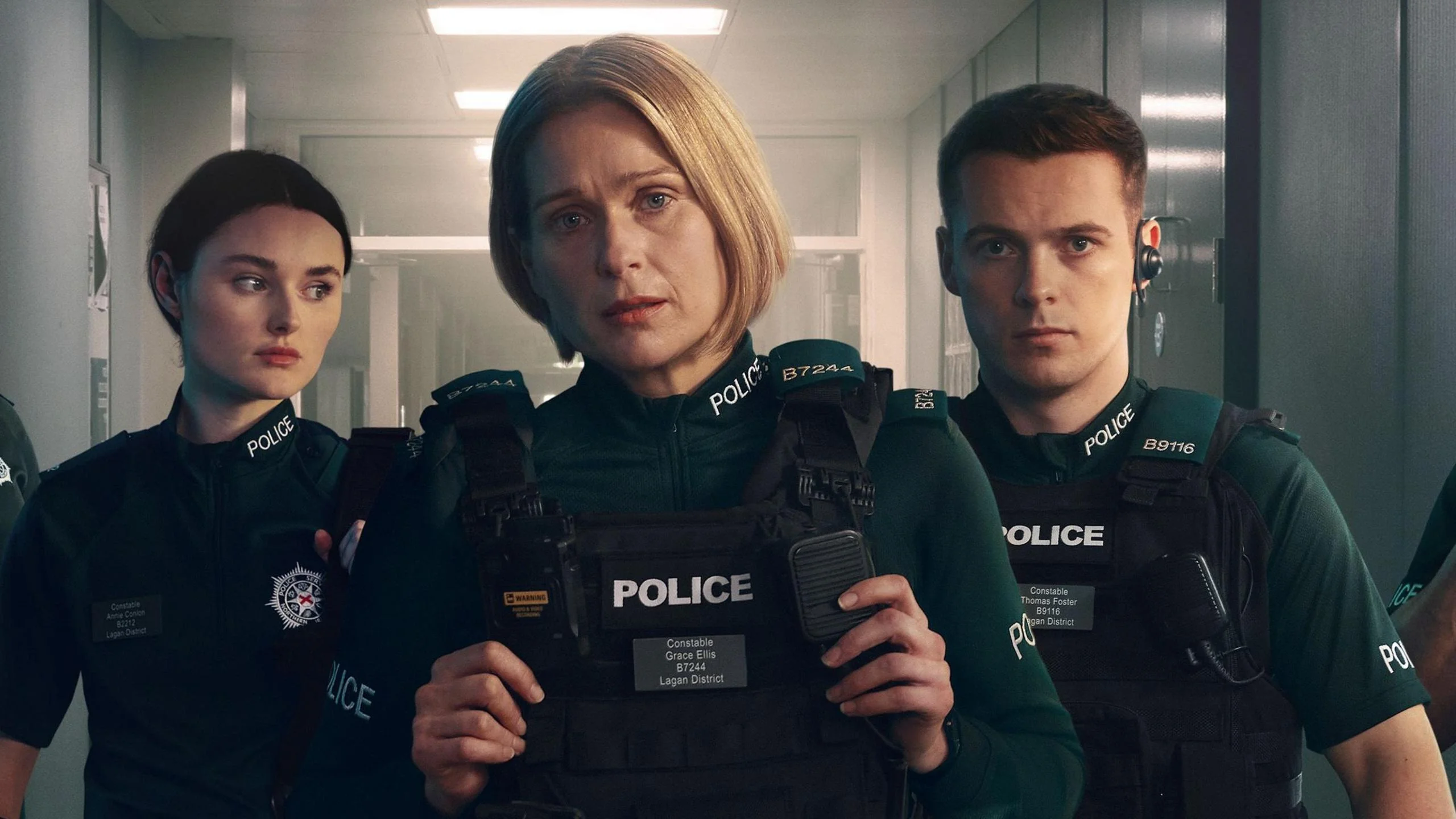

Before the riot, Stevie has time to admire the Syrian pastry at a Belfast refugee centre’s fete. The gathering has been given minimal police coverage; soon, officers are facing fists and flying rocks. That small interval matters. People have assembled to eat and socialise before an anti-immigration crowd makes their presence a public-order emergency. Blue Lights brings its fourth season’s urgent subject into view through an ordinary community event, then returns us to the familiar officers trying to protect it. The programme’s established relationships determine how we experience a new threat.
Katie’s phone changes the scale of that threat. Played by Tabitha Smyth, the racist livestreamer gives the protest an audience that can become a crowd. Her recording participates in the confrontation, attracting others while presenting hostility as public scrutiny.
Grace’s attempt to reason with her introduces a difficult distinction: Katie’s account of deprivation and institutional abandonment has substance, while her decision to blame immigrants remains racist. The scene asks compassionate policing to address an argument whose premises and explanation deserve very different responses. Listening carefully cannot make that difference disappear.
Grace, played by Siân Brooke, carries her social-work background into encounters that resist the skills she brings to them. Her approach gives the drama access to Katie’s grievances without requiring agreement with her. But when Katie circulates Grace’s name and service number, the story’s emphasis changes.
An attack on a refugee centre develops into a threat against an officer the audience already knows. This is an effective way to make digital harassment frightening, and a revealing choice about dramatic attention. The centre’s vulnerability brings us into the story; Grace’s vulnerability supplies an established character through whom it continues.
Grace’s unwanted visibility sits beside Blackthorn station’s obligation to make itself visible in a different way. Threatened with closure over inadequate performance figures, the station diverts scarce resources toward minor traffic offences. Pensioners with bald tyres and broken tail-lights become useful to the statistics while known crime bosses continue operating. The closure plot is familiar television machinery, but these details give it force. The institution’s demand for proof of usefulness changes the work being done. A satisfactory total can be assembled from activities that leave the most consequential problems untouched.
Newly promoted chief inspector Helen, played by Joanne Crawford, has to translate that demand into operational decisions. Her position complicates the programme’s affection for officers who understand the street better than the hierarchy does: she now occupies a role that makes the hierarchy’s priorities her colleagues’ problem.
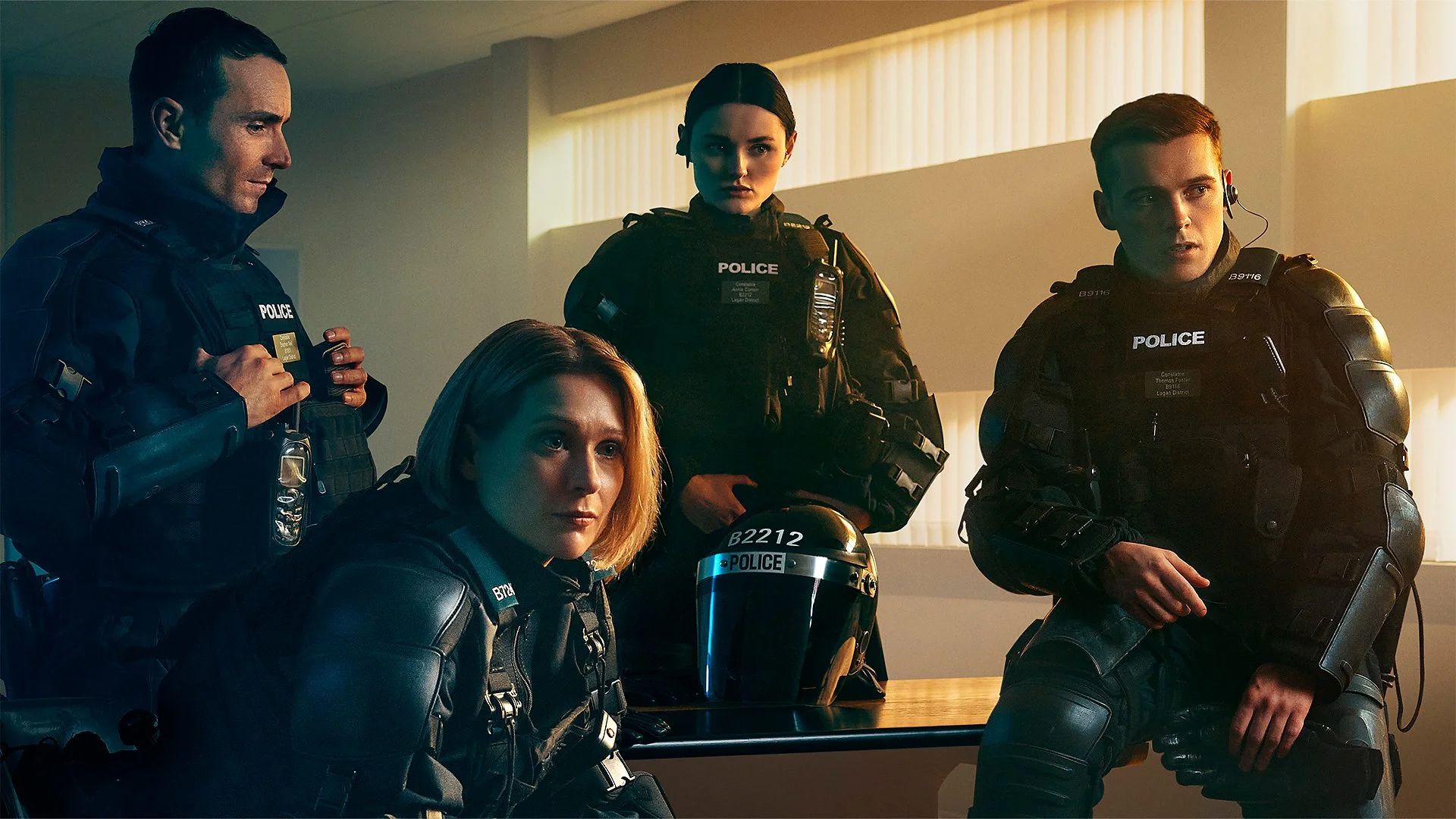
Yet Blue Lights still offers a reassuring division between humane frontline personnel and obstructive authority. Television can maintain faith in the people wearing the uniform while condemning the structures directing them. Grace’s patient engagement and Helen’s managerial predicament make that division emotionally persuasive, even as the traffic-enforcement orders show how difficult it is to keep personal intentions separate from institutional harm.
Episode three’s courtroom proceedings expose a harsher form of selective accountability. Mo McIntyre faces trial for the joint-enterprise killing of Gerry Cliff, while his mother Tina fears that his testimony will disclose the family’s MI5 connections. James McIntyre’s history as a security-service informant gives that anxiety weight beyond the family’s immediate interests. Gerry’s final moments appear in CCTV footage shown to the jury. His death can be displayed, replayed, and examined while the relationships surrounding it remain subject to protection. The footage makes the event available to scrutiny; it cannot guarantee that every relevant interest will face the same scrutiny.
For Sandra, played by Andi Osho, the distinction has a personal cost. Her pursuit of justice keeps running into the interests of people who control what may be disclosed. The courtroom extends the season’s concern with exposure without making every strand equivalent.
Katie publicises an officer’s identity to endanger her; Blackthorn produces figures to justify its existence; the security services guard relationships that could complicate a prosecution. These acts have different purposes. Their connection lies in the unequal power to decide what becomes public and who must live with the consequences.
The season takes time to make those connections feel like a developing argument. Its opening promises sustained attention to anti-immigration violence, then expands into station survival, the murder trial, and protected secrets. The widening can feel loose before the strands acquire clearer relationships. Creators Declan Lawn and Adam Patterson, whose backgrounds are in investigative journalism, are strongest when the drama follows an institutional interest into a specific decision: a traffic stop, a suppressed disclosure, a mother’s fear of what her son might say. The suggestion of concealed influence is less satisfying when it postpones that specificity.
The joint commission of seasons three and four has given the series room to carry its earlier stories forward, and “So Far” makes a substantial case for that freedom. The flashback episode brings Richard Dormer back as Gerry and returns to the beginning of his relationship with Sandra, during public-order training involving Molotov cocktails. Romance develops inside the work’s rehearsed danger.
After the courtroom has reduced Gerry’s final moments to evidence, the episode restores duration to his life: a developing relationship, a professional history, reasons for the officer he became. It also clarifies what he knew. The episode’s emotional generosity and its explanatory function support each other, although that later clarity does not erase the preceding looseness.
This review covers the first five of the season’s six episodes, so the consequences of the officers’ planned action remain open. By episode five, Sandra is weighing what to do with information Gerry passed to her, while her colleagues pool their own knowledge.
Her role has changed from seeking answers through obstructed channels to deciding how answers might be used. That gives the accumulated history an immediate demand. Material preserved from Gerry’s life now requires a choice from Sandra, who has already experienced the distance between having evidence and obtaining justice.
Blue Lights Season 4 premiered on BBC One on September 29, 2026. The Belfast-set police drama follows response officers operating at their absolute limit while navigating high-pressure frontline policing and complex community threats.
Where to Watch Blue Lights Season 4 Online










Full Credits
Title: Blue Lights Season 4
Distributor: BBC One, BritBox
Release date: September 29, 2026
Rating: TV-MA
Running time: 57–58 minutes per episode
Writers: Declan Lawn, Adam Patterson
Producers and Executive Producers: Stephen Wright, Nick Phillips, Marina Martin
Cast: Sian Brooke, Martin McCann, Katherine Devlin, Nathan Braniff, Richard Dormer, Hannah McClean, Jonathan Harden, Desmond Eastwood
The Review
Blue Lights Season 4
Across its first five episodes, Blue Lights turns livestreamed racism, performance statistics, and protected secrets into a sharp examination of who controls public knowledge. Its attachment to familiar officers narrows the refugee-centre story, and the expanding plot takes time to cohere. “So Far” earns its return to Gerry by restoring his life alongside the information his death left behind. The season makes a persuasive case for continuing television’s capacity to revisit its own history.
PROS
- Digital harassment develops through concrete actions.
- Station metrics expose distorted institutional priorities.
- Courtroom scenes distinguish visibility from accountability.
- Gerry’s flashback connects emotional history with present stakes.
CONS
- The racism strand shifts toward familiar police perspectives.
- Connections between expanding storylines emerge slowly.