



























• Latest
  • Trending
Spring Review

Spring Review: Mourning Becomes an Act of Resistance

Dora Review

Dora Review: Psychological Distress Written on the Skin

Think Good Review

Think Good Review: The Exhaustion Behind Every Small Disagreement

Disney/Pixar Toy Story: Retro Roundup! Review

Disney/Pixar Toy Story: Retro Roundup! Review: An Archive Worth Exploring Between Attempts

Dernsie: The Amazing Life of Bruce Dern Review

Dernsie: The Amazing Life of Bruce Dern Review: Admiration Works Best With Evidence

Crescendo Review

Crescendo Review: Mozart Keeps the Company Moving

Vertiginous Review

Vertiginous Review: Reality Can Wait Until After Breakfast

Warhammer 40,000: Boltgun 2 Review

Warhammer 40,000: Boltgun 2 Review: The Pleasure of Being Dangerously Overconfident

The Nightmare Upstairs: What Happened to Ty and Bryn? Review

The Nightmare Upstairs: What Happened to Ty and Bryn? Review: Cameras Capture What Interviews Cannot Resolve

Aquí Review

Aquí Review: Coetzee’s Questions Find Their Feet

Relentless Memory Review

Relentless Memory Review: Listening for Katrülaf

World Without Cows Review

World Without Cows Review: Warm Encounters, Uneasy Confidence

over the hill Review

over the hill Review: Funselektor Finds Its Feet in Low Gear

  • Home
  • Privacy Policy
  • Terms and Conditions
  • Gazettely Review Guidelines
Thursday, October 15, 2026
GAZETTELY
  • Home
  • Movie and TV News
    Midday Meal

    Majid Majidi’s “Midday Meal” Wins Best Film at Busan, Qualifies for Oscars

    Evac

    Renny Harlin to Direct Prison Rescue Thriller “Evac”

    LaRoyce Hawkins

    LaRoyce Hawkins Exits “Chicago P.D.” After 11 Seasons as Atwater

    The Lowdown

    “The Lowdown” Returns With Tommy Lee Jones as Ethan Hawke’s Estranged Father

    Christy Carlson

    Christy Carlson Romano Says She Earned Half of Shia LaBeouf’s Pay on “Even Stevens”

    Sylvester Stallone

    Sylvester Stallone Has “Millions of Regrets” About Doing His Own Stunts

    Kelsey Grammer

    Kelsey Grammer to Play Late-Life EMT in NBC Drama “Pops”

    You Can See Everything

    A24’s “You Can See Everything” Eyes Biggest Documentary Opening Since the Pandemic

    Peter Safran

    Peter Safran Confirms “Swamp Thing” Is Alive as DC Studios Moves Into Skydance Era

  • Movie and TV Reviews
    Dora Review

    Dora Review: Psychological Distress Written on the Skin

    Think Good Review

    Think Good Review: The Exhaustion Behind Every Small Disagreement

    Spring Review

    Spring Review: Mourning Becomes an Act of Resistance

    Dernsie: The Amazing Life of Bruce Dern Review

    Dernsie: The Amazing Life of Bruce Dern Review: Admiration Works Best With Evidence

    Crescendo Review

    Crescendo Review: Mozart Keeps the Company Moving

    Vertiginous Review

    Vertiginous Review: Reality Can Wait Until After Breakfast

    The Nightmare Upstairs: What Happened to Ty and Bryn? Review

    The Nightmare Upstairs: What Happened to Ty and Bryn? Review: Cameras Capture What Interviews Cannot Resolve

    Aquí Review

    Aquí Review: Coetzee’s Questions Find Their Feet

    Relentless Memory Review

    Relentless Memory Review: Listening for Katrülaf

  • Game Reviews
    Disney/Pixar Toy Story: Retro Roundup! Review

    Disney/Pixar Toy Story: Retro Roundup! Review: An Archive Worth Exploring Between Attempts

    Warhammer 40,000: Boltgun 2 Review

    Warhammer 40,000: Boltgun 2 Review: The Pleasure of Being Dangerously Overconfident

    over the hill Review

    over the hill Review: Funselektor Finds Its Feet in Low Gear

    Tales of Eternia Remastered (1)

    Tales of Eternia Remastered Review: Good Plans, Unreliable Execution

    Allogloom Review

    Allogloom Review: Finding Affection Among the Flesh-Eating Moths

    Deep Dish Dungeon Review

    Deep Dish Dungeon Review: Making a Home in Hostile Ruins

    Time To Wake Up Review

    Time To Wake Up Review: Blinking Through an Uneven Nightmare

    Bluey’s Happy Snaps Review

    Bluey’s Happy Snaps Review: Familiar Places, Fresh Reasons to Look

    Planet Zoo 2 1

    Planet Zoo 2 Review: Breeding Beyond the Fence

  • The Bests
No Result
View All Result
  • Home
  • Movie and TV News
    Midday Meal

    Majid Majidi’s “Midday Meal” Wins Best Film at Busan, Qualifies for Oscars

    Evac

    Renny Harlin to Direct Prison Rescue Thriller “Evac”

    LaRoyce Hawkins

    LaRoyce Hawkins Exits “Chicago P.D.” After 11 Seasons as Atwater

    The Lowdown

    “The Lowdown” Returns With Tommy Lee Jones as Ethan Hawke’s Estranged Father

    Christy Carlson

    Christy Carlson Romano Says She Earned Half of Shia LaBeouf’s Pay on “Even Stevens”

    Sylvester Stallone

    Sylvester Stallone Has “Millions of Regrets” About Doing His Own Stunts

    Kelsey Grammer

    Kelsey Grammer to Play Late-Life EMT in NBC Drama “Pops”

    You Can See Everything

    A24’s “You Can See Everything” Eyes Biggest Documentary Opening Since the Pandemic

    Peter Safran

    Peter Safran Confirms “Swamp Thing” Is Alive as DC Studios Moves Into Skydance Era

  • Movie and TV Reviews
    Dora Review

    Dora Review: Psychological Distress Written on the Skin

    Think Good Review

    Think Good Review: The Exhaustion Behind Every Small Disagreement

    Spring Review

    Spring Review: Mourning Becomes an Act of Resistance

    Dernsie: The Amazing Life of Bruce Dern Review

    Dernsie: The Amazing Life of Bruce Dern Review: Admiration Works Best With Evidence

    Crescendo Review

    Crescendo Review: Mozart Keeps the Company Moving

    Vertiginous Review

    Vertiginous Review: Reality Can Wait Until After Breakfast

    The Nightmare Upstairs: What Happened to Ty and Bryn? Review

    The Nightmare Upstairs: What Happened to Ty and Bryn? Review: Cameras Capture What Interviews Cannot Resolve

    Aquí Review

    Aquí Review: Coetzee’s Questions Find Their Feet

    Relentless Memory Review

    Relentless Memory Review: Listening for Katrülaf

  • Game Reviews
    Disney/Pixar Toy Story: Retro Roundup! Review

    Disney/Pixar Toy Story: Retro Roundup! Review: An Archive Worth Exploring Between Attempts

    Warhammer 40,000: Boltgun 2 Review

    Warhammer 40,000: Boltgun 2 Review: The Pleasure of Being Dangerously Overconfident

    over the hill Review

    over the hill Review: Funselektor Finds Its Feet in Low Gear

    Tales of Eternia Remastered (1)

    Tales of Eternia Remastered Review: Good Plans, Unreliable Execution

    Allogloom Review

    Allogloom Review: Finding Affection Among the Flesh-Eating Moths

    Deep Dish Dungeon Review

    Deep Dish Dungeon Review: Making a Home in Hostile Ruins

    Time To Wake Up Review

    Time To Wake Up Review: Blinking Through an Uneven Nightmare

    Bluey’s Happy Snaps Review

    Bluey’s Happy Snaps Review: Familiar Places, Fresh Reasons to Look

    Planet Zoo 2 1

    Planet Zoo 2 Review: Breeding Beyond the Fence

  • The Bests
No Result
View All Result
GAZETTELY
No Result
View All Result
Spring Review

Dernsie: The Amazing Life of Bruce Dern Review: Admiration Works Best With Evidence

Disney/Pixar Toy Story: Retro Roundup! Review: An Archive Worth Exploring Between Attempts

Home Entertainment Movies

Spring Review: Mourning Becomes an Act of Resistance

Enzo Barese by Enzo Barese
41 minutes ago
in Entertainment, Movies, Reviews
Reading Time: 5 mins read
A A
0
Share on FacebookShare on TwitterShare on PinterestShare on WhatsAppShare on TelegramSummarize with ChatGPTSummarize with Perplexity

The burial prohibition in Rostislav Kirpičenko’s Spring makes a Ukrainian Orthodox priest confront an authority familiar from Sophocles: a ruler who believes his jurisdiction extends to the dead. Andriy must store civilians’ bodies for the Russian forces occupying his town, keeping them from relatives until they can be consigned to mass graves.

He secretly returns them to their families. The resemblance to Antigone is precise, yet the difference matters. Where Antigone acts for her brother, Andriy’s obligation reaches across a community. His religious office makes strangers’ grief his responsibility, and every body returned becomes a breach of military discipline.

Reading this Ukrainian situation through Greek tragedy helps identify what the occupiers are trying to destroy. A funeral acknowledges relationships that survive the killing: someone remains a parent, a spouse, a neighbor. Preventing that acknowledgment lets military power dictate the civilian’s identity after death.

Andriy’s resistance restores the family’s claim to a person the army has reduced to something awaiting disposal. The film is strongest when this argument stays attached to the work involved. Bodies require shelter, concealment, transport, and ground that will receive them. An ethical commitment creates immediate practical difficulties.

Kirpičenko approaches Ukraine through a biography that crosses several borders: born in Lithuania, raised in Ukraine, later studying in Paris. His predominantly Lithuanian cast and crew, with Ukrainian actress Anastasiia Pustovit among the performers, make Spring an act of regional representation carried across languages and national origins.

That proximity deserves attention without becoming a certificate of authenticity. The film itself offers the firmer ground for judgment: Orthodox responsibility, domestic deprivation, and military intrusion give its occupation a particular social texture. The classical comparison explains the struggle over burial; it cannot account for all the ways these people inhabit it.
Spring Review

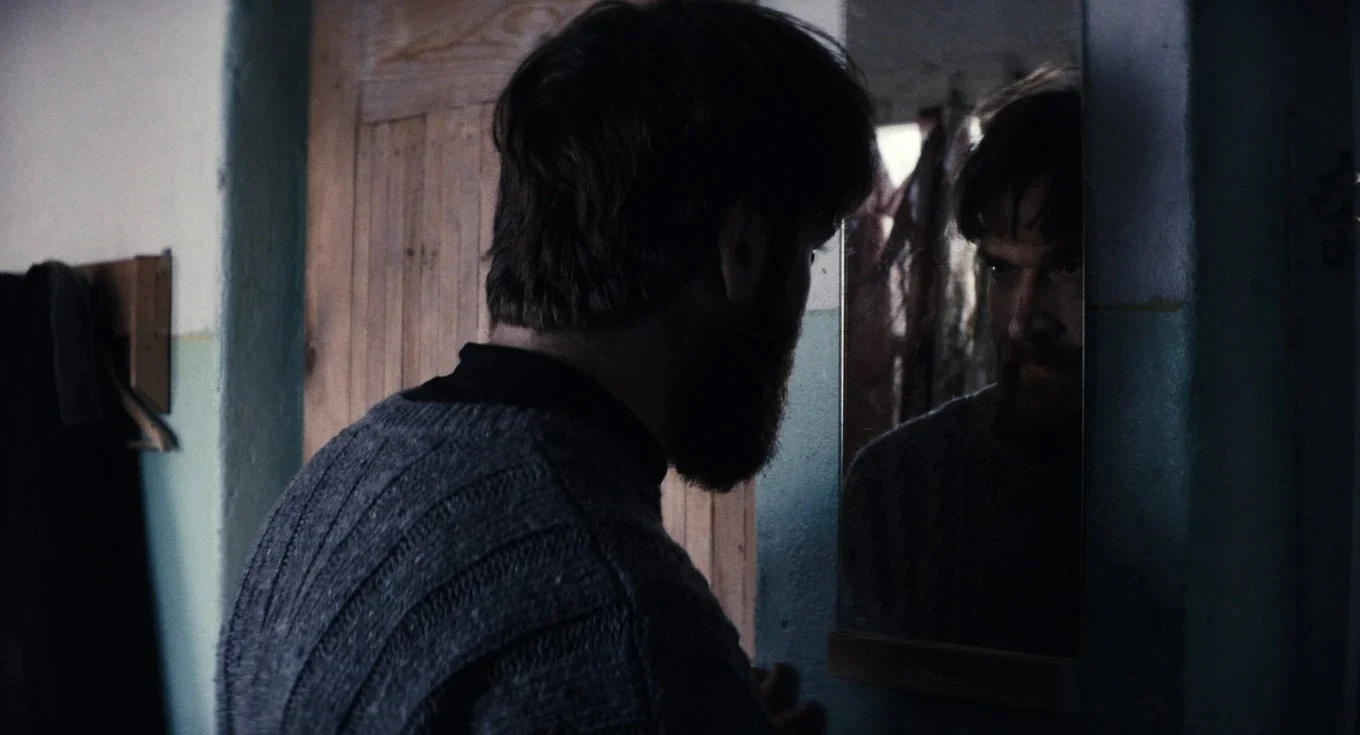
Andriy’s clerical identity is initially withheld, a useful decision that allows his relationships to precede the authority of his clothing. Living with the young married couple Tanya and Vassya, he participates in an intimacy that needs little verbal explanation. Kęstutis Cicėnas gives the priest a restrained presence suited to someone whose obligations leave scant room for declarations.

The economy of these exchanges makes the household feel established before the film asks us to fear for it. Andriy’s care for the dead then develops from conduct already visible among the living, giving his resistance a human basis beneath its religious significance.

Captain Igor’s convictions operate through a different relationship to power. Putin’s announcement of the invasion accompanies the film’s opening, supplying the political language behind the captain’s belief in his mission. Daumantas Ciunis combines that certainty with drinking and an appetite for domination.

The parallel between soldier and priest has dramatic value because conviction sustains both men, though the consequences are radically unequal. Andriy’s faith places demands on himself. Igor’s authorizes demands on everyone around him. The film finds something disturbing in his dependence on the very authority he exercises, even if it sometimes treats ideological certainty as a sufficient explanation for cruelty.

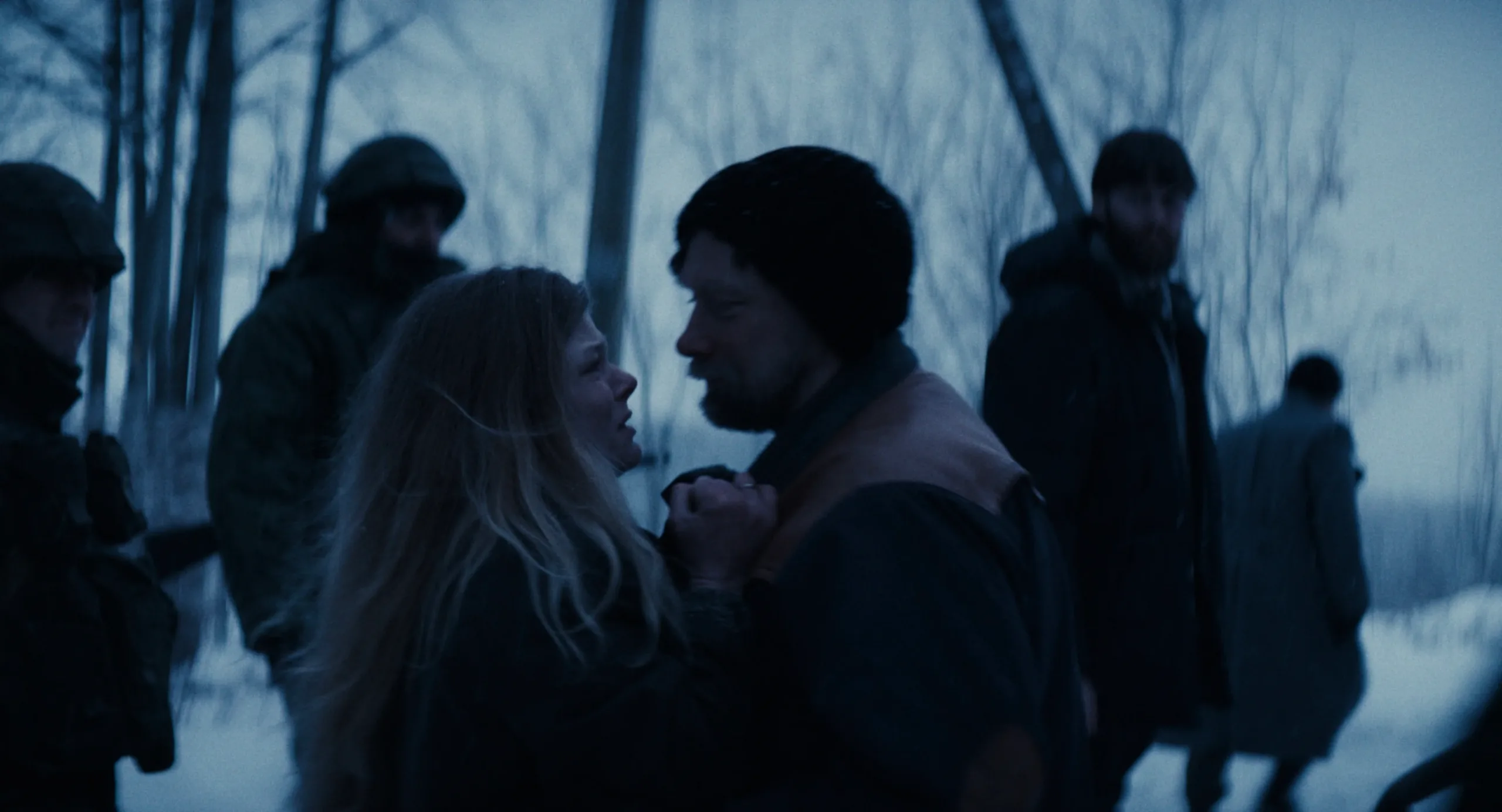
The tavern scene makes that cruelty socially legible. Igor beats and humiliates Vassya while the other customers remain silent. The violence establishes his command over a room, and the witnesses’ fear helps maintain it. Occupation becomes a set of altered relationships among people who might otherwise speak, intervene, or simply share a public place.

Here Ciunis has concrete behavior through which to express the captain’s character, rather than having to embody the invasion as an abstraction. The scene’s familiarity as wartime drama matters less than its attention to the enforced passivity surrounding the assault.

Outside these encounters, Vilius Mačiulskis’s photography gives winter an obstructive physical presence. Night and weak daylight restrict visibility; available light catches bodies and faces without making the surrounding darkness feel safely empty. Distant military sounds merge with the wind, keeping the front outside the immediate frame while denying the town any separation from it.

This is an effective way to preserve the civilians’ restricted perspective. They hear forces they cannot inspect or control. The frozen ground creates an equally severe limit: Andriy can continue accepting responsibility for the dead after the ordinary means of fulfilling it have disappeared.

The church setting also gives the images a religious vocabulary, reinforced by the organ in Sten Sheripov’s score. As the music expands, the dead acquire the weight of communal mourning that military orders have forbidden. Yet the film’s visual and musical solemnity can become too directive.

Shadowed faces, sacred surroundings, and an increasingly sorrowful score repeatedly tell us how to regard suffering whose circumstances already carry considerable force. The restrained household exchanges allow meaning to emerge through familiarity; these passages press the characters toward martyrdom, making them easier to recognize as symbols and harder to encounter as particular people.

The folkloric details offer a less settled relationship to inherited belief. Dreams on Saturdays are expected to come true; goat’s milk enters the household through wartime necessity; the red-haired boy Makarov speaks with a directness adults cannot safely afford. Such elements allow religious practice and everyday superstition to coexist without a tidy division between them.

They suggest the persistence of ways of understanding events that military language cannot absorb. The difficulty comes when the eleven-year-old boy must carry an increasingly explicit promise of uncorrupted humanity. His mother’s heels, worn because the war has left him without suitable shoes, begin as an affecting detail of deprivation.

The later sexual violence against Makarov places that detail under punishing symbolic pressure. Reaction shots of his parents watching extend the scene’s horror, but they also recruit additional witnesses to certify an atrocity whose meaning needs little reinforcement.

The boy’s ordeal becomes a test of preserved innocence, narrowing the space available for the experience of the harmed child. Spring has already made civilian vulnerability palpable through military intimidation, prohibited mourning, and the difficulty of finding shoes. At this point, its insistence on making goodness survive visibly risks enclosing that vulnerability within a reassuring moral design.

The seasonal promise contained in Vesna, its original title, encounters a similar resistance from the film’s most persuasive material. Spring will loosen the earth, but a thaw serves the occupiers’ plans for mass burial as readily as it makes individual funerals possible. Nature supplies no judgment between those uses. For the priest, warmer ground would restore a practical means of carrying out his duty, while leaving the military prohibition intact. The people awaiting their relatives still need someone prepared to disobey it.

Spring (released in international festival markets under its original title Vesna) made its world premiere in the Special Screenings section at the 79th Cannes Film Festival on May 18, 2026. Directed by Rostislav Kirpičenko, the Ukrainian-Lithuanian-French war drama follows a village priest in occupied Ukraine who risks his own life to covertly return executed civilian bodies from his church-turned-morgue to their grieving families.

Full Credits

  • Title: Spring (Original title: Vesna)

  • Distributor: JHR Films, Film Jam, Matka Films, ESSE House

  • Release date: May 18, 2026 (Cannes Film Festival Premiere)

  • Running time: 1 hour 35 minutes (95 minutes)

  • Director: Rostislav Kirpičenko

  • Writers: Rostislav Kirpičenko

  • Producers and Executive Producers: Stasys Baltakis, Thomas Hakim, Vitaliy Sheremetiev, Olga Beskhmelnitsyna

  • Cast: Kęstutis Cicėnas, Bartas Ždanovičius, Anastasiia Pustovit, Daumantas Ciunis, Viačeslav Lukjanov, Šarūnas Datenis, Ieva Gladij

  • Director of Photography (Cinematographer): Jaroslaw Waliszewski

  • Editors: Gabriel Gonzalez

  • Composer: Sten Šeripov

The Review

Spring

7 Score

Spring brings the burial conflict of Greek tragedy into occupied Ukraine with force and specificity. Andriy’s forbidden work makes religious duty tangible, supported by restrained performances and a winter landscape that obstructs every act of care. Its solemn imagery becomes less persuasive when suffering is repeatedly sanctified, especially through the child’s ordeal. Kirpičenko’s debut is most affecting when the demands of protecting the dead leave its characters little room to become symbols.

PROS

  • Burial rituals give civilian resistance concrete stakes.
  • Restrained performances establish believable household intimacy.
  • Wind, distant warfare, and winter photography sustain oppression.
  • The tavern scene exposes how intimidation controls public life.

CONS

  • Sacred imagery and swelling music overstate suffering.
  • Igor’s ideological certainty sometimes substitutes for psychological depth.
  • The child’s ordeal becomes subordinate to symbolic innocence.

Review Breakdown

  • Overall 0
Tags: Anastasiia PustovitBartas ŽdanovičiusDaumantas CiunisDramaFeaturedJHR FilmsKestutis CicenasRostislav KirpičenkoŠarūnas DatenisSpringViačeslav LukjanovWar
Previous Post

Dernsie: The Amazing Life of Bruce Dern Review: Admiration Works Best With Evidence

Next Post

Disney/Pixar Toy Story: Retro Roundup! Review: An Archive Worth Exploring Between Attempts

0 0 votes
Article Rating
Subscribe
Login
Notify of
guest
guest
0 Comments
Oldest
Newest Most Voted

This Week's Top Reads

  • Is This Seat Taken? Review

    Is This Seat Taken? Review: A Satisfying Mental Workout

    1324 shares
    Share 0 Tweet 0
  • Treasure Island Review: David Oyelowo Commands an Uneven Adventure

    0 shares
    Share 0 Tweet 0
  • Trust Review: Squandered Potential and an Incoherent Plot

    6 shares
    Share 0 Tweet 0
  • Dustfall Review: Crime Television That Stays With the Survivor

    0 shares
    Share 0 Tweet 0
  • Adult Supervision Review: Children Need Help Their Fathers Cannot Quite Give

    0 shares
    Share 0 Tweet 0
  • Murder In A Small Town Season 2 Review: Politics and Police Work

    5 shares
    Share 0 Tweet 0
  • Blue Lights Season 4 Review: Who Gets Exposed, Who Stays Protected

    1 shares
    Share 0 Tweet 0

Must Read Articles

The Diplomat Season 4 Review
TV Shows

The Diplomat Season 4 Review: Every Marriage Has a Foreign Policy

4 hours ago
Whalefall Review
Movies

Whalefall Review: Breathing Lessons from a Damaging Father

5 hours ago
Ludwig Season 2 Review
TV Shows

Ludwig Season 2 Review: Lucy Gets the Credentials and the Story Gets Better

1 day ago
Crystal Lake Review
TV Shows

Crystal Lake Review: Cardellini Carries the Carnage

1 day ago
Time Season 3 Review
TV Shows

Time Season 3 Review: Rehabilitation Left Off the Rota

2 days ago
Loading poll ...
Coming Soon
Which of Alfred Hitchcock's 1960s thrillers is your all-time favorite?

Gazettely is your go-to destination for all things gaming, movies, and TV. With fresh reviews, trending articles, and editor picks, we help you stay informed and entertained.

© 2021-2026 All Rights Reserved for Gazettely

What’s Inside

  • Movie & TV Reviews
  • Game Reviews
  • Featured Articles
  • Latest News
  • Editorial Picks

Quick Links

  • Home
  • About US
  • Contact Us
  • Advertise with Us
  • Review Guidelines

Follow Us

Facebook X-twitter Youtube Instagram
No Result
View All Result
  • Gazettely | Movie, TV & Game Reviews, News, and Rankings
  • Movies
  • Entertainment News
  • Movie and TV Reviews
  • TV Shows
  • Game News
  • Game Reviews
  • Contact Us

© 2024 All Rights Reserved for Gazettely

wpDiscuz
0
0
Would love your thoughts, please comment.x




