





























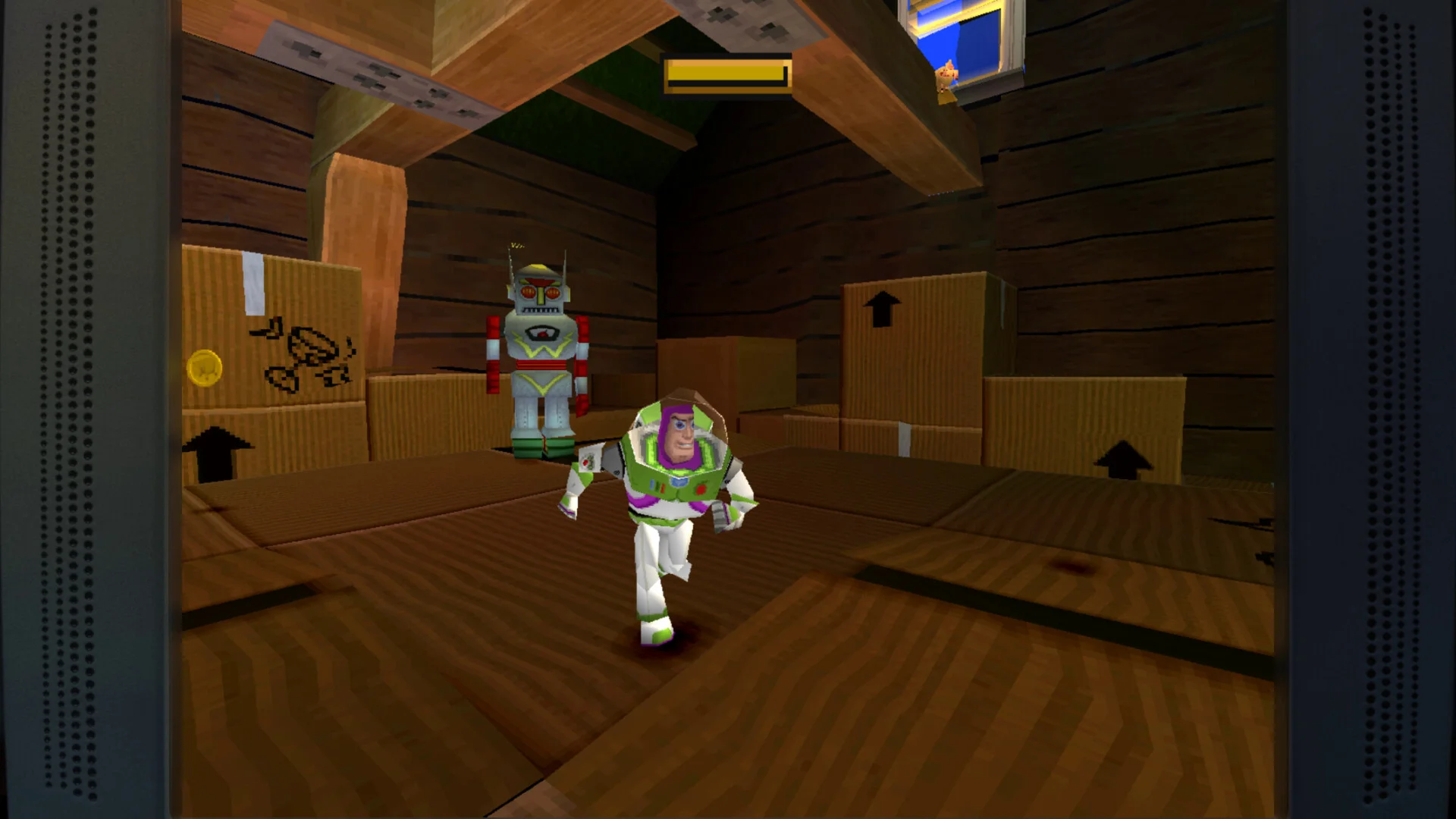
Five Pizza Planet Tokens in each level give Buzz Lightyear a reason to investigate the oversized spaces of Toy Story 2: Buzz Lightyear to the Rescue!. Collecting them opens access to further levels and bosses, turning exploration into progress toward rescuing Woody. Racing RC in the garage belongs to the same logic as double-jumping around the house: ordinary surroundings become substantial challenges because Buzz is small. The familiar setting does useful design work. You understand what a garage is, then discover what crossing one requires from a toy.
The camera makes that relationship less dependable. Finding a route and executing it require a readable view, and awkward angles can leave the player fighting for information before attempting the jump. Movement that carries a character beyond the intended stopping point adds another source of uncertainty. There is satisfaction in learning Buzz’s reach and momentum, but an obstructed viewpoint makes that learning harder to trust. The game encourages close inspection of its environments while sometimes making precise movement through them needlessly troublesome.
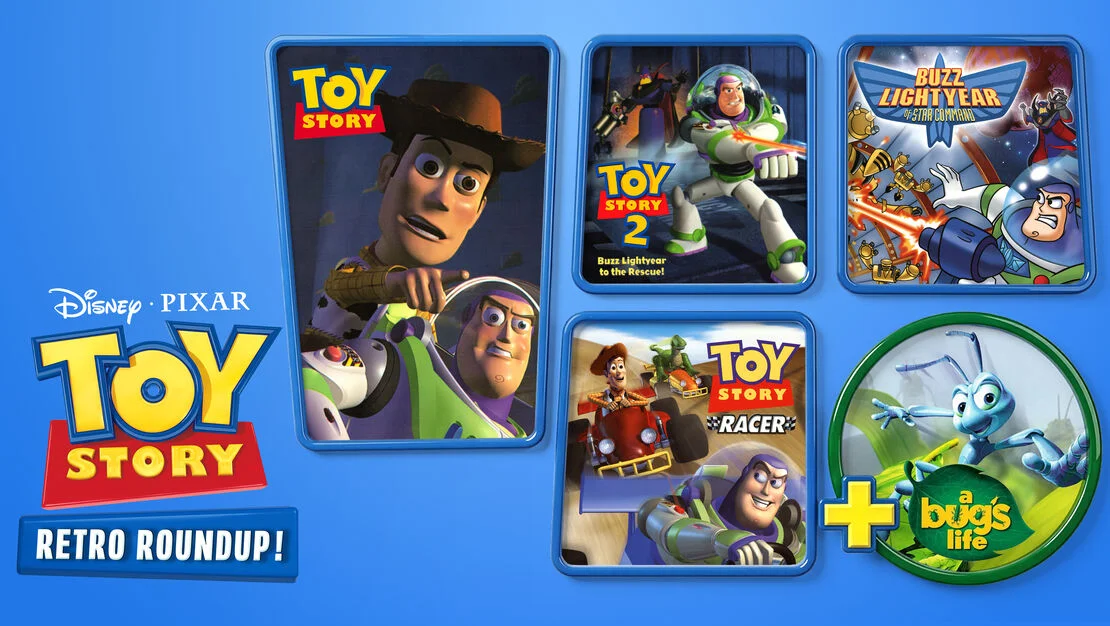
Digital Eclipse’s Disney/Pixar Toy Story: Retro Roundup!, published by Atari, preserves both sides of that experience. Its five title families cover the original Toy Story, its sequel, Buzz Lightyear of Star Command, Toy Story Racer, and the neighboring Pixar adaptation A Bug’s Life, with console and handheld versions included. The collection’s appeal depends partly on how these games turn familiar characters into different activities. Its modern tools then let players decide how much repetition they will tolerate to experience those activities.
The Genesis and SNES versions of Toy Story remain especially interesting for their willingness to change the player’s task. Woody’s side-scrolling stages give way to controlling RC from above and exploring a stage in first person. These shifts attempt to accommodate the film through several forms of interaction, alongside rendered character graphics that retain an impressive sense of volume. They also demand repeated adjustment. Difficult platforming and boss encounters can hold players in place long enough that the next change of perspective becomes something they are struggling to reach.
Buzz Lightyear of Star Command builds its PlayStation action around a narrower pursuit loop. Buzz runs through linear stages after criminals, using weapons and hover vehicles before reaching a boss confrontation. The target cannot be damaged during the chase, so keeping up and fighting are separate tasks. That division gives the stages a clear destination, although it limits how much the pursuit itself can resolve. Heavier movement makes catching up less immediately comfortable than exploring in Toy Story 2, while repeated boss encounters expose the format’s restricted range. Animated sequences preserve the connection to the television series without changing that underlying repetition.
Toy Story Racer asks for a different kind of precision. Its straightforward acceleration and item inputs make the basic activity easy to grasp, while light vehicle handling requires care to keep a clean line. Toy-themed weapons fit the small-scale racing, and mission challenges provide reasons to return with different characters. That progression has a cost: unlocking the roster can mean spending further time with challenges that have already lost their appeal. The racer is worth exploring, though the incentive to complete its challenges can outlast the pleasure of repeating them.
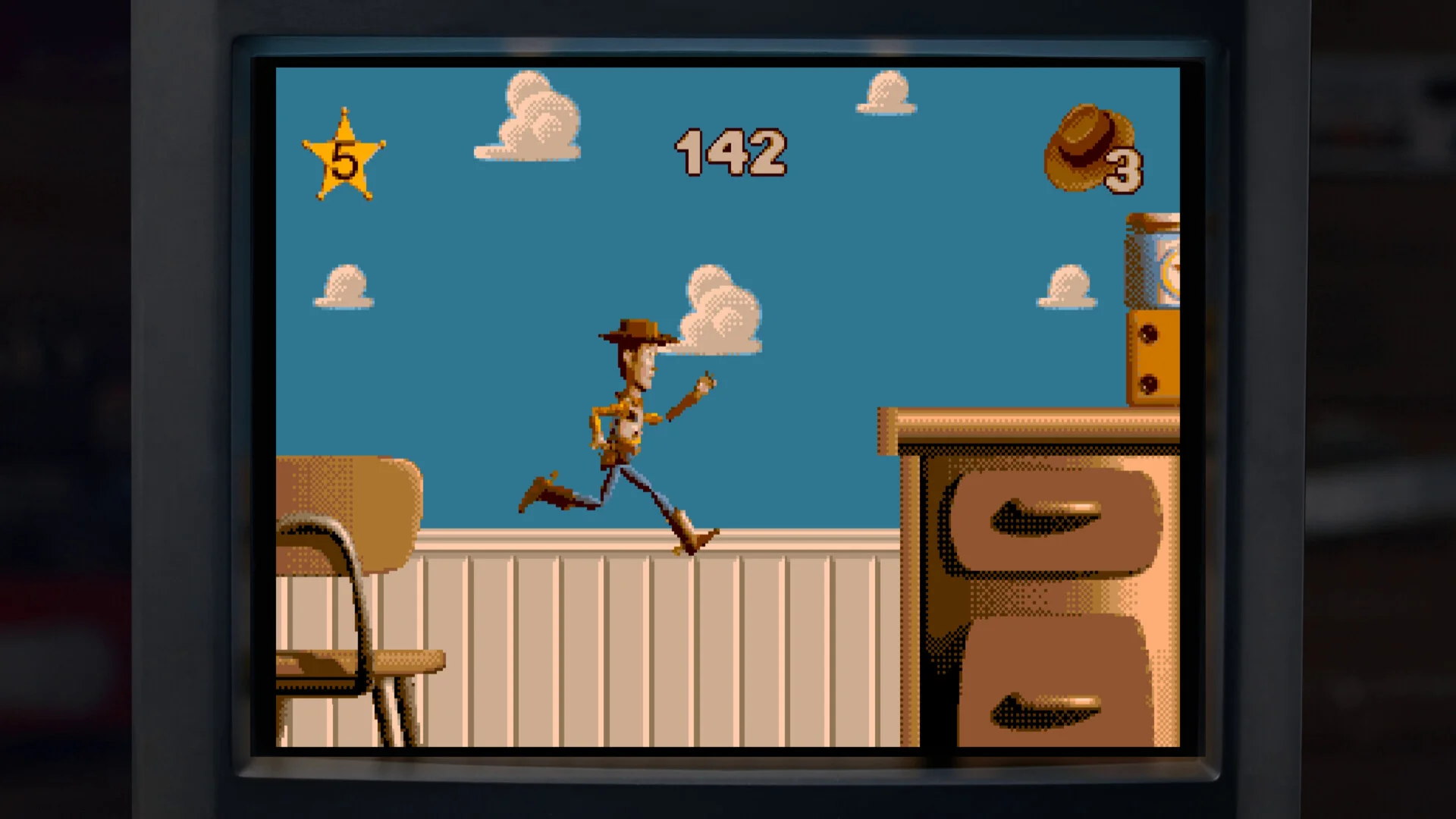
Rewind and save states change the practical terms of all this persistence. A missed jump can become an immediate retry; a difficult stretch can be approached from a chosen save point. The original password systems and simulated memory-card saving remain available, preserving the older methods alongside the shortcuts. Rex’s cheats offer options including infinite health or lives and access to content. In the original Toy Story, those choices make it much easier to reach the perspective changes and later stages that its difficulty might otherwise keep out of reach.
These tools address different needs. Rewind lets a player practice an action without repeating the approach. Unlimited lives remove the threat of running out of attempts. Automated play goes further, demonstrating progress through a stage and allowing the player to take over during the action. Watching a route and executing it are separate experiences, and the option to switch between them is valuable. Someone revisiting a remembered sequence can reach it without accepting every demand that originally surrounded it.
Controller remapping provides further flexibility, although button assignments cannot correct a camera angle or reshape movement inertia. The distinction matters when judging how inviting the collection has become. Failure now costs less time, but awkward controls can remain awkward on every attempt. Presentation follows a similarly conservative approach: CRT-style filters and upscaling help accommodate modern displays while period cutscenes retain their original texture. These are ways to encounter the existing games, with their visual and mechanical character still recognizable.
A Bug’s Life earns its place through an interaction that makes an effective companion to Buzz’s exploration. Flik plants seeds that grow into platforms and help solve small environmental puzzles, giving the player a role in making a route accessible. The handheld adaptations provide further comparisons. Toy Story 2 becomes a 2D puzzle platformer, while Star Command shifts toward arcade shooting. Their differences are worth examining even when repetition and limited visibility make extended play less rewarding. Sampling an adaptation can explain something that completing it would merely repeat.
The historical material supports that kind of attention. Over an hour of video sits alongside concept art, level maps, design documents, manuals, and marketing material. Having a map available beside the playable environment offers a useful opportunity to compare its planned arrangement with the demands it places on movement. The music player gives soundtracks their own space, away from the concentration required by a difficult stage. Those features make the collection useful after the desire to finish another platformer has faded.
The selection still leaves gaps for anyone hoping to compare every edition. Toy Story 2 is represented by its PlayStation and handheld releases, leaving its other home versions outside the package. The original Toy Story has Genesis, SNES, and Game Boy versions available to play. Its PC soundtrack is included in the music player, preserving an audible part of an edition whose playable counterpart is missing.
The Review
DisneyPixar Toy Story Retro Roundup!
Disney/Pixar Toy Story: Retro Roundup! gives players useful control over how they revisit an uneven selection. Rewind, save states, and automated play reduce the repetition surrounding difficult stages, while Toy Story 2 still rewards exploration through its clever use of scale. Awkward cameras and movement remain, and some challenges wear thin. The extensive archive gives these games lasting value beyond completion, though missing editions limit the comparisons it can offer.
PROS
- Toy Story 2 connects toy scale with rewarding exploration.
- Flexible assists reduce lost progress and repeated attempts.
- Extensive video, documents, artwork, and soundtrack extras.
- Distinct adaptations make platform comparisons worthwhile.
CONS
- Awkward cameras and movement complicate precise platforming.
- Repeated pursuits and racing challenges can lose their appeal.
- Missing editions leave gaps in the playable archive.







